

A new year and a new word
How singing illuminates the past and brings the future closer
If “confession” is a recurring theme on Rosh Hashanah and Yom Kippur, then I have a confession to make. “Al chet” for the sin that I have committed before Thee by sometimes getting distracted during services.
For example, happily crammed in a row of synagogue seats this year, my mind wandered to the pandemic High Holidays. In 2020, homebound with our children and grandchildren, we watched services livestreamed from our synagogues in Philadelphia, NYC, and Montclair.
“Al chet” for being disappointed that our grandsons’ first time hearing the blast of the shofar was experienced remotely on three screens.
In 2021, we returned to Congregation Shomrei Emunah, our Montclair synagogue, in person. Would we daven in a tent, in the sanctuary, or in an alternative space where services were being live-streamed? Whichever location we chose, masks, photo IDs, and proofs of vaccination were required. If we were indoors, we had to sit a safe distance from the nearest congregant. Who cared? Grateful to be out of the house and to see other people, we didn’t mind those protocols.
“Al chet” for wondering if this would be the new normal.
While chanting the haftarah on the bimah in 2025, I had a momentary flashback further back, all the way to 1982 and our synagogue in Cobble Hill, Brooklyn. At that time, I felt like Hannah in the Book of Samuel, desperately praying to conceive. Then a year later, there I was chanting the haftarah again, unable to fit behind the shulchan with my very pregnant belly.
“Al chet” for questioning my faith in You.
As past and present wove their way through the liturgy, I suddenly had one more journey to take.
My synagogue had offered an array of classes to prepare us for the New Year. “Shomrei Sings,” led by Talia Lakritz, our guest shelichat tzibor” — prayer leader — caught my attention. But was it for me? I wasn’t sure. I was familiar with the prayers, so I skipped the first of two classes.
I reconsidered when a friend reminded me about the second class. I definitely needed singing to break the endless cycle of bad news that was wearing me down. Old melodies, new melodies, getting away from my screen — it would be a panacea for my state of mind.
Before the classes, Talia sent us recordings. I retired “Alexa” and filled the kitchen with Talia (and me!) singing “HaYom Harat Olam” and “Mareh Kohen,” just to name a few of the highlights in her “Meshorerim” guide. Meshorerim? I had never heard that word before, but I loved the sound of it. The root had to be “shir” or “shira” — something to do with songs or singing. Rabbi Julie Roth called us choral singers, but Google Translate says it means poets. Either way, I was excited to join the class.
One evening, about 15 of us sat in a circle, learning the prayers and their meanings. For some of us, the Hebrew words and the melodies were new territory. For veterans like me, hearing them felt like greeting old friends whom you see once a year. With luck, maybe I would even make a new friend.
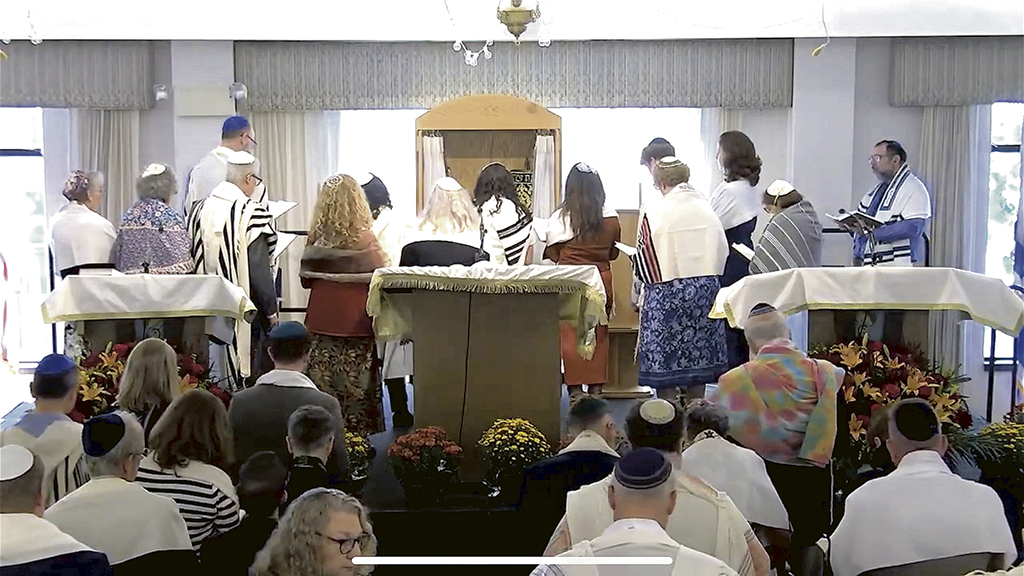
On Rosh Hashanah and Yom Kippur, I stood on the bimah with the other “singers/poets.” We sang along with Talia. I was warmed by her smile and the meaning of the prayers. Looking out at our growing congregation, bursting at the seams, bustling with people of all ages, from prenatal to post-centenarian, I was heartened to see Judaism thriving in Montclair.
But while I was savoring the moment, I drifted to another memory. As I looked out at the congregation, I no longer saw the familiar faces of my current community. Instead, I saw the High Holiday services in Brooklyn, in the Marine Park synagogue where I grew up. I found my parents and uncle sitting in the back of the sanctuary. I saw the sun sparkling through the stained-glass windows.
Moreover, in that scene, I was also part of the Meshorerim, except I didn’t know that word yet.
The cantor led a choir of probably 10 children, from 10 to 13 years old. We had practiced during the summer, and somehow we were ready to sing on Rosh Hashanah and Yom Kippur. We had exchanged our blue Shabbat choir robes and our siddurim for the High Holidays’ white robes and machzorim.
I can’t remember all the details, but I do remember the awe of the holidays and the majesty of the prayers. I was just a kid, but 60 years later, the haunting words and melodies of “Aveinu Malkeinu” and the exultation of “Areshet S’fateinu” have stayed with me.
“Al chet” for momentarily losing the Meshorerim of 5786 and finding them in 5726.
As I reflect on the prayers in the Machzor and, yes, sometimes get distracted by the past, I also look ahead. My prayer is that we fill the New Year with singers and poets — meshorerim — who bring joy and harmony to our discordant world.