

24 years later
A volunteer remembers September 11
There are days of joy and happiness that you remember for a lifetime. The birth of my daughters, the birth of my grandchildren, and the birth of my great-granddaughter. Those are happy days to recall for the rest of your life.
Then there is a day that you can never forget, as much as you would like to do so.
September 11, 2001, was that day for me.
It was one of those warm, sunny, late-summer days. You wanted to open the car window and sing “Zip-A-Dee-Doo-Dah.” The sky was blue with only a few small clouds skittling across it.
Then, in a heartbeat, it all changed.
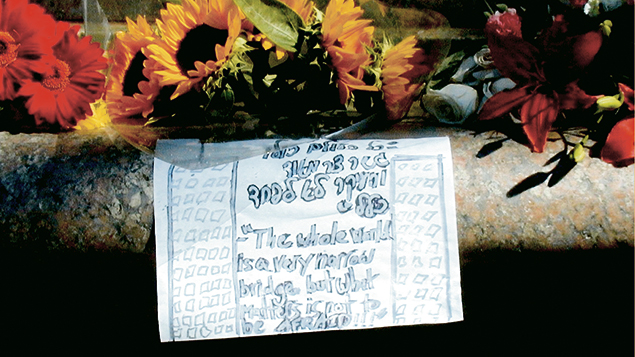
A bulletin interrupted the music on the radio. A passenger jet had just crashed into the North Tower of the World Trade Center. It was 8:46 a.m., and the world came to a standstill. The first thought that went through my mind was about a misty day, July 28, 1945. An American B-52 bomber crashed into the Empire State Building on that day.
It was an accident, it was foggy — and 14 people died. About 24 others were injured.
What happened? In 1945 radar was not what it is today. Combine that with the pilot’s reduced vision because of the fog. He obviously did not see what was then the world’s tallest building looming ahead.
But in 2001? The day was clear. There were few clouds. Blue sky. How the hell did that happen?
Minutes later I was at the Bergen County administration building. At the time I was communications director for the sheriff’s office.
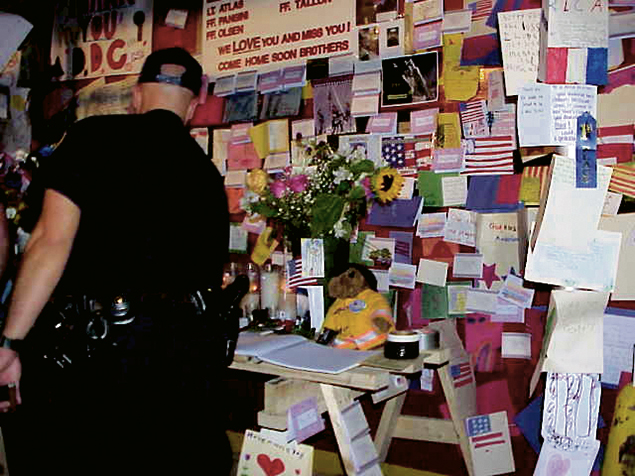
Inside, almost the entire staff was crowded into the conference room watching the situation unfold on TV.
Only minutes later, at 9:03 a.m., the second plane slammed into the World Trade Center’s South Tower and seemed to go right through the structure, leaving an immense fireball in its wake.
At that moment, we all realized that this was no accident.
There would be no other work done that day. Instead, several of us, including Sheriff Gordon Johnson, drove to the George Washington Bridge, where a command post had been set up with a SWAT team, waiting for any follow-up to the attack. News and details were sparse because no one knew what the hell had happened.
The sheriff and I discussed the situation and decided that we had to go in to Manhattan. We were going to escort a busload of nurses and other medical personnel we assumed would be badly needed.
But then came a rumor — a false one, as it turned out — that an explosive-laden truck was headed toward the bridge to blow it up.
An hour later, when it was determined that the idea of blowing up the bridge was merely a rumor, we drove across it, escorting several trucks carrying water and other supplies down to Ground Zero. Coming down the ramp onto the West Side Highway we saw people holding handmade signs. They jumped off the curb holding the signs up so we could see them.
“You Are Heroes,” one said. “God Bless You,” said another. There were more, but all of us in the car found it difficult to see them because of the tears in our eyes.
On our way south on the West Side Highway we could see the dark plumes of smoke. Passing the Javits Center about midway down, we saw about 30 ambulances backed into the building, waiting for a call to help victims of the attack. That’s when it really struck home. There were no living victims.
My brother, Aaron Nesoff, was a doctor at Peninsula General Hospital in Queens and head of family services. He, and several of his associates, drove in to help the victims. They were thanked and told to go home. There were no victims in need of medical attention.
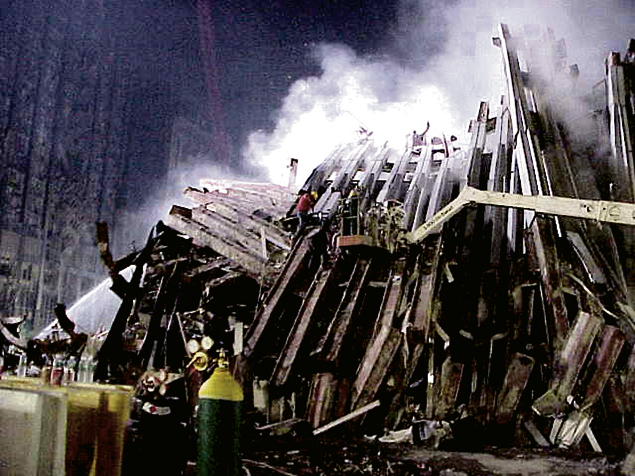
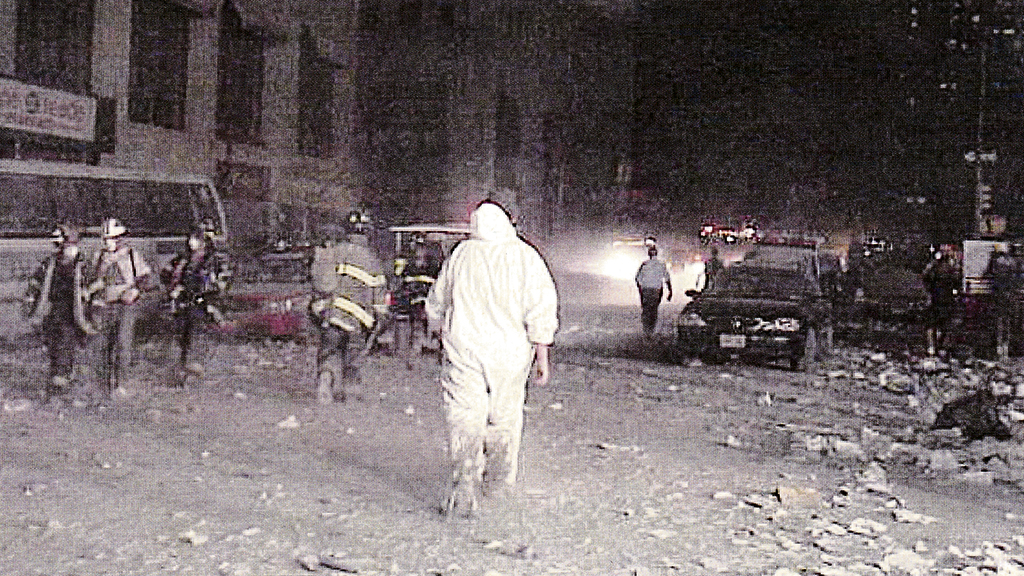
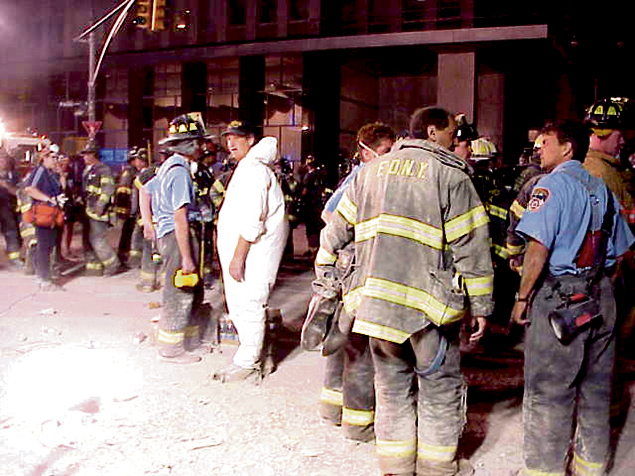
We continued on toward the site. We had to use our flashing lights and sirens; smoke and concrete dust from Ground Zero had traveled all the way north, so visibility was low. We parked at Vesey Street and walked toward the maelstrom that was Ground Zero, now covered in ash. A blizzard of papers slowly drifted downward. We were standing on concrete dust that covered the street — that dust had been part of giant buildings just hours ago. A fireman ran to us and gave us masks of a type we later learned were basically useless. A few feet from where we stood we saw a boot. A single boot. We didn’t investigate it, not knowing if there were something gruesome inside. The smell coming from the pile was overpowering. We all knew what was burning, but no one said a word about it. It would have been hard to describe.
We watched men in white Tyvek suits walking into the remnants of the Twin Towers. It looked like a sci-fi movie about astronauts walking on the moon. Others, mostly construction workers, feverishly attacked the debris, also looking for victims. They too were there for naught. We were able to provide security at the site that night and many other days to come. The curiosity-seekers had to be kept away. The pile was declared a crime scene, and souvenir hunting was prohibited.
Leaving the water and supplies, we provided security to the workers, but the entire area was closed to everyone except police, fire and emergency personnel, so there was not much more that we could do. We drove to 1 Police Plaza for a brief meeting with Police Commissioner Bernard Kerik. A news photo of Kerik and Mayor Rudy Giuliani walking into the smoldering wreckage made the news across the world.
Later, we drove back to New Jersey. As soon as I got home, I stripped off my clothes and my wife put them into the washing machine. The odor of burning victims clung to me. The smoke plume from the terror attack lasted for a long time. It could be seen for miles. I returned to the site many times as a volunteer, helping to provide security. It was the least we could do.
Months after the attack, things that we heard or saw would have the same effect on most of us. We simply choked up.
It was a day that will live with us for the rest of our lives.
Bob Nesoff of New Milford was a reporter for two daily newspapers and former executive editor of New York Lifestyles magazine. His novel, “Spyder Hole,” won first place over more than 100 entries in the International Impact Book Award, and he is a finalist for Author of the Year.