

One Israel Fund celebrates 32 years
Group with focus on West Bank security moves gala to Central Jersey
It is disturbingly indicative of the times in which we live that the One Israel Fund decided to move its annual dinner from New York City to Central Jersey, and that Executive Vice President Scott Feltman cannot publicly divulge the exact location.
“Unfortunately, that’s what we’re dealing with today and we can’t take a chance that people show up at an event on behalf of Israel and try to wreak havoc,” Mr. Feltman said.
Nevertheless, the 32nd anniversary gala of One Israel Fund, featuring a keynote by British commentator and cultural critic Douglas Murray, is very much a celebration.
The evening will pay tribute to the organization’s many contributions to the safety and well-being of the more than half a million residents of approximately 150 Jewish communities in Judea, Samaria, and the Jordan Valley — aka the West Bank.
Yechiel Leiter, now Israel’s ambassador to the United States, founded One Israel Fund in 1994 to strengthen these communities through security, medical, education, recreation, and community development projects.
Although the organization is headquartered in New York, many of its most prominent supporters live in Bergen and Essex counties. Among them are its president, Jacqui Herman; 2026 dinner awardees Andrea and Bryan Bier and Naomi and Dr. Daniel Feuer; dinner co-chairs John and Nina Nanasi; and board member Dr. Arthur Kook.
The Nanasi name graces One Israel Fund’s current flagship project, a medical center scheduled to open in about six months at the commercial center of Binyamin, the largest regional council in the West Bank.
In the works since 2016, Nanasi Medical Center will be game-changing for the estimated 80,000 residents of about 40 Jewish communities in Binyamin, who now must travel to Jerusalem for most healthcare services, including emergency care. Significantly, the center also will serve an additional 150,000 or so Jewish and Arab residents of the greater region, including two large northern Jerusalem neighborhoods.
Mr. Feltman said that in addition to fulfilling hundreds of projects every year, One Israel Fund runs guided day trips and missions to acquaint visitors with beneficiary communities such as Shiloh, Beth El, and Hebron. One Israel Fund Women’s Division organizes many of these missions, such as a Mother & Daughter Bat Mitzvah Mission scheduled for February 27 to March 4, and other on-the-ground projects, educational programs, and events to build solidarity with residents of the region.
“Most organizations will not set foot in those biblical heartland areas for various reasons. We have been doing this for 32 years,” Mr. Feltman said. “We do it in order to let people understand the area, meet the people, see the industry and the beauty that it has to offer, and connect to their history.”
Mr. Feltman, a New Yorker, was hired as One Israel Fund’s director of development in 2001, just two months before the terrorist attacks of 9/11. At the same time, the second intifada was raging in Israel.
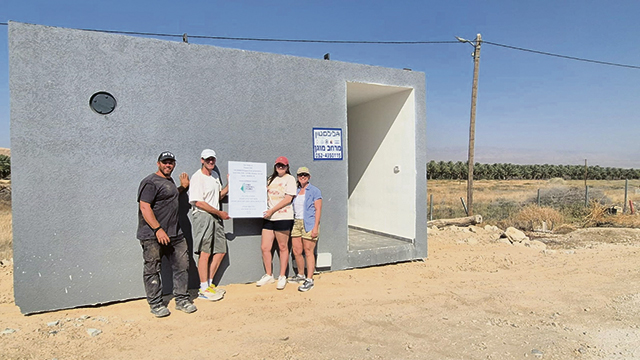
His first project, in collaboration with the Chofetz Chaim Heritage Foundation, was raising money to buy bulletproof vests for parents to put on their children when traveling on dangerous roads outside Jewish enclaves in the West Bank and Gaza. Another project, with matching funds from the IDF, was buying several dozen “armored vans to transport special-needs students to and from school during those intifada years, when there were drive-by shootings on the roads almost on a daily basis. Some of those vans are still in use today, 25 years later.”
Mr. Feltman left that position in 2004 and returned as executive vice president in 2007. During the three intervening years, donations to the One Israel Fund had declined.
“A lot of that had to do with the ending of the intifada, but also the disengagement from Gaza in 2005 really put a pause on people willingly dedicating capital building projects,” he said. “Nobody was comfortable with the idea that eventually their synagogue or their institution that they put their parents’ name on to memorialize them would ultimately be given away and become a terrorism base for Hamas.
“When I came back in ’07, I decided to see if I could take a crack at rebuilding the organization. And I think the past nearly 20 years has proven that out.”
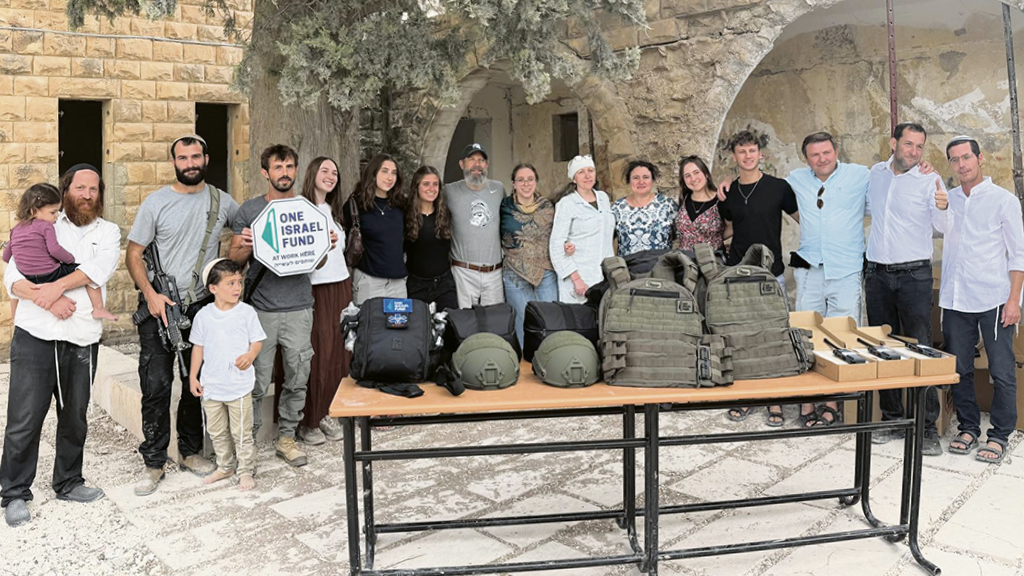
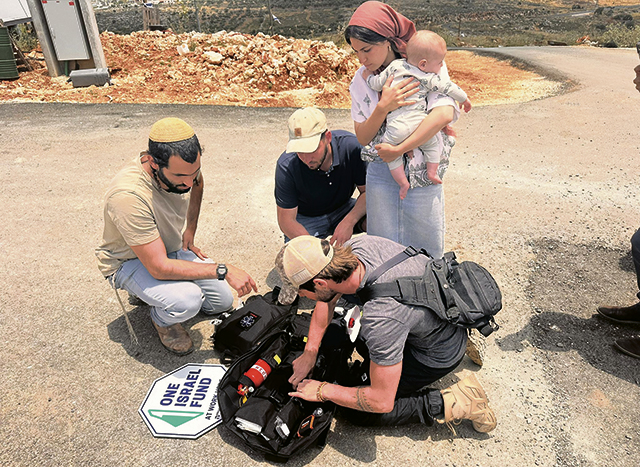
In the last five years, and especially the three years since October 7, One Israel Fund has redoubled its efforts to provide preventive civilian security equipment for West Bank and Gaza border communities — anything from surveillance drone technology to first-responder gear.
“We’re very proud that there were many lives saved on October 7 because of the work of One Israel Fund, and since then we have kicked it into high gear,” Mr. Feltman said. “We were able to turn that money around rapidly and distribute equipment that was needed in order to prevent further terror attacks, especially in the area of Judea and Samaria, which everybody knows was a tinderbox right after the attacks.”
One Israel Fund continues to sponsor community-development projects including playgrounds, libraries, dance studios, youth centers, senior centers, synagogues, community centers, mikvaot, daycare centers, therapy centers, emergency medical facilities, and more.
“Right now, we have an art exhibit at the Jerusalem Theater showcasing many artists from Judea and Samaria in order to give them a platform to further their careers,” Mr. Feltman said.
Given the broad range of projects, “I can ask a donor what speaks to them and then find a project they identify with,” he continued. “But our bread and butter has always been preventive security equipment, and that is what resonates with the majority of donors.”
One Israel Fund is exploring the possibility of partnering in the development of a regional rehabilitation village for injured IDF soldiers and their families. “Right now it’s in the infancy stages and it’s not officially a One Israel Fund project yet, but we’re very excited about the prospects that this could bring to the area,” Mr. Feltman said.
“One of the things that I try to do in my position at One Israel Fund is seek out projects that resonate beyond the borders of Judea and Samaria. This builds an understanding of the importance of this area to the rest of the country.”
Strategically, the mountain ranges of Judea and Samaria serve as a natural protective barrier because they overlook 70 percent of Israel’s population, including Tel Aviv, Jerusalem, Beersheva, and Ben-Gurion Airport.
One Israel Fund strives to counter many misconceptions about these territories. For example, both Israelis and foreigners tend to think that West Bank residents are overwhelmingly Orthodox. But in fact, many secular Jews live in most of the communities as well, often because they are relatively affordable.
“One big misconception people have is that the communities in Judea and Samaria and the Jordan Valley are illegal,” Mr. Feltman said. “People hear this all the time. But telling a lie 1,000 times doesn’t make it true. These communities are not illegal. They are, at best, disputed. Truthfully, Israel has the best claim of any entity to those areas.”
That’s because most of the foundational stories in the Torah take place in Judea and Samaria. “It is the cradle of our civilization,” he said. “And today there are over 540,000 citizens living in Judea and Samaria. If you add in the northern and eastern communities of Jerusalem, which the international community also views as settlements, then today 10 percent of all Israeli Jews would be considered settlers.”
Moreover, he continued, the residents of these areas contribute to the country in many ways. A disproportionate percentage of high-ranking officers in the IDF come from the West Bank, and the region has become world-famous for its wine and olive oil production. “It’s even becoming a major player in technology and biomedical development and research,” he said.
Mr. Feltman said the biggest misconception right now is that the people who live in the West Bank are violent.
“By and large, most people who live in Judea and Samaria would like to just live peacefully with their neighbors,” he said. “They’re not looking for adversarial situations. Many of the Arabs there probably would say the same thing, but unfortunately the leadership in the Arab world doesn’t allow for that.”
Mr. Feltman added that the term “settler violence” is most often inaccurate.
“People would be appalled if they understood what is considered by the U.N. in their reports as ‘settler violence,’” he said. “Anytime somebody goes up to pray on the Temple Mount, it is listed by the United Nations as settler violence. If there’s a car accident between a Jew and an Arab in Judea and Samaria, it’s listed as settler violence. If the army responds to any kind of an altercation with the Arab population in Judea and Samaria, it is considered settler violence, even if no settlers were involved.
“That’s not to say that there aren’t incidents perpetrated by settlers, usually provoked by Arab terror attacks or attempted attacks, but the percentage is so low that it’s just basically been used as a cudgel to attack Israel by the international community. It is patently false in the way it is being presented and perceived.”
These misperceptions are strengthened by the anti-Israel rhetoric of politicians such as New York City Mayor Zohran Mamdani. “Before he was the mayor, he was an assemblyman in the New York State Assembly and went on the attack against One Israel Fund on numerous occasions,” Mr. Feltman said. “He had a bill in the Assembly to try to strip our organization from receiving tax-exempt status.”
One Israel Fund’s main office now has a post office box address rather than a street address. The board of trustees decided to stop holding the organization’s anniversary gala in New York — even though that decision necessitates arranging for free transportation to Central Jersey for supporters coming from Long Island, Queens, and the Upper West Side. The exact time and location of the gala will be given only to paid ticket holders.
None of this noise has diverted Mr. Feltman’s attention from the organization’s main objective, which he described as “making sure that Judea and Samaria remains a strong and vibrant place for people to put roots down. One Israel Fund is committed and dedicated to providing the quality-of-life projects necessary for families to do so. For example, it is our major goal to see the Nanasi Medical Center open on time in the spring, which will dramatically change the landscape for people to move to these areas. It’s always our goal to help Judea and Samaria continue to grow and strengthen and to continue being a wonderful place to raise a family.”
Much as he’d like to see the day when security equipment is no longer needed, “it’s too pollyanna-ish to think that that’s going to happen anytime soon,” he said. “It’s something that we dream about — that we can direct all of our resources to building playgrounds and libraries and schools — but unfortunately security is a vitally needed component to living there, especially now that there are over 100 new communities that have been approved by the government over these past four years even though there’s not a full budget to take care of all of their needs.
“We will continue raising the money necessary to give those new emerging communities the basic necessities to be able to protect themselves and defend themselves against would-be terrorists, as well as the other infrastructure needed for their residents to grow and thrive.”