

‘Who are your people?’
Jew-by-choice Joe Buchanan sings about faith and community
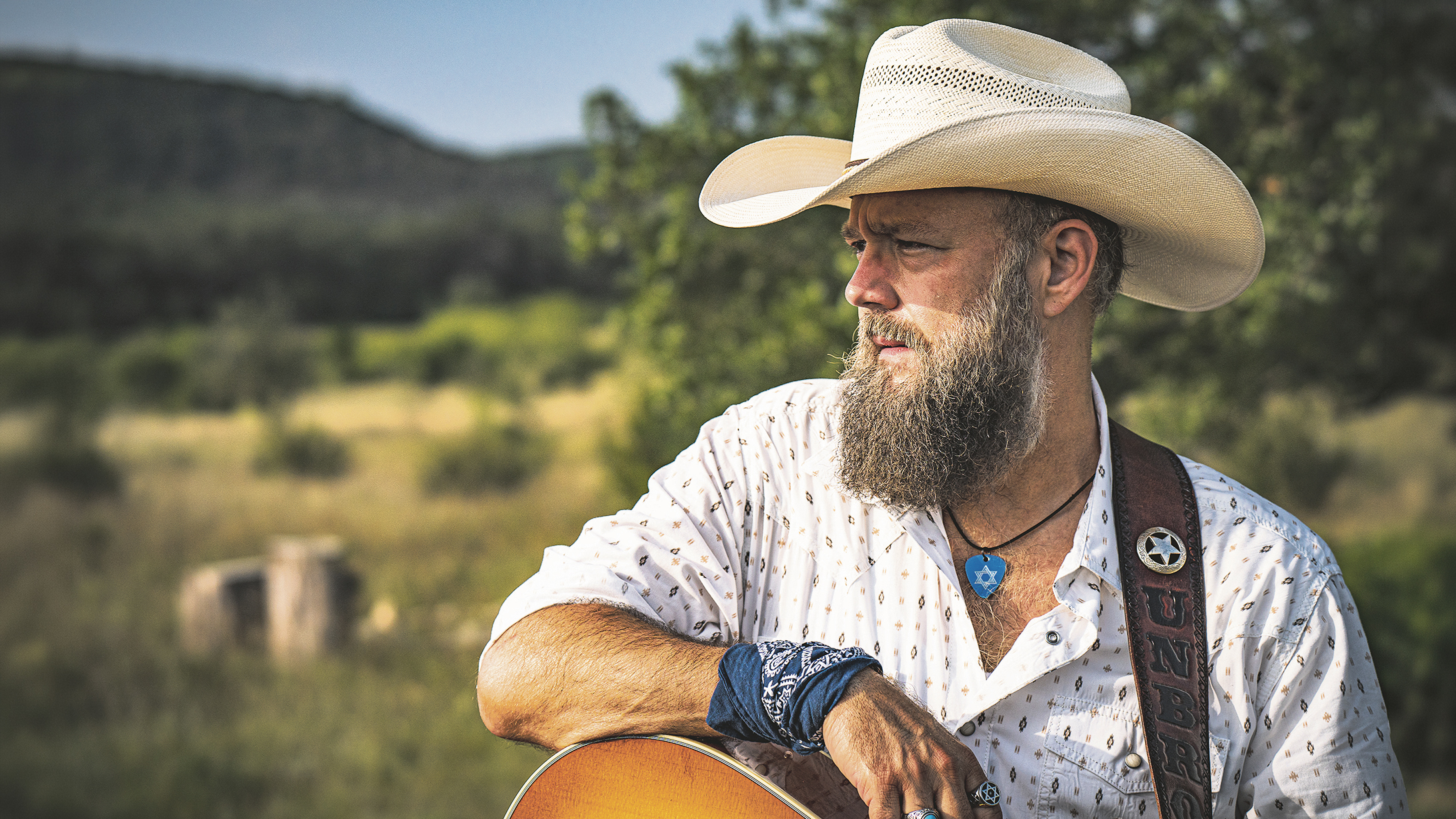
When Temple Beth Shalom of Livingston celebrates its 75th anniversary on December 5, it likely will mark the first time the Friday night service will be led by someone wearing a cowboy hat.
It’s part of a commemorative weekend featuring Joe Buchanan, a country singer and Jew by choice who approaches his music and his faith with the passion of a chasidic rabbi.
Mr. Buchanan recently was at the other end of a Zoom call, sitting in his Houston office/studio and looking every bit the poo-kicking cowhand straight out of a Taylor Sheridan TV series. He’s wearing a baseball cap, but there is a collection of cowboy hats on pegs, along with several guitars, an American flag, and a state of Texas wall clock.
Nothing is out of place — except for the Israeli flag hanging behind him and the Star of David around his neck. He recognizes the dichotomy and chuckles when I suggest his beard makes him look like someone more likely to carry a tiki torch than a Torah scroll.
And, yes, folks are surprised when they discover that the 49-year-old country boy is Jewish. But it all starts to make sense when you hear his story about a journey that began on a visit to the Holocaust museum.
Mr. Buchanan spent his first seven years living on a ranch in south Texas with his grandparents.
“There were no other kids at the ranch,” he said. “I was pretty lonely, but I got to spend a lot of time in the country. It was a beautiful way to grow up. My grandparents gave me a lot of freedom and a lot of love.
“They would put what I call boundaries on the gutters. You know, gutters like in a bowling alley. I wasn’t always going to roll a strike, but they made sure I didn’t go into the gutter.
“They had a very simple idea about God. I remember, my grandfather would call me over to the window, and he’d be like, ‘Look outside. You can see the hand of a creator in the design and how it all works together.” I very much believed in God as a kid.
“I asked him what he thinks God wants from me, and he said, ‘Joey, I have no idea. I’m not God. I think all God can ask is that you live a good life, take care of yourself and take care of others.’”
When his mother married, Mr. Buchanan moved in with her and his stepfather. “They didn’t go to church. There wasn’t a Bible in the house.” He spent “much of my youth struggling with religion, being told that I was going to go to hell if I didn’t accept this one person.
“That it didn’t matter how good my life was. That it didn’t matter the good that I did in my life. I was doomed because I was deeply flawed as a human being. That’s what I was being taught by people who were supposed to be preaching about our lives.”
His home life was equally hard-nosed. His parents kept asking, “What’s wrong with you? Why do you keep screwing up?”
Not surprisingly, he tells me, “I grew up with the idea that I wasn’t good enough. It wasn’t a great way to grow up. I’m not saying it was anybody’s fault. But that’s how I took it as a kid.”
Mr. Buchanan was 20, barely an adult, when he met Alice Mitchell and “fell madly in love.” He was 21 when they married. He worked a number of jobs, including on oil rigs.
About 13 years into their marriage, on a family vacation to Washington with their 12-year-old son, Nathan, Alice surprised him expressing a desire to visit the Holocaust Museum “to get in touch with my people.”
That caught Mr. Buchanan completely off guard. “Who are your people?” he asked.
“I’m Jewish,” she said.
“How did you get Jewish?” Mr. Buchanan asked. He knew she owned a star of David that she never wore. “I thought it was your mother’s. And you never said you were Jewish.”
He was perplexed, but to a degree so was his wife. Alice, he tells me, “didn’t know anything about being Jewish, because she was raised in a military family. There were no synagogues, no Hebrew school, no anything,
“And if you’d asked my wife ‘What do you do on Friday nights?’ she would have said, ‘I have no idea. Why is Friday night special?” And it was the same for her mom, who didn’t grow up with a lot of that either. So there was a lot of disconnect.”
When they returned home, they visited with Rabbi Stuart Federow, the spiritual leader of Congregation Shaar Hashalom in Houston. Mr. Buchanan told him: “I am not Jewish. My wife is. My son just found out he is Jewish. And we don’t have any idea what that means.”
The rabbi’s response was inspiring:
“There is one God and there’s nothing wrong with you,” he said. “You are loved by your creator exactly as you are. You don’t have to be Jewish or anything else to be loved by God. It’s already done. You do good things because it puts good things out in the world.
“The good you see in the world, that’s the reward for doing good. So do more good. We don’t really know what happens next after this life. But we know what happens now. This life is a gift, and you have to take care of it.”
The response just wowed Mr. Buchanan. “I’ll never forget it,” he said. “I think about it every day. It was like 30 years of therapy, all at the same time.”
Deeply moved, “I jumped into the conversion process as fast as I could. You can’t rush the process, but I was very excited about it.”
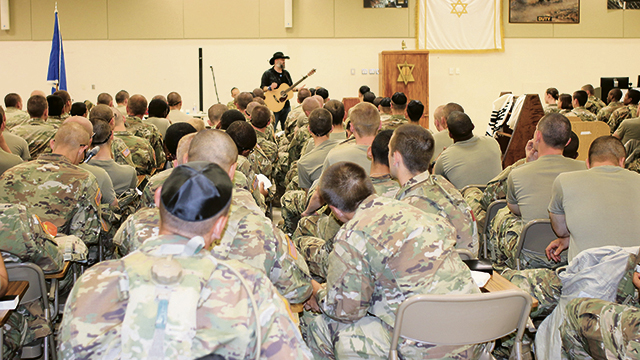
Mr. Buchanan, a self-taught guitarist, had no professional singing aspirations, but, he says, during the course of his conversion “I started writing music to help me understand what I was going through. To help me understand — why does this make me feel so good? Why is this a very healing religion? Why is this making so much sense for me? I started writing songs about things I was learning.
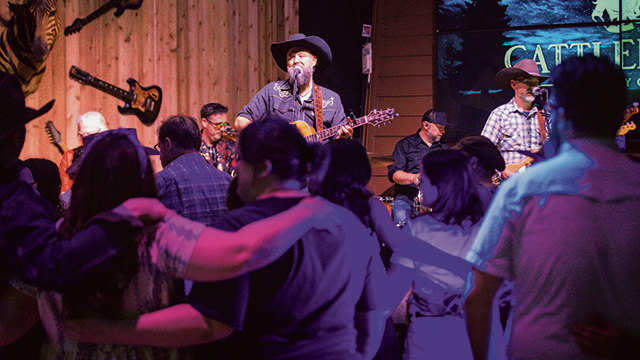
“My wife told the rabbi, ‘Hey, Joe’s writing music, and you should hear it.’ He asked me to play it for him one time, and when I did, he asked me to play it in front. I did, and someone was there from another place, and invited me to play for their community, and it just sort of took off. It’s not what I expected, and now we’re three albums in.”
Mr. Buchanan’s music is made up of traditional prayers sung in Hebrew combined with English lyrics about his faith.
I asked him if he harbored an ambition to take his music beyond the world of Jewish institutions it largely inhabits now. “I don’t know if it is really an ambition, but I feel like Judaism is such a beautiful thing,” he answered. “But the question is what does it look like out there in the world. Does the world have any clue what it means to be Jewish if we’re not telling the world? A big part of what I wanted to do was make music that uplifts Jewish communities, but also music I can share with the world at large.”
That world at large largely changed on October 7. “I didn’t lose any family in the Holocaust,” Mr. Buchanan said. “There is not a drop of Jewish blood in my family tree as far as anybody can find. But when you become Jewish, you join a people. You take on a responsibility. So while I may not have lost anybody in the Holocaust, my family did lose family.
“When October 7 happened, I felt a strong responsibility to do what I could to support communities in a big way and also be someone who is very vocal about Israel’s right to exist.
“I obviously didn’t experience antisemitism when I was younger, but it came in full force. I have people every day flood my social media pages with the most hateful things you can think of. I spend an hour every morning blocking and deleting that stuff. People don’t say it to my face, but they’re vey brave online.”
“But part of the effect of October 7 is in the conversations I have in the communities I visit. I do a lot when I visit a place. We do prayer leadership and Torah study. Of course there is the music, but a lot of it is hearing people’s stories, talking to them about how October 7 has impacted their lives. I feel a strong responsibility to be a supportive pillar.”
On December 5, Mr. Buchanan will help lead the service. The following morning, he will speak and lead a discussion at the post-service kiddush. That evening, there will be cocktails at 7:15, followed by a concert, and then dessert.
Concert tickets are $75; order them at TBSNJ.org.
Mr. Buchanan also is scheduled to appear at the Kaplen JCC on the Palisades in Tenafly on January 9.