

So very much light
Livingston’s WAE Center is a beacon for the community
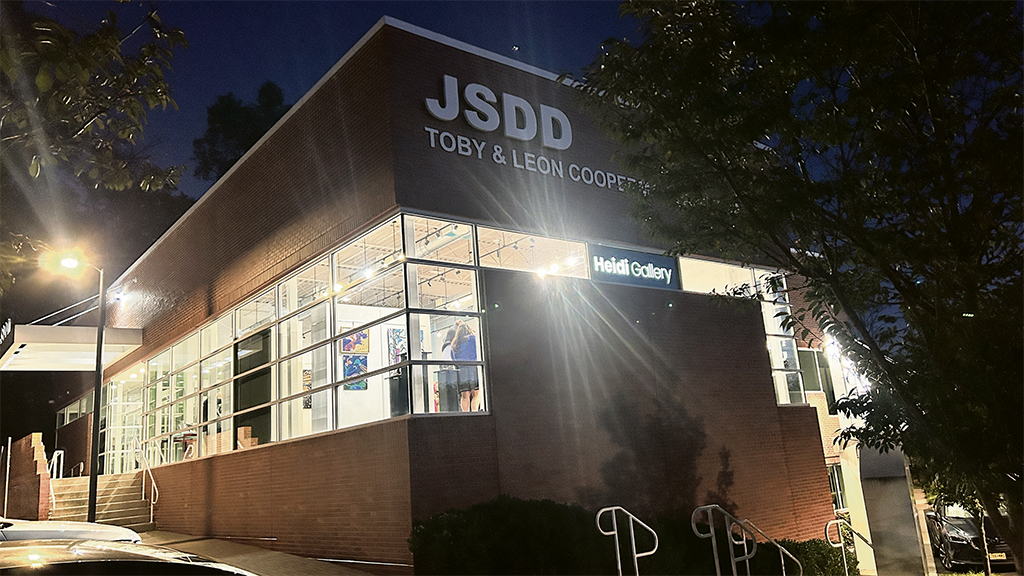
As soon as you walk into the WAE Center, you realize that it’s not what you’d expected.
When most people try to visualize what a building for programs for people with disabilities would center around, they’re unlikely to hit first on the idea of beauty. Those buildings generally are utilitarian structures, often built for some other use first; function matters far more than form, if they’re lucky. If they’re not lucky, they get neither function nor form.
Then there’s the WAE Center.
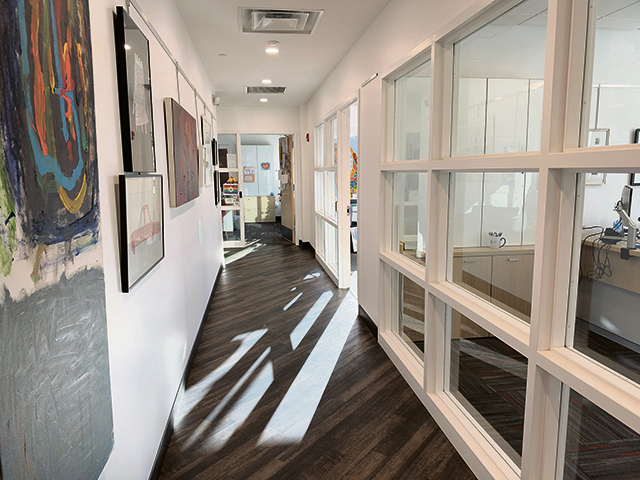
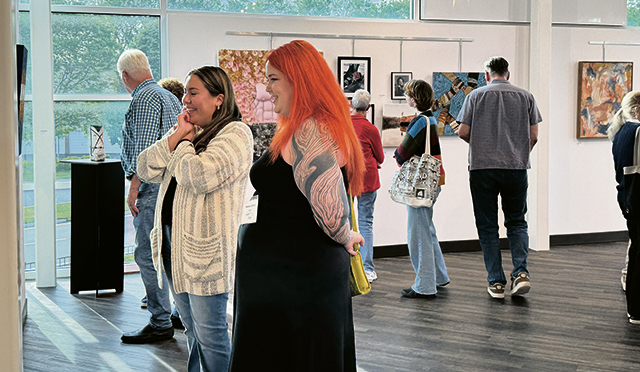
You walk in and you’re surrounded by light, coming at you from all directions. To your right, you’ll see a gallery, of course light-filled, hung with work by local artists; juried shows, that sometimes include pieces from artists with developmental disabilities whose work was chosen according to the same guidelines as everybody else’s.
 The WAE Center in Livingston — the acronym stands for Wellness, Arts, and Enrichment — is part of the Jewish Service for the Developmentally Disabled, which is celebrating its 30th anniversary as an independent agency this year.
JSDD was created in 1989 as a committee of the Jewish Federation of Greater MetroWest; it was championed by the federation’s CEO, Howard Charish. (Mr. Charish was also the CEO of the Jewish Federation of Northern New Jersey; he lived in Englewood then. When he retired from North Jersey, he moved back to MetroWest.) In 1996, when JSDD became independent — it’s a 501(c)(3) now, and a partner agency of the federation — Max Kleinman was the MetroWest federation’s CEO, and he helped the process along.
In October, the JSDD honored both Mr. Charish and Mr. Kleinman with its Visionary award at its annual gala. “Their vision helped turn an important community need into a lasting reality, creating opportunities for individuals to live with dignity, independence, and connection,” the organization’s citation read.
That evening, the JSDD also honored Mimi and Bob Sochor with the Leadership and Advocacy award for “their longstanding commitment to JSDD and their extraordinary contributions to the organization.”
Recently, both Mr. Charish and Mr. Kleinman joined JSDD board president Lori Solomon, its executive director, Linda Press, and its associate executive director, Rebecca Wanatick, to talk about the organization.
 Their pride in it was clear.
“In 1996, we had one group home,” Ms. Press said. “It’s in Millburn. It’s still there, and so are two of the original six residents. Today, we have 16 residential programs, supporting 60 people, and we’re about to open a 17th residence, in Livingston; there are four apartments there that we’ll be using.
“We have three other commitments to develop apartments in the community imminently. We’re working with the township of Livingston to develop some new group homes. Two will be for the aging population, and the other one will accommodate general needs.
“We’re going to nearly double our capacity.
“We have a relatively new department that provides enabling technology so people can be as independent as possible. This will be our first project with remote support actually built in. The technology is very individualized. Smart locks, ring doorbell cameras, induction cooktops, smart toothbrushes, Alexis, whatever the person needs.
“And we make lifelong commitments,” she added. JSDD works with clients who are 21 or older — that’s when state-provided educational services end. Once you’re in, you’re in.
And the need “is always growing,” Ms. Press said.
Funding is difficult and complicated. Some of it comes from the federal government, some from the state, and some from donors. JSDD is a deeply connected part of the Jewish community, but it is not only for Jews; instead, it balances its commitments to the Jewish community with its connection and commitment to the broader community. Not all the residents or clients are Jewish. “We encourage everyone to share their traditions and values,” Ms. Press said. There is always some self-selection involved; anyone who would feel uncomfortable in a Jewish environment, or whose parents would feel that discomfort on their children’s behalf, wouldn’t chose to join.
“The Judaic programming is voluntary,” Ms. Press said. “We celebrate all the holidays. We recognize everything.” There’s no overall Christmas celebration, but residents are free to mark the holiday in their rooms in any way they choose. JSDD marks Black History Month.
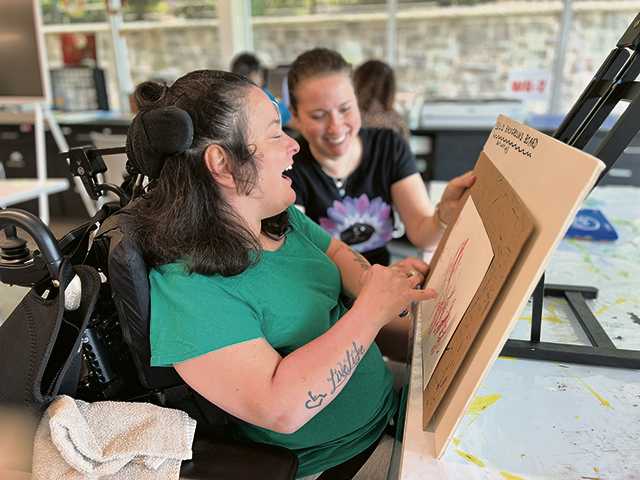
Overall, “if you’d told me 30 years ago that the agency would be where it is today, I would say that’s unbelievable,” Mr. Kleinman said.
The WAE Center, which opened in 2021, is just part of what JSDD does. It is home to a wide range of services, including physical, occupational, and speech therapy.
The therapists’ work is done in light-filled offices; they work one-on-one with their clients closely, carefully, patiently, deliberately, in ways closely tailored to each client’s particular needs and interests. One therapist helps a client with the repetitive motions he must learn to be able to feed himself. Another one helps another client coax sounds that become words from her mouth.
A larger group assembles for a program that includes a performance by staffers; it’s educational and it’s also fun, and that matters too.
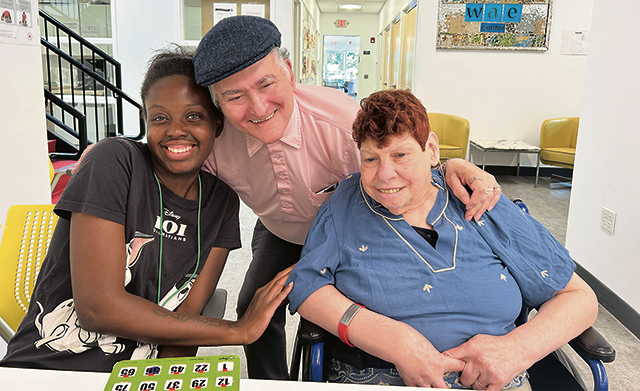
Throughout, the emphasis is on individuality. We’re all unique, every one of us, whether or not we’re developmentally disabled (or for that matter physically disabled, or seemingly entirely standard issue). The leaders of the WAE Center understand that.
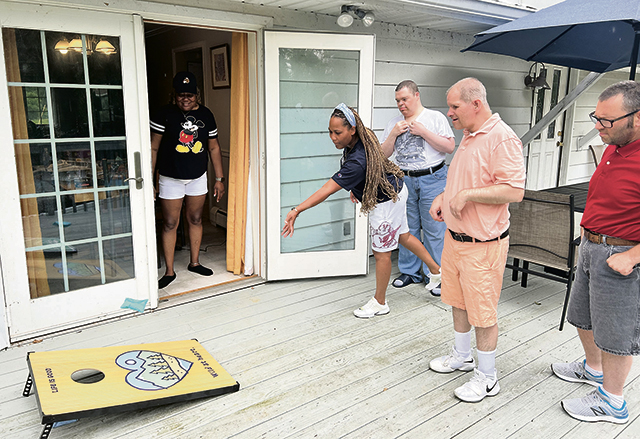
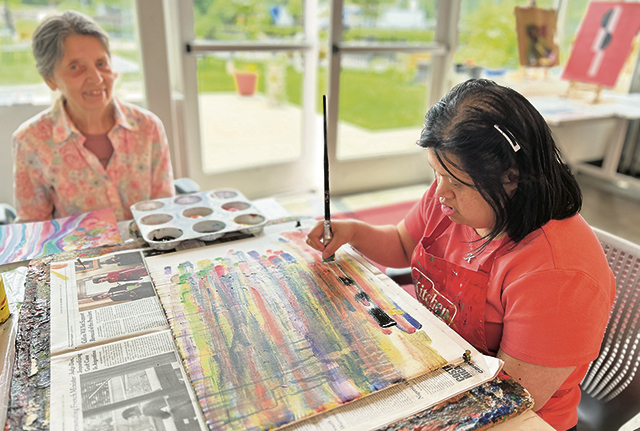
Members, as the people who use the WAE Center are called, can come whenever they want; most come five days a week, Ms. Press said. The center offers classes in theater arts, music, cooking, yoga, gardening, and Judaic studies, all taught by instructors who have a passion for their subject and a talent for working with WAE’s members. It has an LGBTQ+ group, conversation groups, and community outings. There’s a 3-D printer that members can use. There’s something for everyone. Some of the activities are upstairs, and some are downstairs. That lower floor, though, is not a basement. Like the rest of the building, it is light-flooded.
There are success stories. Some members find the environment transformative. “One woman came in very shy, very timid,” Ms. Press said. “There had been some dysfunction in her family. She had two brothers with autism, and probably was on the spectrum herself.
“She spent a few years here, and as she learned about her ability as an artist and a filmmaker, she started to feel more comfortable. She met someone with an interest in film, they started dating, and she ended up starting a business. She is living a full life.”
That’s not the trajectory that most JSDD members will follow, and it shouldn’t be. The point is that the programs, the attention, and the individualized care with which each member is treated will allow that person to fully realize his or her potential, and that people with developmental disabilities, like everyone else, have specific potential.
The WAE building is the work of Stephen Schwartz of Livingston, a retired architect whose work with Legos — yes, Legos, the always present and now hugely popular building toy — has taught Jewish kids and adults about the basic architecture of Jewish life.
His work with Legos began in the 1990s, when his daughter was teaching second grade in the Bronx, Mr. Schwartz said. “She asked me if I could come to her class to explain how a city is designed.” He had a few bins of Legos then — by now he has mounds and piles and oceans of Legos — so he drove them over the river. “When I left, the kids understood zoning,” he said, not really joking.
“With Legos, you engage people to such an extent that they really can forget about time,” he said. He’s brought Legos to shuls and schools and JCCs — mainly but by no means only Jewish institutions — and the group has built everything from local suburban towns to Jerusalem to the Warsaw Ghetto.
It’s a brilliant tool for someone who is an architect, a teacher, and an enthusiast.
But “until 2015, I don’t think I’d even heard of JSDD,” Mr. Schwartz said. That’s when Lois Rose, one of the most important backers of the organization since it first was created — in 2024, the JSDD honored her with its first Lifetime Achievement Award, saying, “It is impossible to think about the history and trajectory of this extraordinary agency without Lois’s name being connected to that incredible story” — met him for lunch. “She said, ‘I know that you do a lot of things with Legos. We are doing a program called the Chairs of Inclusion. Why don’t you come to West Orange” — where JSDD was headquartered until the WAE Center opened — “to see what we are doing.”
The Chairs of Inclusion, a JSDD fundraiser, involved 11 artists, working in different media, working with JSDD members to build a “chair of inclusion”; the definition of that chair was open for each artist to create.
Mr. Schwartz was the 11th artist, and of course his chair had to be made from Legos.
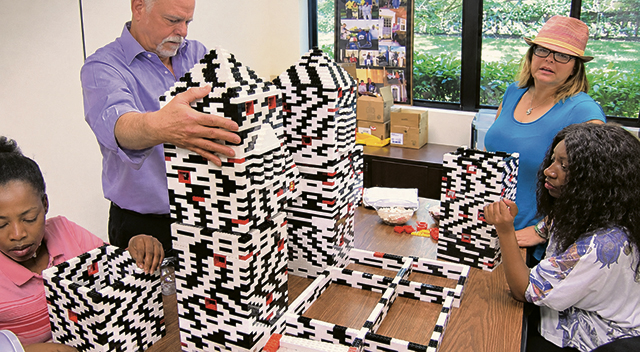
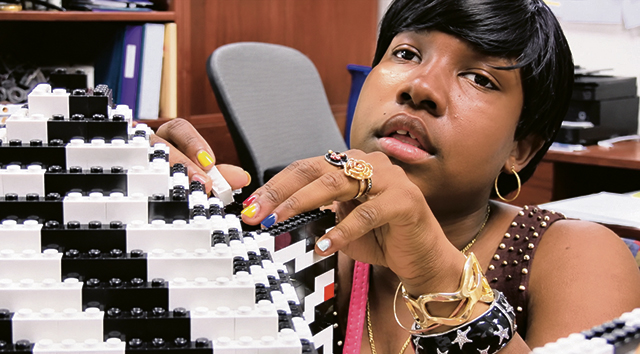
First, he came up with a sketch. “I drew a concept of a throne, and I think I called it the Empire State Throne. I incorporated windows and little doors, so that the chair itself is like a giant building. We had little stairs going up into the chair’s legs.” It was a fantastical version of the Empire State Building. “And it was in black and white.”
Then he went to JSDD’s offices to meet members who were interested in working with him. He had to find people who would enjoy building with Legos for the two-hour sessions he’d planned.
“The chair being in black and white became very important when I found out that one of the people who enjoyed working with Legos was totally blind,” Mr. Schwartz said. “We gave her a bowl of white and black blocks. It didn’t matter which one she picked up, because then the pattern became random.
“She was happy building. She was one of my best students.
“We had two or three people working on it at a time, and we had six sessions. I would walk around it, like circling the fort, and once in a while I’d stick a red Lego in. And every once in a while we were able to incorporate a window. I’d stick my hand in when they were working, and say, ‘Oh! It’s time for a window!’”
It was built in components, Mr. Schwartz said. Volunteers would work on their own sections, and then they’d be combined. All along, “I knew what it was supposed to look like. So I was directing the whole thing at a distance, but I was in full control.”
The chair sold for $5,000, which of course all went to JSDD.
While he was working on the chair, Mr. Schwartz, ever the architect, saw that there was so little space in the building that furniture had to be rearranged to allow him and his volunteers room to work.
“Everything was makeshift,” he said. “So at the end of the session, I said, ‘You know, you guys, this building is way too small for you. You can’t run an operation when you’ve got to move 10 desks just to have a functional space to build Legos.’
“I asked, ‘Have you ever considered your own building?’ The answer was, ‘Of course we would love to have our own building, but we don’t even know where to start.’
“So I said, ‘Let me start for you.’”
So he talked to people from every one of the many departments JSDD already had, and asked about the space they needed, and he analyzed the answers. He realized that land that he had owned in Livingston since 1980, but had never developed or sold or used for anything — “it was just sitting there” s — could be used for JSDD.
Mr. Schwartz looks back at how that worked out with astonishment. “People would call to buy the property,” he said. “I had many opportunities to sell it. When they’d call, I’d say no. I’d say I wasn’t ready to sell. So I’m amazed by that. How did I hold onto that land until they needed it?”
Once he decided to build JSDD’s building on the land, the process moved surprisingly quickly. The town saw the need for it, and the zoning was adjusted to allow it. Then, to collapse what was of course a far more detailed story, including a fund-raising campaign, work began, and “the building took shape.
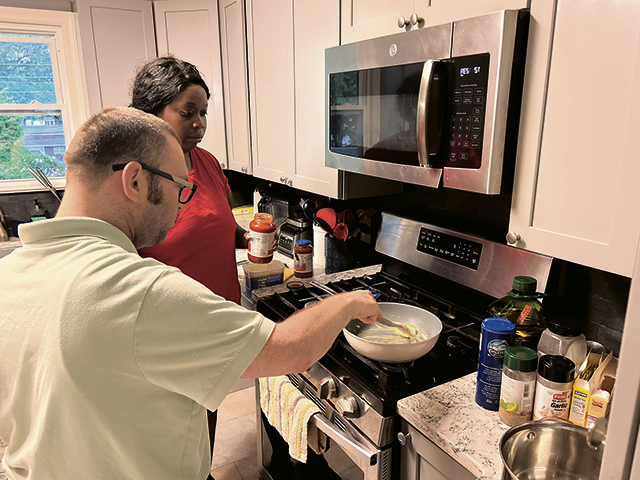
“We have really a lot of rooms in there,” Mr. Schwartz said. There are many expandable doors, so rooms can be adapted to be cozy for small groups or big enough for big ones. The building is built for the needs of its users. For example, “because a lot of people live in group homes, there’s a teaching kitchen where they can train, and we also can use the kitchen if we’re having a function.
“I tried to take advantage of every nook and cranny. There’s storage space under the front entry, because I thought that they could use it. Nobody even knows it’s there, except for the people who use it.
“The studio is on the end of the building where it gets natural light. Everything works in conjunction with the orientation, with the contours of the land. The drop-off point, with a beautiful canopy, is on the lower level. Everything on that level is for members to use — studios, the kitchen, the dance studio, the library, all of that. And the upstairs is administrative, and the gallery.
“There are little touches all over. All the doorways are three feet four inches wide, instead of the normal three feet. We added those four inches to make sure that people in wheelchairs didn’t clip their fingers as they went through a doorway. Almost every door has handicapped assistance, so you just press a button. And all the bathrooms open automatically. That’s a nice thing about doing something from scratch, rather than trying to modify an existing structure.
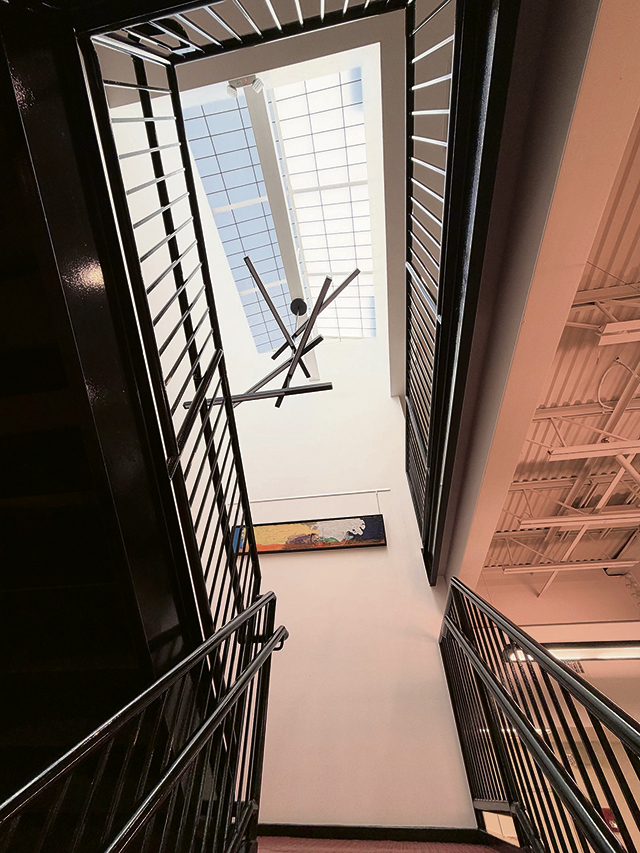
And the light!
“I moved the stairwell right into the center of the building, and we put a huge skylight on top, so we bring natural light into the middle of the building,” Mr. Schwartz said. “It’s pretty amazing, the way that works.”
Learn more about JSDD and the WAE Center at jsdd.org.