

‘We Met at Grossinger’s’
Teaneck International Film Festival shows borscht belt documentary
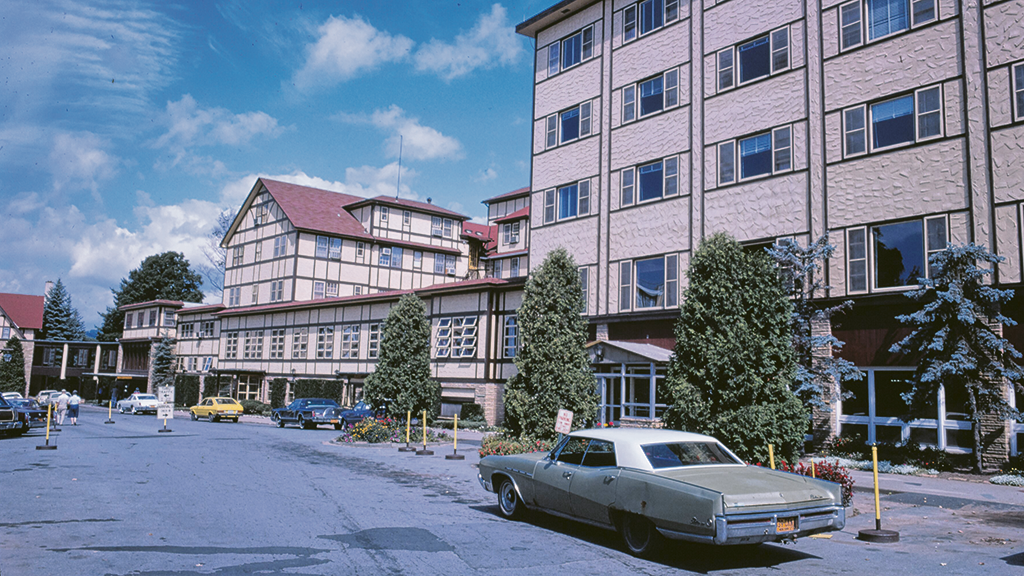
Grossinger’s is a mythic place, a sort of Jewish Camelot — without the swords and the armor, with as much food, much more tidily eaten, on regular plates, with no bone tossing and of course kosher — with a beginning, middle, and sadly romantic end, as it faded away into the dusk.
It was also a very real place, a flourishing business, run by very human if slightly terrifying people, with their own backstories and very real dreams and guiding principles.
Filmmaker and producer Paula Eiselt of Teaneck has made a documentary about the hotel. The Teaneck International Film Festival will screen “We Met at Grossinger’s” at Temple Emeth this Sunday, November 8, at noon.
“When I was first approached to do this movie — because I wasn’t looking to make a movie about Grossinger’s, or the Borscht Belt — I thought, okay, I know this story. What could be new here?
“I thought I knew about it, and, you know…” Not that it wasn’t great, it’s just that it was all surface, and a well-trodden surface at that.
“But then, when I met the Grossinger family, and I was able to dig into what exactly Grossinger’s was, what it meant, and who built it, it became so fascinating that it felt essential. It felt like it was a piece of American history. It wasn’t schmaltz. It wasn’t borscht and dirty jokes.

“It was something much larger for Jewish Americans, for American entertainment at large, and for inclusivity. It was about Black-Jewish relationships.
“It’s basically the story of the Jewish immigrant experience. It’s the story of how Jews became Americans.”
Ms. Eiselt was able to tell the story “through the lens of the Grossinger family, and this amazing hotel, that was the crème de la crème of all the Borscht Belt hotels.”
The hotel’s story encompasses the “significance of becoming American, and of thriving as a reaction to antisemitism and being excluded,” she said.
And there was another component too, she added. “It was about how the Grossingers built something amazing. And it was just super fun.
“It’s so much fun to make it and to explore it. A lot of my films are investigative. Ms. Eiselt’s work includes “Under God,” about American Jewish women’s reaction to the Supreme Court’s decision to demolish the right to abortion through its Dobbs decision. Her “Aftershock” is about the difficulties and inequities in the medical system that result in a terrible number of Black women dying after childbirth. And her “93Queen” is about a chasidic woman’s stressful but successful struggle to provide a women-only EMS service in Boro Park. These films “are character-driven, and they follow the story as it is unfolding,” she said.
“This one is historical, and it has a ton of resonance to today.”
In other words, much of the story is history, and that will not change, even as our understanding of it and its context do change. But the stories already exist, many with not only beginnings and middles but also ends. Both the unfolding stories and the histories call for a great deal of creativity, but in slightly different directions.
One element that makes this film different from Ms. Eiselt’s other work is that is uses animation. “I’m a millennial, and I know that this film has to feel very vibrant and current. I knew that we had to bring this story to life in a very modern way, and the visuals were really important to me.
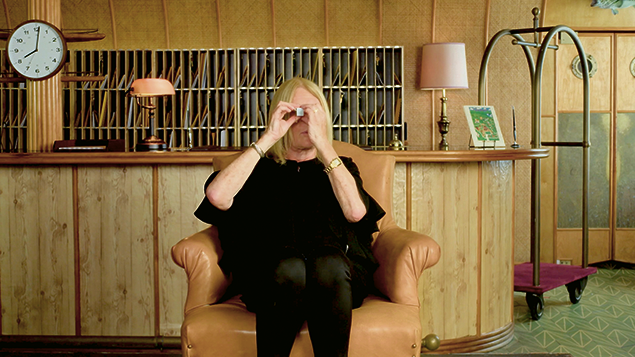
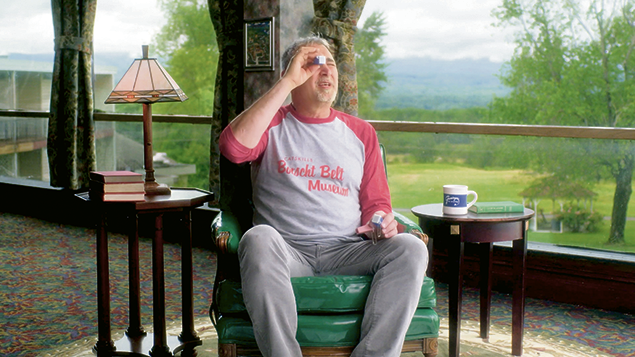
“I wanted all the interview sets to be significant to the subjects I’m interviewing, and really be immersive. There are four sets — the check-in counter that we built. We even built the mail slots. That’s for the family.
“Then there’s the dining room, which we filmed in the Hudson Valley Resort. It was the old Granit Hotel before it was demolished, just a couple of years ago. And then there’s the panoramic view of the Catskills for the experts” — the academics and other subject-matter specialists — “and the Gotham Comedy Club for the entertainers.
One of the movie’s focal points is the three women — Malka, her daughter, Jennie, and Jennie’s daughter, Elaine— who created and ran the hotel, made it what it became, and kept it that way. Theirs is a complicated story — ambition, inspiration, and pain entwine — and one of the ways that Ms. Eiselt tells it is through an interview with the last of the three, Elaine, who died in January this year at 98. “She was 95 when I interviewed her, and she was still talking about her relationship with her mother,” she said.
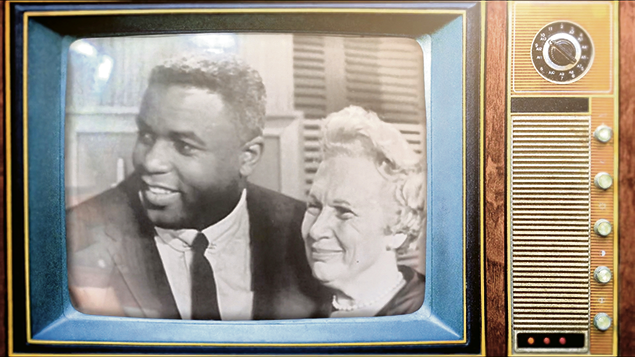
Another relationship that surprised Ms. Eiselt was the Grossinger family’s with Jackie Robinson, the groundbreaking Black baseball player, and his family.
The family’s belief in equality was strong and it was real. “Jackie Robinson and Jennie Grossinger had the first interracial hug on television,” she said. And Mr. Robinson’s wife, Rachel, had an entire chapter in her memoir about the hotel and the family
The movie was fun to make, Ms. Eiselt said. “It also was hard. Every movie is. But this was really fun.
“And then it took on a real level of poignance and importance because October 7 happened, and it became much more present and current because now, unfortunately, there’s almost a need for cultural spaces where Jews can be themselves.”
Susan Etess is the daughter of Elaine Grossinger Etess and David Etess. She’s a retired educator — “I’m the only one except my father who didn’t go in the hotel business,” she said; her father was a doctor.
She’ll be at a talkback after the film; so will Paula Eiselt.
“The movie is the story of my mother, her mother, and her mother, the three women who were so instrumental in creating Grossingers,” Ms. Etess said. “It’s their story, and it’s also the history of the Catskills.
“I’ve seen the movie eight or nine times by this point, with lots of different audiences, and I think that it speaks to people. It reminds them of the really happy times they had in the Catskills, and people want happy times. So whether you went to a hotel like Grossinger’s, or you went to a bungalow colony, or you worked in a camp up there — if you had any experience in the Catskills — this movie reminds you of those happy times.”
The reason why the Catskills became a Jewish summer paradise was not happy. “The Catskills wouldn’t have existed without antisemitism,” Ms. Etess said. Jews went there because they were not allowed into more established, higher-end resorts — so they created their own mountain palaces.
“Remember the movie ‘Green Book’?” Ms. Etess asked. That was about African-American travelers, who used a book compiled by a community member that provided them with lists of places that would allow them in.
“The Green Book was based on a book that Jews had created about where they could go.” Hotels they could stay in. Restaurants where they could eat. Banks that would take there money. “Because there were a lot of signs that said ‘Gentiles Only.’ ‘No Jews Allowed.’
“I think that the movie does a good job talking about that, and how the Catskills came to be.”

The film tells the story of Malka Grossinger, who came to America with some of her children. Eventually her husband joined them on the Lower East Side; they moved up to the Catskills when he became sick and had to leave the city. He’d been a farmer back in Austria, and she worked at an inn, so they bought some land upstate, hoping to farm. But the land turned out to be rocky, so they went to Plan B. The little boarding house that Malka started grew and grew. “The first year they had nine or 10 boarders, and made $80 altogether,” Ms. Etess said. But they kept having more boarders, building more space, expanding and expanding.
Then Jennie took it over, and it boomed.
Ms. Etess grew up in a house on the hotel’s property; the family stayed there until they sold the hotel in 1985.
She went to school in town, Ms. Etess said, but it was too far away for what was not yet called playdates, so she’d come home and roam the vast hotel and its grounds. “I used the hotel as my toy,” she said. “I loved to play at the switchboard and work with the operators. I’d go to the reservation desk and help them alphabetize the reservations. I’d go into the kitchen and watch them bake the cookies and the breads and the cakes. I’d go down to the basement where they kept all the potatoes and carrots in huge bathtubs filled with water. That’s how they kept them fresh.”
The Etess family ate most of its meals at home, though, rather than in the hotel.
“My mother very much wanted us to have a normal childhood,” Ms. Etess said. “In the movie, they talk about the fact that my grandmother was so busy making the hotel successful that my mom was raised by a governess who picked her up at the hospital and dropped her off at college.

“My mom very much wanted us to have a normal childhood. So we’d eat in the dining room every so often, and we could call for room service and get food from the hotel, but mostly we ate at home.”
There were stories about the outside world too.
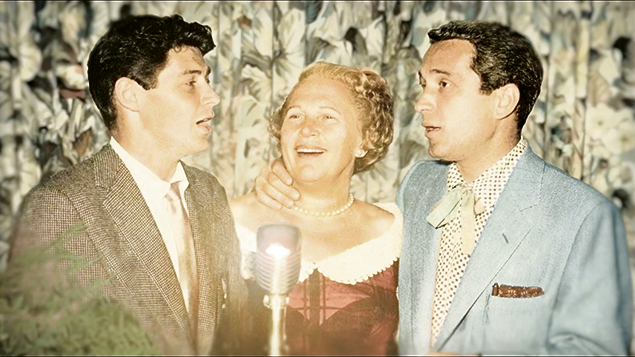
“Eddie Fisher was discovered at Grossinger’s by Eddie Cantor, and he considered Grossinger’s his home. He was dating Debbie Reynolds — they were the Taylor and Travis of their time. So he decided that he would marry Debbie, and that they would get married at Grossinger’s. And because they were such a big deal, the amount of press that came up was really overwhelming. So they decided to get married in my house. We had just moved, so we didn’t have much furniture, and it was easy to set up. I was the flower girl.”
Athletes flocked to Grossinger’s. It all started with Barney Ross, who was both a celebrity boxer and an Orthodox Jew. “When his manager was looking for a place for him to train and was having a hard time because he needed kosher food, he approached my grandmother, and she let him train there.
“And he felt really comfortable, because of the kosher food. And then all the sports writers came up to watch the training. And then the word spread. We had boxers — Rocky Marciano, Ingemar Johansson — and we also had baseball players. A lot of Yankees — Roger Maris, Whitey Ford.
“Probably the most significant one was Jackie Robinson.
“My grandmother was obsessed with Jackie Robinson and his story. And she very much wanted everybody to be accepted. That was very important to her.
“She invited Jackie and Rachel and the kids to come to Grossinger’s, but at first they didn’t come. Finally he agreed, and when he came, my mom asked him what took him so long. And he said, ‘You know, I can play ball with the Yankees. I can go to press conferences with them. But I can’t eat with them. I can’t travel with them. I was afraid that if I came to Grossinger’s, the guests would feel the same way.’”
But of course they didn’t. “And Grossinger’s became such an important part of Jackie’s life,” Ms. Etess said.
Where did the Grossingers get their sense of social justice? “My grandmother had to quit school when she was in sixth grade to help support the family, and she worked in a button factory,” Ms. Etess said. “She saw that women were not treated as well as men. She saw discrimination, fighting it became an important part of who she was, and that was passed down through the generations.
“Grossinger’s was known as a Jewish hotel, but many other people came there and were welcomed. I have a friend whose father was a minister in the Methodist church. He used to come up with his father to a conference; the Methodist ministers had their conferences there.”
And Grossinger’s always was proudly Jewish. The food was always kosher. There were always two mashgiachs in the kitchen. There were always people who came every Pesach or Rosh Hashanah, and always sat at the same tables, year after year. “The people who came who weren’t Jewish sometimes didn’t understand why they couldn’t have their milk and meat, or why they couldn’t get bacon for breakfast. But they came to understand, and just because they weren’t Jewish it didn’t mean that they couldn’t enjoy a wonderful place, with all the facilities, where they were treated really well.”
So the message of the film, and of the hotel, was that it “wasn’t only for Jews,” Ms. Etess said. “It wasn’t only for famous people or sports figures.
“It was really for everybody.”
The Jewish Standard sponsored “We Met at Grossinger’s” at the TIFF. The film will open theatrically in Florida on December 4 and will be shown across the country in the spring. After that run, it will screen; details are not available yet.