

Chaverei nevarech
He’s a wanderer — with roots
There are many ways to be a rabbi.
Traditionally, he — always a he — was a scholar and a teacher. He could be a man of great charisma, or compassion, or, ideally, both.
As the world changed, so too did some rabbinates. In America, particularly after World War II, the relationships between Jews and non-Jews, rabbis and other faith leaders, modified. The relationships between congregations and their rabbis sometimes became democratized. In parts of the Jewish world, women became rabbis; in fact, in some parts of the Jewish world, by now most rabbis are women.
In general, the idea of a rabbi seems to be of a communal leader and therapist, more Jewishly learned than the congregation but approachable, affable, and worldly; an all-around regular person.
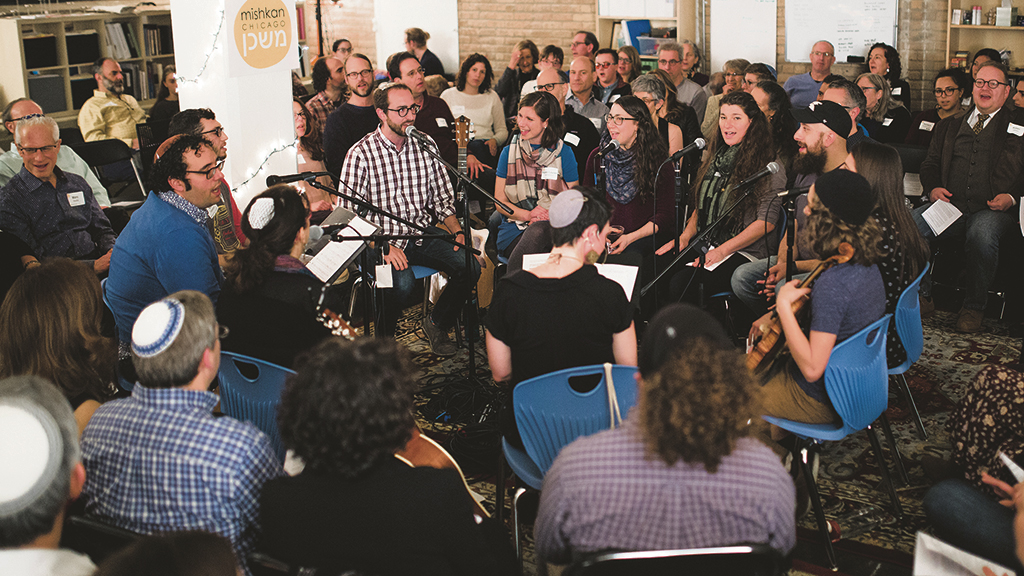
Recently, the idea of a rabbi as an itinerant musician, working with the spiritual power and beauty of music, to come for an intensive weekend of
davening, singing, and learning, cross-pollinating synagogues by spreading good ideas from one to the other, has gained traction. The foundational understanding is that music can reach deeply into both individual and communal souls, going where words cannot.
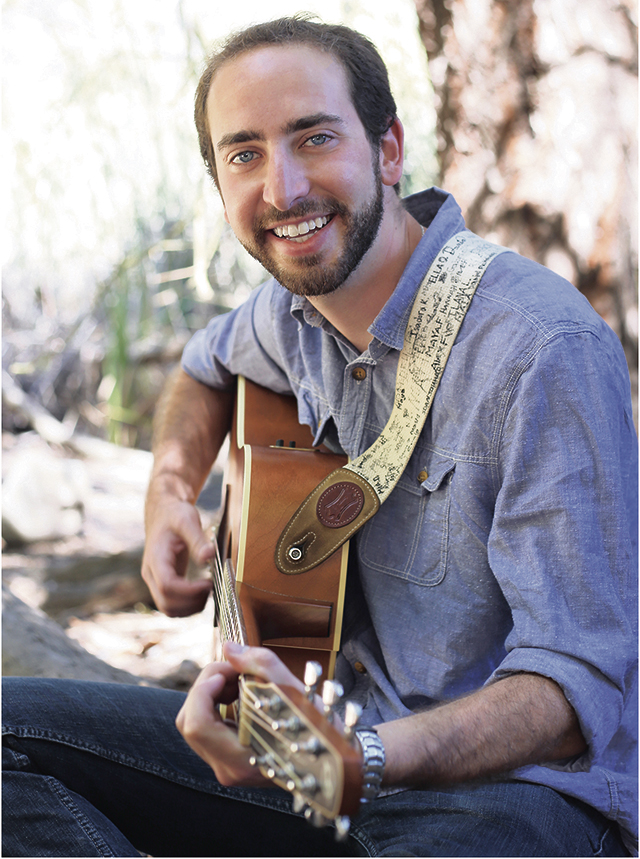
It’s hard to do both those things at once — to be a congregational rabbi and a soulful, wandering musician. But that’s Josh Warshawsky’s life.
Rabbi Warshawsky will be at Congregation Beth Sholom in Teaneck next weekend, starting on Thursday, December 3. (Go to cbsteaneck.org for details.)
That weekend had been planned a very long time ago, Rabbi Warshawsky said; it was supposed to be in early 2020. But covid intervened. And much has happened in his life since then.
Here is his story.
Josh Warshawky is from Chicago, where he grew up cradled in the Conservative movement. He went to the Solomon Schechter Day School of Metropolitan Chicago, and then to Rochelle Zell Jewish High School, just outside Chicago. He’s a serious Ramahnik, a longtime camper and staff member at Ramah Wisconsin; in fact, that’s where he met his wife, Adina Allen. He was on the international board of the movement’s United Synagogue Youth, so the first time he saw Beth Sholom was in 2007, at a USY Hagalil convention.
College was Columbia’s joint program with the Jewish Theological Seminary; when he was a student there, Josh taught music at Congregation Beth El in South Orange. (It’s always a neat trick for carless-because-who-can-find-parking Columbia and JTS students to get to New Jersey to teach. He was lucky. “I got a ride with a rabbinical student, who picked me up in a Zip car,” he said.)
At Beth El, “I realized that I really loved teaching music, and engaging with prayer, and with the children,” he said. “But I didn’t know a lot of melodies — just the melodies I’d learned at school. So I started to write melodies for tefilla” — for prayer. “I wanted to learn more, to read more, so I read different texts, and I was really inspired by that experience.”
That experience at Beth El, and at Manhattan’s Congregation B’nai Jeshurun, where he also taught, helped him realize that “I wanted to go to rabbinical school, to keep learning and teaching.” He applied, logically enough, to JTS, was accepted, but then deferred that acceptance, “because I wanted to explore doing music.
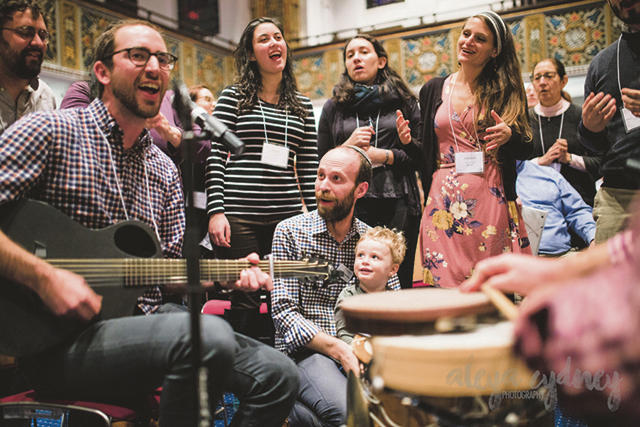
“So I moved out to California to be the artist in residence at a synagogue out there, Temple Beth Am. I was doing music and teaching at the day school there, the Pressman Academy, and I fell in love with it. I fell in love with Los Angeles, and with the Los Angeles Jewish community, and I decided to go to rabbinical school at the Ziegler School of Rabbinical Studies at the American Jewish University there.” Ziegler, like JTS, is Conservative, and it is of Los Angeles in the way that JTS is of New York. Same movement, different flavor.
“So I moved my whole life out there. I met my band. I started writing a lot of music, I started recording a lot of music, and I started rabbinical school. Synagogues started to reach out, and say, ‘Hey, do you do artist-in-residence weekends?’ And I say yes. So I started to travel to different synagogues and share and teach, and I realized that it was something I was really passionate about.”
When Rabbi Warshawsky, who got married in 2019, was ordained that year, “that’s what I decided I wanted to do,” he said. “I wanted to be an itinerant musical rabbi, traveling to synagogues around the country. And it was really wonderful. For about eight months.
“It was March 2020. So I kind of put everything on pause.”
He’d already composed, recorded, and released three albums, all volumes of Chaverai Nevarech — he’s up to Volume 4 now — so he kept recording and playing.
He, Adina, and their three young children moved around a bit, settling in Bexley, Ohio, a suburban town just outside Columbus in 2020. They joined Congregation Agudas Achim there. After a few years, the shul’s rabbi left. “I had continued to travel, and started to get back to going to different synagogues all over,” Rabbi Warshawsky said; he also became Agudas Achim’s interim rabbi. Taking that job full time was not his plan. He’d already booked weekends at other shuls, as rabbi-in-residence, to play music. But the shul started a formal rabbinical search, “and they said, ‘Would you be our rabbi?’”
He considered it. “My first week as the interim rabbi was September 30, 2023,” Rabbi Warshawski said. “And then it was October 7, 2023. And I thought, did they really need an interim rabbi? No. They needed a rabbi. I decided that it was something that I wanted to step into.” He applied for the job, and got it. “Because I had been doing this traveling already, and it already had allowed me to see some of the best practices in other places and bring it back to the community, I said, ‘Can I keep doing that as part of this role?’
“So now there are five weekends over the course of the year when I travel to different communities and share the music and teach and talk about Columbus, Ohio, and then come back and bring some of the wonderful things I’m learning and experiencing back to our community here.”
He and his family love Bexley, Rabbi Warshawsky said. “It’s a fascinating Jewish community. There are six synagogues within walking distance of my house. Three Orthodox synagogues, two Conservative synagogues, and one Reform temple. Bexley is about 30 percent Jewish. It’s a wonderful, hidden gem of a town.”
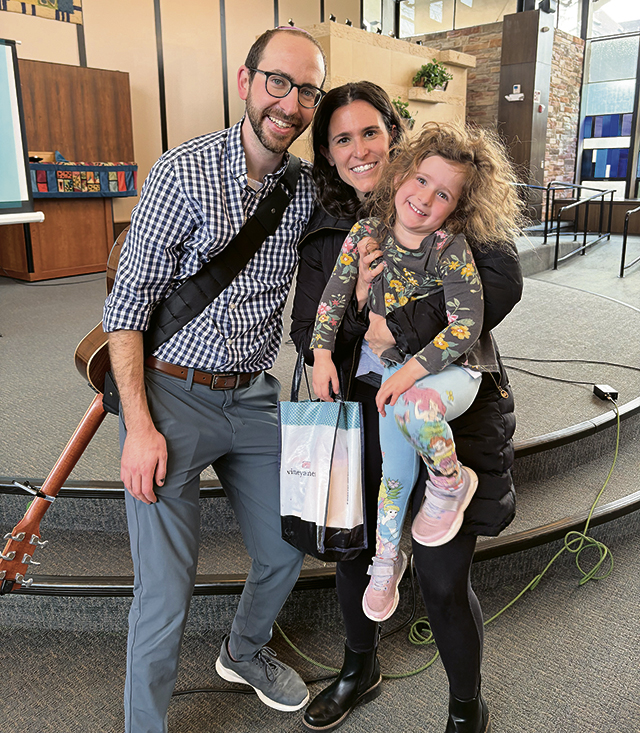
In March, Rabbi Warshawsky and his band had a weekend in residence at Beth El.
“It was really amazing,” he said. “I had worked there for three years, from 2010 to 2013, almost the entire time I was I college, and it was like a homecoming. They had put up pictures of my time there. With all these little kids, who are now seniors in high school, or in college. Many of them came back for the weekend. It was wonderful to experience that, and to get to see the community again. And that community really had grown and thrived in this last decade, with its amazing rabbis.”
As embedded in the Conservative movement as he is, Rabbi Warshawsky also has done work with the Reform movement. The Reform movement’s American Conference of Cantors and the Conservative movement’s Cantors Assembly have joined to release a book of his music, in the first such partnership. It will be launched at the Reform movement’s biennial in Philadelphia in December, soon after his weekend in Teaneck. He’s also been a frequent teacher at the Reform movement song leader conferences, and “I’ve experienced the really wonderful music of that world,” he said. “It’s wonderful to be able to bridge those worlds.”
The weekend at Beth Sholom will include a concert on Thursday night “with my co-writer, the violinist Coleen Dieker,” Rabbi Warshawsky said. “She’s incredible. We’re going to be with a percussionist, so we’ll be a trio, and we’ll kick off Chanukah with some beautiful songs of light.
“Then we’ll spend Shabbat together. I’ll do some teaching at Shabbat dinner. I’ve written some melodies for Shabbat. And I’ll sing with the kids choir, Tzipporei Shalom. I’ll give the sermon and lead Musaf on Shabbat morning, and on Saturday night we’ll have a family Havdalah and candlelight singalong.
“It’s a jam-packed weekend.”
Why does he do it?
“Because music is a universal language. It’s something that everyone can experience, and feel through their own emotions, and find very powerful.
“When I compose, I try to compose melodies that better express what the words already are trying to say. So if you don’t understand the words, or the language, you might feel distance. And then you listen to the melodies, and you would say, ‘Oh, I know what this is trying to get me to feel.’
“Crafting that experience helps bring people together in community. It helps to do something that one voice can’t do on its own. And at the same time, when you stay in community, it helps you find the strength and power in your own voice.”
And how about Jewish music?
“I think Jewish music does that in spades, because it comes from a thousand-year tradition,” Rabbi Warshawsky said. “Jewish music feels like it comes from the kishkas, like it goes back all the way, all the way back to Sinai. And at the same time, every Jewish composer has infused it with their own identities. It reflects both the current time and the past, at exactly the same time. It both feels timeless and it marks us in the moment. It connects us both along the chain of our tradition and to everybody we happened to be gathered with at the time.
So, as we say at the beginning of the grace after meals, the Birkat HaMazon, and as Rabbi Warshawsky says with each of his new recordings, chaverei, nevarech. Friends, let us bless.
Learn more about Rabbi Josh Warshawky at his website, joshwarshawsky.com. Learn more about the weekend, “A Shabbat of Light and Song,” at Beth Sholom’s website, cbsteaneck.org.