

The shoes on the Danube
How a disconnected Jew came to lay tefillin in Budapest
Whenever my wife and I plan our travel to Europe, I poke fun at her scant knowledge of our practices and our people. I tell her that in this country, they hanged us, and I point to a place on the map. Then I pick out another country. Over here, they burned us at the stake. In this place, they threw us out, invited us back in, confined the entire Jewish population to one block, and then waited until they were deported and gassed or shot or starved.
I knew none of this to be true of any particular place or any particular time, but I surmised that I could not be that far off when trying to trace the history of the Jews on the continent.
I have watched “The Sorrow and the Pity.” I have seen “Shoah.” I watched the segment about Abraham Bomba in a graduate class — he was the camp survivor who had cut the hair of the women being led into the gas chamber and the horror of his having to keep silent when he knew his victims. I argued with a member of the Holocaust studies program about our appropriation of the term “never again,” and wanted her to tell me why every Jew in America didn’t get on a plane and run to the aid of Rwanda, or Cambodia, or Darfur if we really meant it when we proclaimed it.
I did not expect my wife to cry within the walls of the ghettos in Venice when we visited in person, but she did when she saw the gold paint, the slanted tile floor, the plain wooden pews inside the synagogue. That was because the opulence of everything Catholic outside it poignantly displayed the poverty of the Jewish experience, an experience that the Jews were not even allowed to shape themselves because they were forbidden to practice the trades that could have made the synagogue straighter, more proper, and covered with real gold, not simply something colored yellow.
Yes, we could be money lenders, or morticians, or vendors of used clothing, and we were valued because of our skill in trade and our fluency in languages, skills that you picked up when you were banished time and again from wherever you considered home. You did not need to be well schooled in our religious practices to see what was so evident, that we were allowed only the pretext of something sacred.
We ran from them in the Venice ghetto, the flock of young men who came out of the first storefront carrying siddurs, pursuing every man they thought could be a Jew to pray with them, to do what a Jew should do, as they fell on me every time I came out of one building and walked toward another. They are easy to spot, wearing white shirts, black pants and shoes, and black yarmulkes. If you did not see them first, they always saw you, and they made themselves a nuisance with their predatory persistence as they followed you as you tried to walk away.
“You daven?” “You pray?” “You bar mitzvah?” They asked me that over and over, as they ignored my wife, as if she did not exist. We took refuge in the Judaica store and asked about a back exit to avoid being badgered again, and we were told which way to go to get away from the insistent and unrelenting call to prayer from the young men.
But here in Budapest, it was different. We visited the synagogue and the site of the ghetto. We talked to many Israelis. We discussed our mistrust and dislike of Israel’s leadership, but I still had no desire to make aliyah. I had met a few sabras, and I knew that the Israelis were not my people. I was an American and a Jew. And I did not know why the Jews in Hungary today are not observant anymore, according to what the tour guide told us. Maybe for the same vague reasons that I am not.
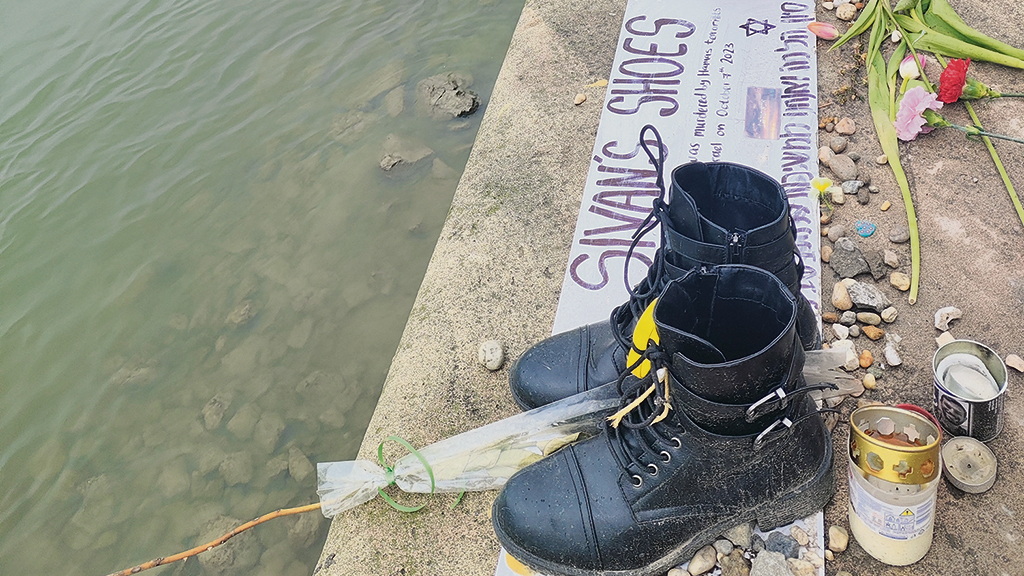
We knew about the shoes that stand on the banks of the Danube before we visited Hungary. And we knew we had to see them. As we approached them, we knew their story. We knew that they represented the bodies of the people who were shot there and allowed to topple into the river to be carried away somewhere, perhaps out to sea and lost. Still, standing there, seeing the empty iron shoes, laced and unlaced, paired or solitary, askew or pointing straight ahead to the river, left me speechless. I had no anecdote or amusing tale to tell.
And I could not help but see the table with the two young Lubavitcher men and the velvet pouches.
This time, I saw them first. I approached them. No one else seemed to be doing anything except staring solemnly at the shoes or taking pictures. Almost no one spoke. And before they could corner me, badger me, plead with me to recite ancient and forgotten prayers and rituals, I took the tefillin bag, unrolled the leather straps, let the young men place them on my head and on my arm, allowed them to adjust the yarmulke on my head, as we recited some ancient prayers, some of the Kaddish I remembered, and parts of the before and after psalms.
The shoes in the display are not real shoes. They’re made of iron, replicas of the kinds of shoes people wore in 1945 in Hungary. But at that moment, at the place, there was no denying that I was a real Jew, adorned with the phylacteries, the kippah that I had not put on in decades, all as real as the shoes the victims had owned and worn, before they were murdered, until those shoes were all that was left of the real bodies that had no use for them anymore.
And the shoes were not mine. Nor did they belong to anyone in my family, though my brother remembers that my grandfather came from Hungary. But it hardly mattered if the victims were related to me because, of course, they were. And the decision was immediate. At that place, at that time, we must not simply notice and take tourist photos. We must join them. Imagine that those shoes were worn by husbands, wives, sons, and daughters who, of course in a larger sense, were my blood.
I could pray for them, over what remained, for what happened in that very spot. In fact, how could I not?
Somewhere on my wife’s iPhone there is the video of our praying, of me mumbling the phrases, parts of each prayer, flanked by bearded young men, adorned with things I hadn’t seen or worn for decades, but which were instantly appropriate and fitting, because the very least that I could do at the moment, at that place, was join them, the pair of Lubavitchers, the Jews who were killed and gone, and the Jew who I still was, noticing, praying, paying tribute in some small way.
I remain grateful that they showed me how.
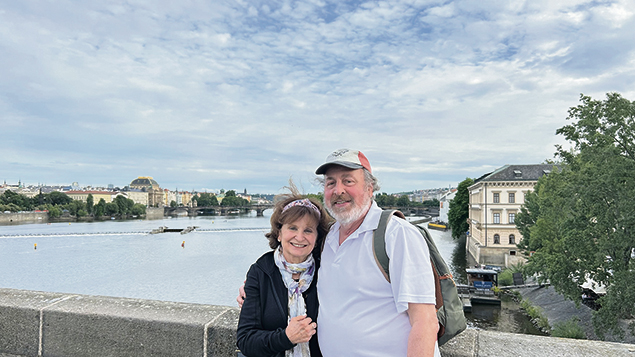
Bill Ehrlich graduated from Irvington High School and Rutgers and taught English and journalism in West Orange for 35 years; he retired in 2012. Since then he’s taught at Caldwell University, Montclair State, Fairleigh Dickinson, and Essex County College. He and his wife, Jill, live in Livingston.