

‘I had to dance’
Yehuda Hyman explains the genesis of ‘Dancing Into Roses’
Is Brooklyn a bridge too far?
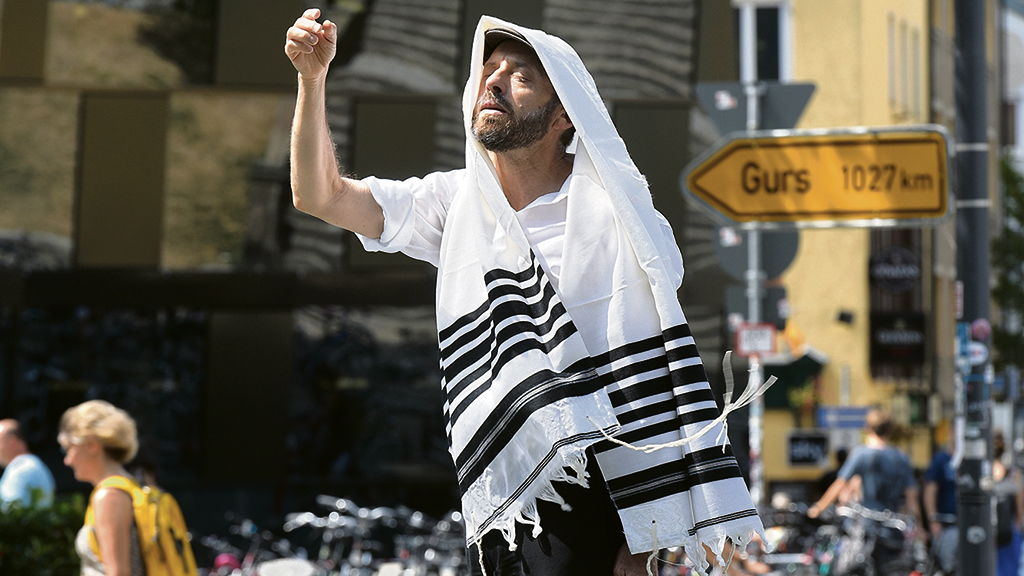
Yehuda L. Hyman hopes not, since that’s where he will stage “Dancing Into Roses,” his performance piece about returning to Germany and using dance as a way to transform pain into happiness.
Mr. Hyman, 71, is an actor, dancer, writer and choreographer with an impressive resume that includes Broadway shows. But it is when he mounts Jewish-themed shows that he feels entirely whole.
He grew up in Los Angeles, the son of immigrants — dad from Poland and mom from Russia. “They weren’t Orthodox Jews,” he said in a Zoom interview. “They weren’t socialist Jews. But they were Jews. I was sent to Hebrew school. I was a bar mitzvah. We did all the holidays. But we were the only Jews in the neighborhood.
“We didn’t grow up around Jews, but we had a very Jewish upbringing. We were always different. It wasn’t like growing up in New York. It’s a very different situation if you don’t grow up in a Jewish neighborhood. I was the only person who got out of school for the holidays. I experienced some antisemitism. That was my upbringing.”
But that wasn’t all that set him apart. There also was his fascination with dance.
“My mother was this crazy Russian gypsy dancer,” he said. “I know it’s Roma now. But she just loved to dance, and we — my brother, sister, and me and my mother — we would dance around the living room.
“She’d put on Theodore Bikel records, and we would dance. She started taking me to Greek and Israeli folk dancing performances at a place called Cafe Dannsa. I was sort of a very uncomfortable shy child, but I immediately felt connected with dance.
“When I was 13, I was in a community production of ‘Pajama Game’ and I had to dance. I’d never taken a class. The musical director saw me and understood me. He took me to my first dance class.”
Mr. Hyman then began taking lessons on a regular basis, usually on “a work scholarship, because my parents didn’t have any money.” When he was 16, he won a scholarship to study at Maurice Bejart’s school in Brussels.
Whoa, I tell him. That came out of nowhere.
“I read Dance magazine religiously,” he said. “I saw an ad for an audition in New York City. I took my bar mitzvah money and flew to New York. A friend of a friend put me up. I went to the audition. There were like 300 people there, and they chose me. I was just driven, because it was the one thing that made me feel great.”
What I didn’t understand is what set him apart from the others, many of them older, more experienced, better trained. “That’s a good question,” Mr. Hyman said.
Then he described the transformation he feels when he dances.
“When I dance, it’s like something else inside of me,” he said. “I’m not like just doing the movement. I’m feeling something. I was not your ideal dancer. I didn’t have a dancer’s body. I was a chubby kid. I had bowlegs. But people tell me when I dance, I transform into something else.”
That led to an interesting Broadway career, which he describes as “my legendary Broadway disasters.” This includes a musical version of “Gone With the Wind” that closed in San Francisco before it even made it to Broadway. The headline on a local review was “The South Falls Again.”
Then he did “Rockabye Hamlet,” a rock version of the play that included Meatloaf in the cast and was directed by Gower Champion.
Finally, he appeared in “Bringing Back Birdie,” a sequel to “Bye Bye Birdie” starring Cheetah Rivera and Donald O’Connor. “It was terrible, but a lot of fun,” he said.
“So those were my Broadway shows. I did tours. I worked with a lot of great people. Tommy Tune. Michael Kidd. I had a very solid career, but after ‘Bring Back Birdie,’. I remember on closing night, which was right after opening night, I just started crying.
“I wasn’t sad about the show. I just knew this was the end for me. I was never the perfect Broadway chorus boy.”
This led him into choreography and ultimately what he calls his role as an ambassador of Jewish dance. That started when he was hired to choreograph a play called “Ghetto” by Joshua Sobel. It was about a group of actors and artists forced to start a theater company in Nazi-occupied Vilna ghetto.
His work was spotted and validated by noted klezmer clarinetist Giora Feidman, “who saw something in me, that I had some sort of Jewish connection when I danced.”
There followed pilgrimages to Israel and Breslov and an immersion in Jewish dance history. “Again, it wasn’t something I chose,” Mr. Hyman said. “It chose me. And when I got into it, it became obvious that when I move, when I dance to Jewish music, something within me responds right away. I enter a sort of different … I don’t know.”
Mr. Hyman underwent another transformation at around that time. His parents had named him Larry, but he never liked that name. It never really felt like him. “In 1992, I was brought to Israel to participate in a Jewish Artists Symposium and had an awakening,” he said. “It led to the changing of my name. It was not a sudden or rash decision. I thought about it for two years and then had a religious ceremony, where I changed my name to the one that represents who I am now.” Larry Hyman became Yehuda L. Hyman.
Several Jewish-themed productions that Mr. Hyman wrote and usually starred in followed. They include this new production, which had its genesis in 1983. “I’d moved to New York City and danced professionally for nine years,” he said. “I’d been on Broadway, but I was very unhappy. So I decided I want to create my own work.”
That was not the best financial decision. “I was basically cleaning apartments for a living. I got a call out of nowhere from a friend who wanted to know if I could leave in four days to go to Germany and work for a ballroom company teaching disco dance. He told me, ‘You’ll be going all over Germany. You’ll be making $50 an hour.’
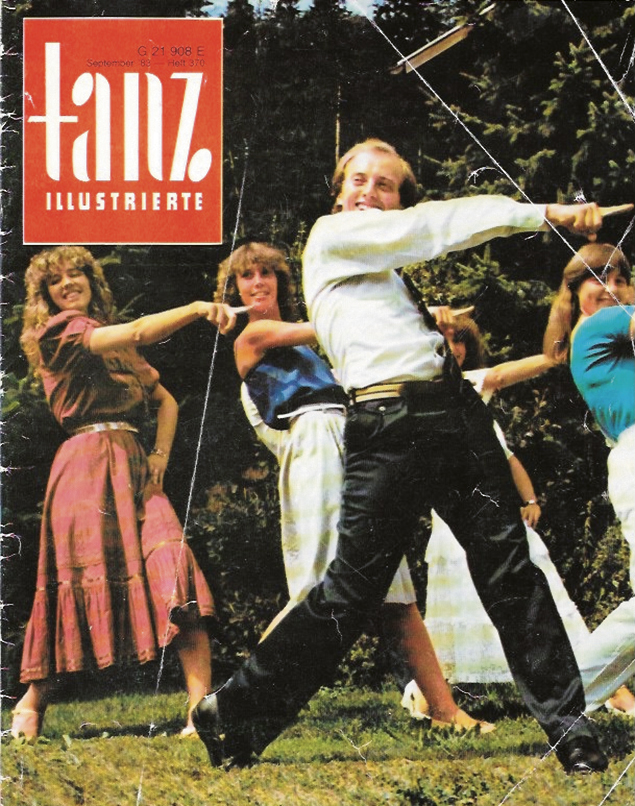
“I really didn’t want to do it. I’m not a disco dancer. But I got the gig. I went all over Germany from school to school. I did this for three years, three months at a time.
“And that is the first part of the show, the experience I had. I met many wonderful people there, but also had experiences that were not nice.”
In 2017 Mr. Hyman visited close friends in Freiberg. The Nazis attacked and burned its main synagogue in that Black Forest city in 1938. In 2016, the town council decided to remove the stone block remains of the building, which had served as memorial to the building — and to the community. The council replaced it with a memorial pool.
“It was supposed to be like the 9/11 memorial, very respectful,” Mr. Hyman said. “But there were no signs saying what it was. It was just a big gray slab in the middle of the city. They didn’t put signs there saying what it was.
“Freiberg is one of the hottest cities in Germany,” he continued. By the time he got there, town residents had begun using the memorial as a wading pool. “I was enraged,” he said. “I knew I had to do something, but I didn’t know what.
“But I thought, ‘Okay. I’m a dancer. I’m going to go in the pool.’ I put my yarmulke and tallis on, and for 3 1/2 hours for three days in the summer heat I danced in the pool as a Jew.
“That’s what the second part of the piece is about. How it changed what happened there.”
Reaction was mixed. One elderly woman said she was a child when it happened, thought that what happened was terrible, and thanked Mr. Hyman for his performance. A man started screaming at him that all religious buildings should be burned down, that they were the cause of all evil in the world.
Mr. Hyman’s actions raised awareness. Several weeks after he returned home, 100 people held hands around the pool in silent vigil. Eventually, the town put up some signs. (They’ve since been removed.)
“The new mayor wrote me a letter, saying, ‘Yes, we realize this is a problem and we will try to fix it.’ Looking back to that time, I knew I had to do something. I was watching this party on top of the half-excavated ruins of the synagogue.
“I’m a dancer. So I did that.”
“Dancing Into Roses” is so named because “the rose is a mystical symbol of love and purity, particularly in Jewish and Islamic mysticism,” Mr. Hyman said. There are several references to roses in the show, including one to “the legendary dancer Vaslav Nijinsky in his most iconic role, ‘Spectre de la Rose’ — ‘The Spirit of the Rose.’ For me, this was the absolute ideal of what a dancer could be, and what as a 16-year-old ballet student I wanted to be.”
Another, very different reference to roses comes in the second act, “when I am in Germany and I learn for the first time of the White Rose, which was an underground resistance group in Nazi Germany founded by five non-Jewish young people who risked their lives to speak out against the atrocities going on.”
All this combines into “Dancing Into Roses,” which premieres on October 23 and runs through November 1 at Jack, 22 Putnam St. in Brooklyn. Tickets are at zeffy.com/en-US/ticketing/dancing-into-roses