

Nachamu, nachamu, ami

Years ago, my daughter Miriam and her friend Rachel, both Ramahniks, sat at Shabbat dinner at our house and sang a version of Nachamu that they’d learned at camp.
The sweetness of that melody, the purity of the teenage voices singing it, and the comfort of those words have lived inside me ever since then.
I can’t give you the melody — this is a visual medium, not an aural one, and anyway I can’t sing — but I can tell you that it fit the words entirely. (As I discovered through a happy trip through the rabbit hole of Nachamu on Google, there are many lovely versions of Nachamu. Miriam and Rachel’s, I learned, is from Safam.)
Get The Jewish Standard Newsletter by email and never miss our top stories Free Sign Up
And the words — Nachamu, nachamu, ami; nachamu nachamu yomar Elohechem — Comfort, comfort, my people, says your God — from Isaiah 40:1, the start of the haftarah on Shabbat Nachamu, the Shabbat after the desolation of Tisha B’Av, and the gradual move up from the ashes — are a balm now, as they have been over the millennia of our existence.
We can use comfort now. The world is not doing well right now, and neither are we, as a people. It’s not great to be a Jew right now.
But wait. I type that, and I think whaaat? It is infinitely better than it has been over most of our history; it’s just not as good now as it was, say, 15 or 20 years ago. But everything is relative.
So what about being open to the marvels all around us? It’s a good antidote to despair — it shouldn’t keep us from advocacy or activism, but it’s a great way to recharge. So here’s an everyday (sort of) marvel.
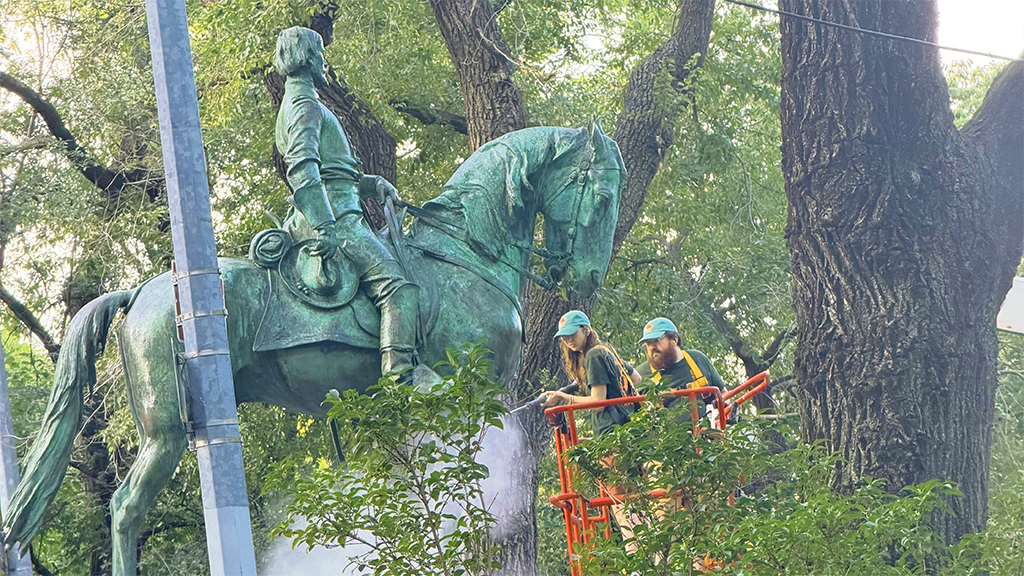
There’s a way-more-than-lifesize sculpture of a man on a horse at 106th Street and Riverside Drive in Manhattan. He’s on a plinth, on a hill, and he stares out over the river. He’s been there roughly forever, so I hadn’t bothered to learn this, but now I know he’s Franz Sigel, a German-born writer, educator, and Civil War general. (He fought for the North.) He adds a kind of balance and seriousness to the stone and green around him.
This week, he’s been cleaned.
Crews of city workers, standing on red lifts that at times have them level with the tops of the massive trees, wielding huge snake-like hoses that end in terrifying long nozzles, sprayed water at him. Later, they polished him. I don’t know why it’s so fascinating to stand and watch this work, both large-scale and painstaking, but it is. And I take comfort in the presence of the statue, and the workers, and the hoses, and the care, and the beauty.
Nachamu, nachamu, ami. Look for comfort. It’s all around us. And it gives us strength.
—JP