

Being Jewish, there and here
British actor, a star in ‘Giant,’ compares London to New York
Elliot Levey loves New York.
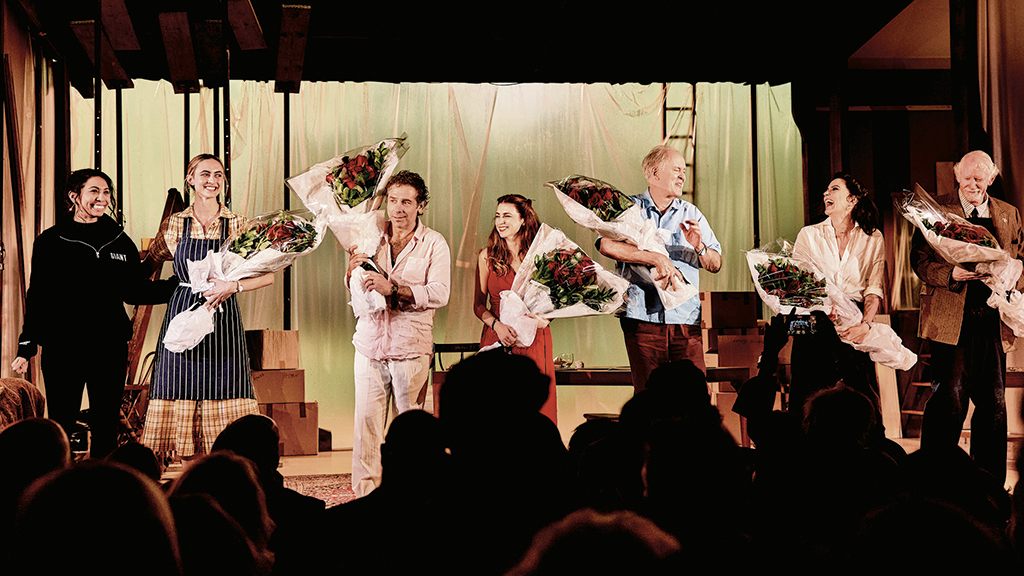
Mr. Levey, a Brit, is in the United States now; he’s appearing on Broadway in “Giant.” The rapturously reviewed drama stars John Lithgow as Roald Dahl and Levey as Tom Maschler, his British publisher. It is a fiction based on real people and a real event.
Maschler, who died in 2020, when he was 87, spent four decades at the prestigious British publishing house Jonathan Cape, where he became publisher and editorial director. Philip Roth, Kurt Vonnegut, and Doris Lessing, were among his authors.
Dahl, who died in 1990, when he was 74, was the frequently mean-spirited, difficult-to-work-with author of beloved children’s classics, including “Charlie and the Chocolate Factory” and “James and the Giant Peach.” In 1983, he reviewed “God Cried,” a book about the 1982 Lebanon War. In his review, he described Jews as a people who “switched so rapidly from victims to barbarous murderers.”
The United States, he said in the review, was “so utterly dominated by the great Jewish financial institutions” that it “dare not defy Israel.” And if that was insufficient to confirm his antisemitic bona fides, in a magazine interview shortly thereafter, he said “there is a trait in the Jewish character that does provoke animosity … even a stinker like Hitler didn’t pick on them for no reason.”
In the play, Maschler and Jessie Stone (Aya Cash), a representative of his American publisher, attempt to get Dahl to issue a statement that might tamp down the controversy his words engendered.
Last month, “Giant” moved to New York from London, where it, Lithgow, and Levey justifiably won Laurence Olivier Awards, the British Tonys. So I started our Zoom conversation by asking what the differences were for him between playing the role there and here. For one thing, Mr. Levey, 53, notes, it’s less lonely here. “It’s a numbers thing,” he said. “You know Britain has a tiny, dwindling Jewish population. Historically we have punched above our weight, but we’re dwindling. Because of that, the experience of being a Jew is heightened.”
By that he means you are more likely to have “Jewish” as part of your identity there — a Jewish actor; a Jewish accountant, or a Jewish plumber — than you are in the United States.
“It’s neither a positive or a negative,” he continued. “But I’ve noticed walking your magic streets that I’m surrounded by people who look a bit like me. I leave the show and honestly, it’s feels like it did at my bar mitzvah. Everybody mobs me.
“I have this sensational walk from the Music Box theater to my apartment, and every night I have these great theatrical conversations with people who’ve stopped me. Or I’ve stood at the sidewalk waiting for the light to change and I hear someone say, ‘Really? What? He would just sit there and take that?’’
They are referring, of course, to the antisemitic insults Dahl throws at his two visitors. “I go, ‘Are you talking about me?’ And then it’s just kisses all around.
“I’m not saying everyone is Jewish, but it feels like that’s true. And I can’t tell you how I get giddy. Yes, we have a Jewish community at home, and yes, it is tight knit and it’s beautiful. But we’re rarity. And to walk home every night on these unseasonably warm New York evenings, honestly, it brings a tear to my eyes.
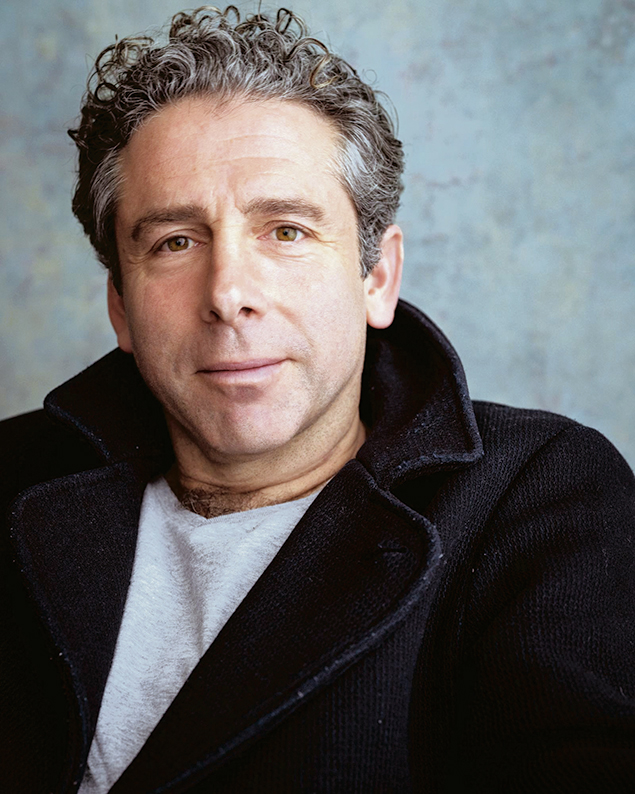
“I want to move here. I want to live here. You’ve got numbers. You’ve got confidence. You’re born into a city where you are not cowering. You feel free.
“It’s a very loose way to say can I come live here?”
Many people, he said, feel that the piece is playwright Mark Rosenblatt’s response to October 7. In fact, the play was finished on October 5, 2023, two days before the massacre. Mr. Levey remembers his reaction when he first read the script. He’d known Rosenblatt more as a director than as a playwright. “He’s a fine director,” he said. “I worked with him briefly years ago. So my critical bar was sky high. I went, ‘Come on, Mark Rosenblatt, let’s see what you got.’
“And then you turn the page and you go, ‘Holy shit. The guy’s brilliant. He’s really brilliant.’ And there were no two ways about it. It was the best thing I’d read in bloody years.”
But, I wonder, does Mr. Levey like his character, a Jew who doesn’t stand up for his people, in part it seems because he doesn’t want to risk losing a best-selling author to a competitor?
“Mark has written a Tom who is different from the real Tom,” Mr. Levey said. “Do I like him? I think the first rule of acting is that you are not allowed to judge your character. I think if you judge your character, you’re in trouble.”
Certainly, Mr. Levey is familiar with the Tom type, “Jews of that generation, long gone now, who, like my ancestors, ended up on the wrong side of the Atlantic. They couldn’t afford passage to New York. They ended up in Britain at the height of the empire and became this sort of crazed breed of super Englishmen.
“They dropped their Yiddish. They talked posh. They played cricket. They acted the Englishman.”
He uses playwright Harold Pinter as an example. “I knew Harold Pinter. He had this old English voice. He talked like he was Lord Pinter from whatever, married to the great Lady Antonia Fraser, but after a couple of whiskeys he was Harry Pinter again.”
Getting back to Maschler, “Tom was the guy who flew to America, made friends with Joseph Heller, and bought the rights to what became ‘Catch-22’ for like the money he had in his pocket, and without telling Heller changed the title of the book to ‘Catch-22.’ It was originally titled ‘Catch-18, ‘but the bosses at Jonathan Cape,” his publishing company, “had just commissioned a book called ‘Stalag 18’” — actually Leon Uris’s “Mila 18” — “or something
“He was a wunderkind, a force of nature, and he made the careers of a roster of British writers who were all swept up by Maschler. So do I like him? I’m in awe of him. Do I like his views on being a Jew? I don’t know.”
Unlike Pinter and perhaps Maschler, Mr. Levey is keenly aware of his roots. In fact, he mentioned them in his acceptance speech for his 2022 Olivier win for playing Herr Schultz in “Cabaret.” Mr. Levey’s grandfather, Elia Zivatovski, sought asylum in Britain, fleeing pogroms in Ukraine.
When he arrived, he didn’t want anyone to know he was Jewish, so, as the celebrity-filled audience at Royal Albert Hall discovered to its amusement, Mr. Zivatovski changed his name to Levey.
“Maybe because I am the grandson of an asylum seeker, when I think of migrants, of asylum seekers, or refugees, I don’t know about you, but I just think, ‘welcome,’” Elliot Levey said.
Three years ago, that statement was greeted by enthusiastic applause. Today, who knows?
“When I first did ‘Giant’ at the Royal Court, great friends of mine, non-Jews, would see the play and then, invariably, three days later, I’d get a text saying ‘Are you free? Let’s walk the dog.’ It was a euphemism. They just wanted to talk.
“They wanted to talk about Gaza. They wanted to talk about Israel. They wanted to know what a liberal Jew feels about this. They just wanted to know from my perspective, because I was their Jew. I was their Jewish friend.
“That doesn’t happen anymore, because minds are made up. Nobody gives a shit what Elliot Levey or anybody else thinks, because after 2 1/2 years the glory days of people wanting to know are over. The opportunity is gone. As a result, I’m very happy to be in New York, where minds are more open.”
Another reason is family. Grandpa Elia was accompanied by an older brother, who made it to the States — Atlantic City, Mr. Levey believes — and changed his name to Charles Schneider. The family lost touch.
“We don’t know where he is,” Mr. Levey said. “Over the next 12 weeks, I’m going to search for Charles Schneider. If anyone has an ancestor, a grandfather, called Charlie Schneider, can you please get in touch with me at the Music Box Theater, because you’re my cousins.”
Mr. Levey grew up in an observant family in Leeds, which at the time had a significant Jewish population. “I was at one point personally quite Orthodox,” he said. “I wore tzitzit. I wore a kippah. Bloody hell, I used to read the Talmud for fun. But I was a strange little boy.”
He attended Clifton College, a public secondary school — what we call a private high school — which had a special house — i.e, dorm — for “Englishmen of Hebraic descent.” There was a shul in the house. Kosher food was served there. And because of his childhood training, young Elliot served as the group’s unofficial rabbi, in charge of running services.
Mr. Levey has fallen a bit away from strict observance. But, he adds quickly, “if I win a Tony, I might have a word with Him.”