

Bamboo as a Jewish value
Two recent high-school graduates sell sustainable utensils online
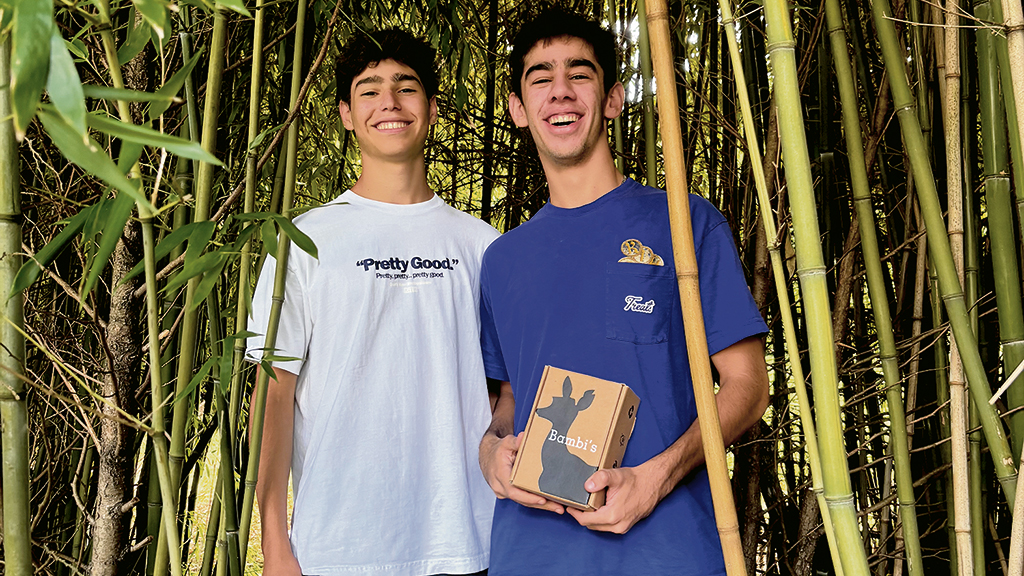
Two Bergen County 18-year-olds have parlayed their Jewish values into a sustainable online business selling premium disposable bamboo utensils as an alternative to plastic.
On August 20, Jonathan Serur of Englewood and Victor Moche of Tenafly launched Bambi’s after spending months developing their branding, website, and product.
Jonathan told the brand’s origin story. “On a trip to Japan, I was walking with my uncle in a bamboo forest. My uncle said he’d started using a bamboo toothbrush, and I thought, ‘What other plastic items can we substitute with bamboo?’ Later, at a restaurant, we were given disposable plastic utensils — and I realized what we could do.”
Bamboo, he learned, takes just six months to grow. Products made of bamboo take 120 to 180 days to decompose in a composter, whereas plastic takes hundreds of years to do the same.
After returning home from Japan, Jonathan called a few friends and asked who would like to work with him on setting up an online bamboo disposables shop. Victor enthusiastically came aboard.
“Victor is one my closest childhood friends,” Jonathan said. “He’s one of the nicest people I know, and I knew I could trust him. And we both shared the same mission.”
Jonathan graduated from Solomon Schechter of Bergen County in New Milford and SAR High School in Riverdale. He soon will start his freshman year at Rutgers, where he plans to major in business or finance. His parents, Anna and David, are physicians.
“My siblings help out with the business here and there,” he said, giving credit to David, 32, for “general life advice”; Leah, 22, and Avital, 20, for design consulting; and Dalia, 15, for her social media insights.
“I’ve run businesses from a young age,” Jonathan explained. “I’ve resold sneakers and traded crypto, but this is the first time I’ve connected to my mission of sustainability and environmental responsibility.

He considers hard work “part of my DNA. My father’s father moved to Israel on camelback from Lebanon around the time of the establishment of the state. He and my grandmother came to America with almost nothing, and through grit and resilience supported a family of five.”
Victor, a graduate of Ramaz Lower and Upper School in Manhattan, will begin his freshman year at the University of Miami in the fall.
Needing a modest $10,000 or so to get started, the young partners raised capital by contacting everyone they knew and selling a percentage of their business to help fund the first order of 1,000 units from the supplier they chose in China. They turned to ChatGPT and YouTube to learn about running an online business, including marketing strategies such as influencer partnerships.
To be sure, Bambi’s is not the only place people can buy bamboo cutlery.
“What sets us apart is the amount of thought and detail that went into creating our brand,” Jonathan said. “It’s not just an ecofriendly alternative but a brand people will be proud to use because we focus on design as well as utility. Every decision from packaging to logo was intentional. We want to prove sustainable products don’t have to look plain.
“The product looks good, feels great, and tastes clean; a lot of other bamboo cutlery brands have a raw woody aftertaste, and we made sure ours didn’t. We achieved that through a lot of back and forth with our supplier, ordering samples and asking for changes until we were satisfied with the final product.”
For the logo, they chose a fawn to evoke the classic Disney animal character Bambi, whose name sounds similar to “bamboo.”
Jonathan said he hopes Jewish customers will consider ordering Bambi’s for the upcoming Jewish holidays, “especially Sukkot, when you’re entertaining outdoors. It’s elegant while saving you from piles of dishes. Bamboo is slightly more expensive than wood or plastic, but the premium branding will make people proud to use it.”
He added that the mission driving Bambi’s forward is deeply inspired by Torah values including bal tashchit (not wasting anything useful), tikkun olam (repairing the world), derech eretz (ethical conduct), and chesed (lovingkindness).
“Judaism shaped how I think about responsibility, personally and communally,” he said. “Growing up, being taught these values, I understood that it’s not just about profit but about impact. Focusing on sustainability or donating a portion of profits are small actions that ripple outwards.
“We’re proud to be building something from the ground up that reflects Jewish ethics while addressing a global issue.”
Bambi’s ships free to customers in the United States; free international shipping is not yet available but is expected to debut in a few months. The company website is bambis.store