

You are the son of my uncle
A rabbi muses on a hug and interfaith relations
The New Jersey State Board Ancient Order of Hibernians, an Irish-American Catholic fraternal organization dedicated to friendship, unity, and Christian charity, asked me to speak at St. Philip the Apostle Church on October 18.
The group was honoring the 250th anniversary of liberty, unity, and the enduring spirit of our nation — that is, the 250th anniversary of the United States of America — as well as the four chaplains who with selfless courage and unwavering faith gave their lives in service to others, and 25 people who exemplify service, faith, and commitment to building a stronger, more united community.
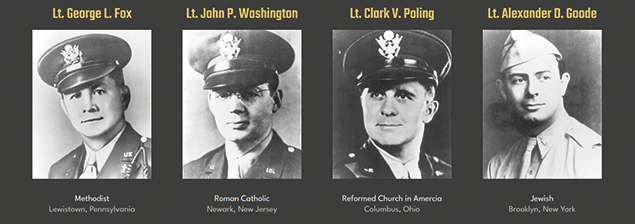
One of those chaplains was a rabbi, two were Protestant ministers, and one was a Roman Catholic priest. I was asked to speak about the rabbi, Lt. Alexander D. Goode.
This is the story. On February 3, 1943, at 1:55 a.m., the U.S. Army transport ship SS Dorchester was torpedoed by a German submarine off the coast of Greenland. The ship lost all power and began sinking.
The four chaplains worked together to calm the panic, guide men to safety, and hand out emergency supplies. When the supply of life jackets on board ran out, the four chaplains removed their own life vests and handed them to terrified soldiers.
As the ship slipped beneath the waves, survivors in nearby lifeboats last saw the four chaplains linked arm in arm on the deck, praying and singing hymns together in English, Hebrew, and Latin.
Out of 902 men aboard, only 230 survived.
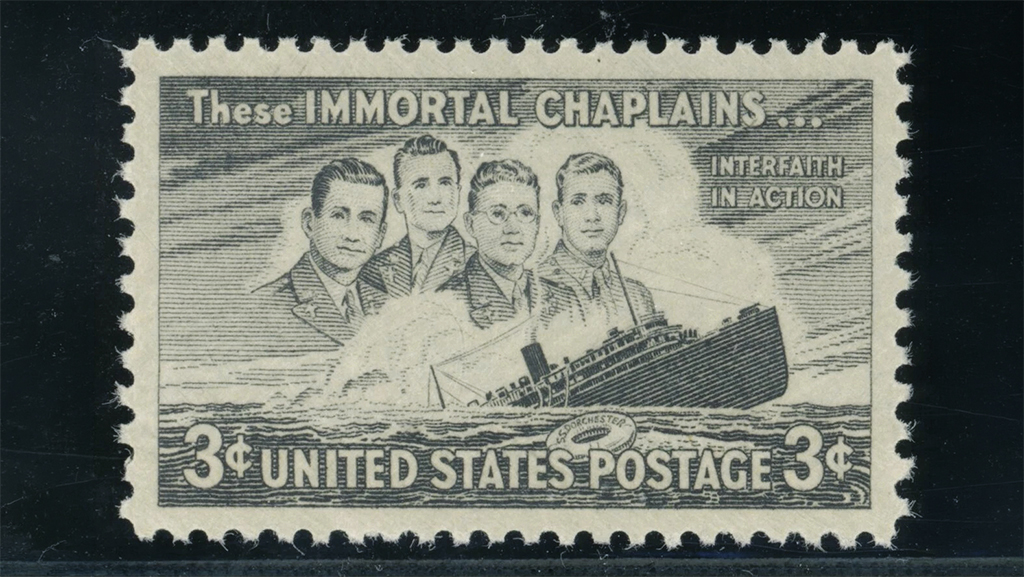
In 1948, the United States Post Office issued a three-cent stamp to honor the chaplains. Over a drawing of the four men and the boat on which they drowned are the words “These IMMORTAL CHAPLAINS”; off to the right it says “INTERFAITH IN ACTION.”
You can read about the chaplains and their heroism online at fourchaplains.org.
Back in Clifton, when the ceremony ended, an imam who had been sitting in the second row, came over to me, shook my hand, and thanked me for my words. (His accent sounded like he was from the Middle East).
I smiled and said, in my limited Arabic, “hal’ant Misri?” Are you Egyptian? He smiled — “ana Filastiniun” — “I am Palestinian” — he said.
Oh, I replied “enteh ib’n amhi”—”you are the son of my uncle!” “No, we are brothers,” he said, gave me a huge hug, asked that I visit him in his mosque on Broadway in Paterson, and walked away.
All I could think about, and what made me write this article, was that when Abraham died, Isaac and Ishmael came together to bury their father. It kept me thinking about the few moments I spent with the imam because the Torah gives us a remarkable moment that invites us to ask whether reconciliation is possible, even after years of family division.
The two half-brothers’ lives had been marked by separation, jealousy, and family pain.
Ishmael had been sent away. Isaac had grown up as the chosen heir. Yet when Abraham died, the two brothers stood together. The Torah doesn’t give us a speech about reconciliation. It tells us that they buried their father together. It’s as simple as that — or is it?
We know that the brothers came together, but we have no idea if they reconciled. That’s a big part of what makes the imam’s words so powerful.
Ishmael was Abraham’s firstborn son, born to Hagar. Isaac later was born to Sarah, and Sarah demanded that Abraham send Hagar and Ishmael away. Abraham, although deeply distressed, eventually sent them into the wilderness.
The brothers grew up apart. They had different mothers, different experiences, and very different places in the family story. And now, years later, their father dies, and Isaac and Ishmael come together to bury him.
Even though the imam embraced me as his brother, we don’t know if Isaac and Ishmael embraced, if they apologized, if they spoke about the past, or even if the old wounds were healed.
Maybe Abraham’s death reminded them that despite everything that had separated them, they shared something that could never be taken away. They were brothers.
I’d love to think that this was some sort of reconciliation, but there’s nothing in the Torah about them becoming close or their differences magically disappearing.
I’m sure that reconciliation doesn’t always begin with agreement, but a willingness to stand together could be — or should be — a good start.
Think about this — they could have stayed apart and let old grievances determine what happened next, but they didn’t. They came together to honor the man who was father to them both; two brothers, divided by history, standing together at their father’s grave. I don’t believe this is reconciliation, but it certainly can be its beginning.
We can’t undo the past. We can’t erase injuries, disappointments, or years of separation. But we can decide whether those things will define every moment of our future.
Let me explain the words “enteh ib’n amh”i — you are the son of my uncle. I had a pain management doctor many years ago whose nurse practitioner was a Palestinian woman. Whenever I was in the office, I would always say enteh b’int — you are the daughter of — instead of ib’n — son of. We don’t say the daughter of my aunt because neither Sarah nor Hagar were ancestors of both Isaac and Ishmael; Abraham, as he is known to Sarah’s descendants, or Ibrahim, as Hagar’s descendants call him, was.
The generations of both Isaac and Ishmael are cousins, the sons and daughters of each other’s uncles.
Not all our cousins hate us, not all our cousins want to see us slaughtered, and if you don’t think that peace (in my opinion not peace at any price) can make a huge difference, look again.
What would it take for us to take that first step — which is exactly what the imam did that Sunday afternoon?
There certainly aren’t any promises that every broken relationship can be repaired, but the possibility of coming together should never be abandoned. Sometimes the first step toward reconciliation is simply showing up, and sometimes that first step is the beginning of a legacy.
From Pirkei Avot — the Ethics of our Fathers — we are told “Lo alecha hamlacha ligmor, v’lo ata ben chorin libatel mimena” — “It is not incumbent upon you to finish the work, but neither are you free to desist from it.”
This is one of Judaism’s most beautiful teachings about responsibility. We aren’t required to complete the work — we’re required to participate in it. We may not achieve peace, but we must work for peace. We may not eliminate suffering, but we must relieve suffering wherever we can.
I think that the lesson in those beautiful words is that we aren’t judged by what we accomplish, but by whether we had the courage to begin and the commitment to continue.
The melody that Rabbi Dan Freedlander and Cantor Jeff Klepper put to that phrase ring in my ears, and so do the words of Rabbi Nachman of Breslov:
Kol ha’olam kulo, gesher tzar me’od. Veha’ikar, veha’ikar, Lo lifached k’lal.
The whole world is a very narrow bridge. And the main thing, the main thing, is to have no fear at all
May we and all our cousins have the courage to walk across that bridge, meet in the middle, and come to a point that will rekindle the possibility of reconciliation.
God willing, im yertzah HaShem, Inshallah!!
Rabbi/Cantor Lenny Mandel of West Orange is the spiritual leader of Congregation B’nai Israel in Emerson.