

‘Think higher, feel deeper’
A look at Elie Wiesel, in person and in a new documentary
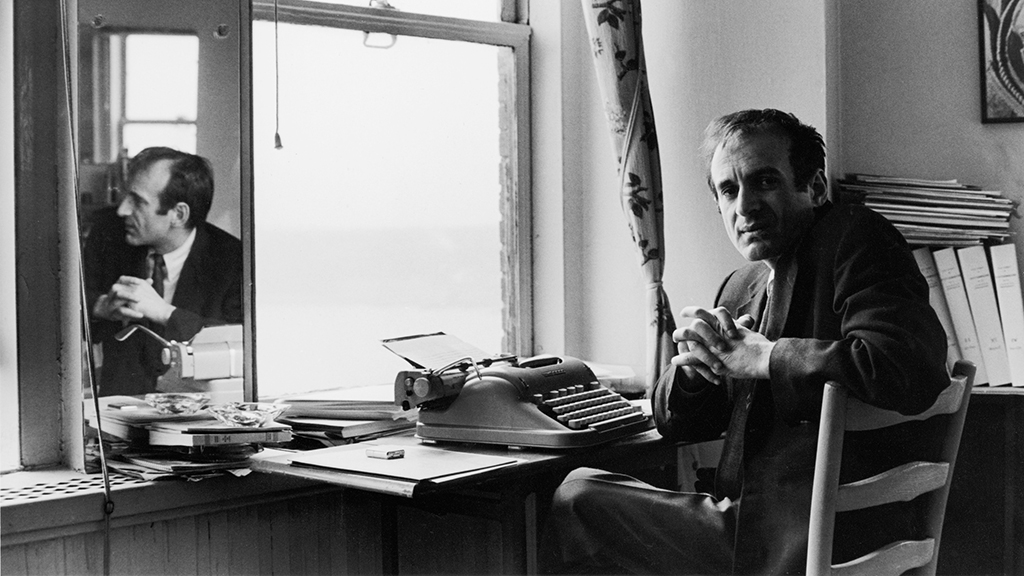
I remember the first time I met Elie Wiesel.
It was in his office on the Upper East Side of Manhattan. I tried to take it all in. The decor. What he was wearing. How quietly he spoke. But I couldn’t stop looking at his eyes. They were large, dark, and very, very sad.
Later I discovered I wasn’t the only one who noticed the aura of sadness that seemed to permeate him. A colleague remembered the first time he’d spotted Wiesel, years earlier, at a symposium. He saw someone who looked a lot like Elie.
“A lot?” he said. “He looked just like him. But then I thought it couldn’t be him. That man is smiling.”
Mr. Wiesel was well aware of his reputation for sadness but felt it inaccurate. “I’m not at all sad,” he told me back then. “My lectures” — he taught at Boston University — “are full of laughs. People laugh and laugh and laugh. I like humor.”
And that was what I found so incomprehensible. How could anyone who’d gone through what he did — the camps, the loss of family members — ever laugh? How could he not hate?
“Hate is destructive, even as a concept,” he said. “Good works of art can come out of anger. But nothing comes out of hate.”
It occurred to me that anyone who could be so forgiving was truly a righteous person. “I am not a tzaddik,” he said. “A tzaddik is a just man. I am just a student, a very good student. I would refuse [the title of tzaddik]. There is a tzaddik inside every one of us. You as well as I.”
I was reminded of all this watching “Elie Wiesel: Soul on Fire,” Oren Rudavsky’s comprehensive and timely documentary about Mr. Wiesel’s remarkable life. It opens in New York on September 5.

It came about when a mutual friend introduced Mr. Rudavsky to Elie’s widow, Marion (who died earlier this year), and their son, Elisha. “They’d been looking for a filmmaker to tell their and Elie’s story,” Mr. Rudavsky said in a Zoom interview. He certainly had the background for the job.
In addition to a wide range of films on general topics, Mr. Rudavsky’s resume is replete with documentaries that have Jewish themes. “Spark Among the Ashes: A Bar Mitzvah in Poland,” the Emmy-nominated “A Life Apart,” about chasidim, and “Saying Kaddish” are just three among many.
Mr. Rudavsky also had personal credentials. He is the son of a Brooklyn-born Reform rabbi, Benjamin Rudavsky, and Malka, whose Orthodox family emigrated from Poland in 1932. Rabbi Rudavsky was a Hillel rabbi at several colleges and then settled in Brookline, Mass., where he led Temple Sinai.
Mr. Rudavsky started making films with friends around the time of his bar mitzvah. But growing up in “a house where social issues were important,” he thought he’d become a lawyer. Until, that is, “I realized very quickly that I didn’t have the kind of tenacity to study all those law books.”
Still, Marion and Elisha Wiesel were impressed enough to decide to collaborate with Mr. Rudavsky. Once details were worked out — giving Mr. Rudavsky full access and editorial freedom — he set about interviewing the family and others who knew Elie Wiesel.
Mr. Rudavsky opens his film with Mr. Wiesel reading from sections of his memoirs, his stories a voiceover for appropriately stark animation. “He’s recounting his memories of his arrival at Auschwitz and the forced march to Buchenwald, and the memory of the first time he saw himself in a mirror,” Mr. Rudavsky said.
“What were most compelling to me were the dreams that he interspersed throughout his writing. So several of the animations are from the dreams that were very much connected to his family, to his younger sister, who died in those first moments in Auschwitz and to his father and mother. The dreams are about encountering and reconnecting to his father, whom he could not save.”
“In my dream, he was alive,” Mr. Wiesel said. “My mother, too. In my dream.”
Using archival footage and interviews, “Soul on Fire” goes on to chronicle a life well lived speaking truth to power. To Ronald Reagan, about to visit a German cemetery that included the graves of SS murderers, Mr. Wiesel said, “Mr. President, this is not your place.” He urged President Clinton to intercede in Bosnia. He gave voice to the voiceless in Ethiopia, Cambodia, Nicaragua and elsewhere.
And it wasn’t just meetings with presidents and bigwigs. “I interviewed a lot of people who told me about their one-on-one encounters with Elie as students. Even though the meetings were short, he made sure to see all his students. He also made sure he or someone else wrote back to all the kids who wrote him letters after reading ‘Night,’ his memoir about surviving the Holocaust.
“What was most telling about him was that early in his life, he believed that the Messiah would come,” Mr. Rudavsky said. “But later, after all he went through, he said that your most important encounters are one-on-one with other human beings. ‘Connect one-on-one with another human being, that’s the way the Messiah will come,’” he said.
It’s all there in Mr. Rudavsky’s engrossing film, except…
What’s missing is that it doesn’t explain how Elie Wiesel became ELIE WIESEL. Of course, it is also difficult to understand how the Shoah was swept under the carpet for years after the war. Survivors wanted to put it past them, to move beyond it. And the governments that stood by while millions were slaughtered, when they could have, for example, bombed the railroads leading to the camps where they knew people were being murdered or not turned away ships filled with refugees or not denied visas to desperate people — those victors certainly weren’t anxious to discuss their shameful passivity in letting millions die.
Because he attributed his survival to a roll of the cosmic dice, Mr. Wiesel felt the need to give his life purpose. But it took time. A student of the Kabbalah, he knew that words could open the gates of heaven — or hell. “I knew the dangers inherent in words,” he told me then. It took more than a decade after he wrote it for him to publish “Night” in the form we know today. (The first version, written in Yiddish, was much longer.) It came out in France in 1958, and in the United States two years later.
It is a book so dark, so unsparingly honest, so grounded in reality, that some refused — or didn’t want — to believe it. In fact, more than a quarter century later, when reporting about his winning the Nobel Peace Prize, Time magazine wrote, “His first novel, ‘Night,’ was an indelible account of the Nazi atrocities as seen through the eyes of a teenage boy.”
Jews, Roma, gay people, disabled people, and members of other persecuted minorities owe a debt to this man. Without his efforts, what we now call the Holocaust would have been a blip in history.
Despite this one lapse, “Elie Wiesel: Soul on Fire” is an important film, especially at this time in history. “We need a voice like Elie today,” Mr. Rudavsky said. “There’s a need to recognize the humanity in each other. And I think audiences, when they see the film, will recognize that we need that kind of compassionate voice.”
He is probably right, because the film, like its subject, is inspiring and encourages people to do what Mr. Wiesel suggested to Oprah Winfrey: “Whatever you do in life, think higher, feel deeper.”