

‘There’s a place for you here’
As it celebrates its 50th anniversary in Wyckoff, Temple Beth Rishon reflects on its joys and struggles
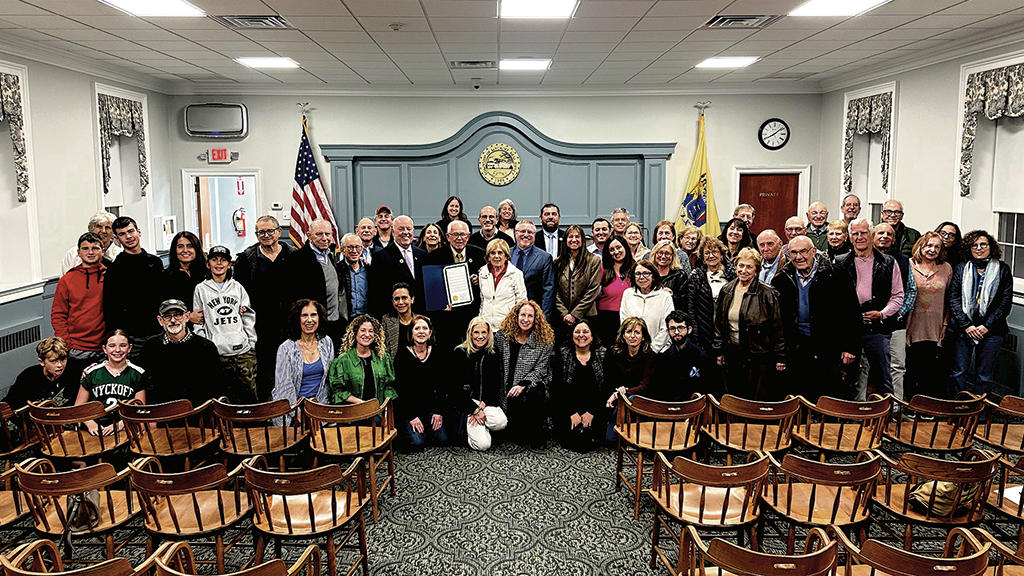
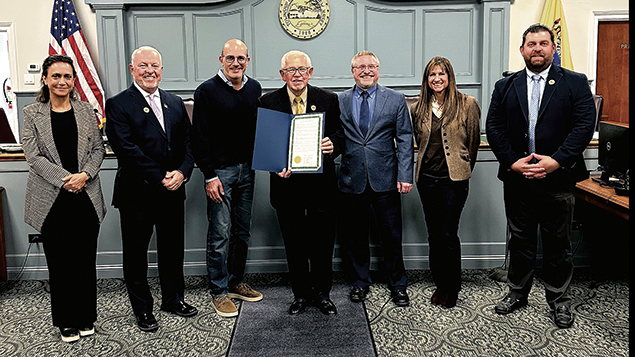
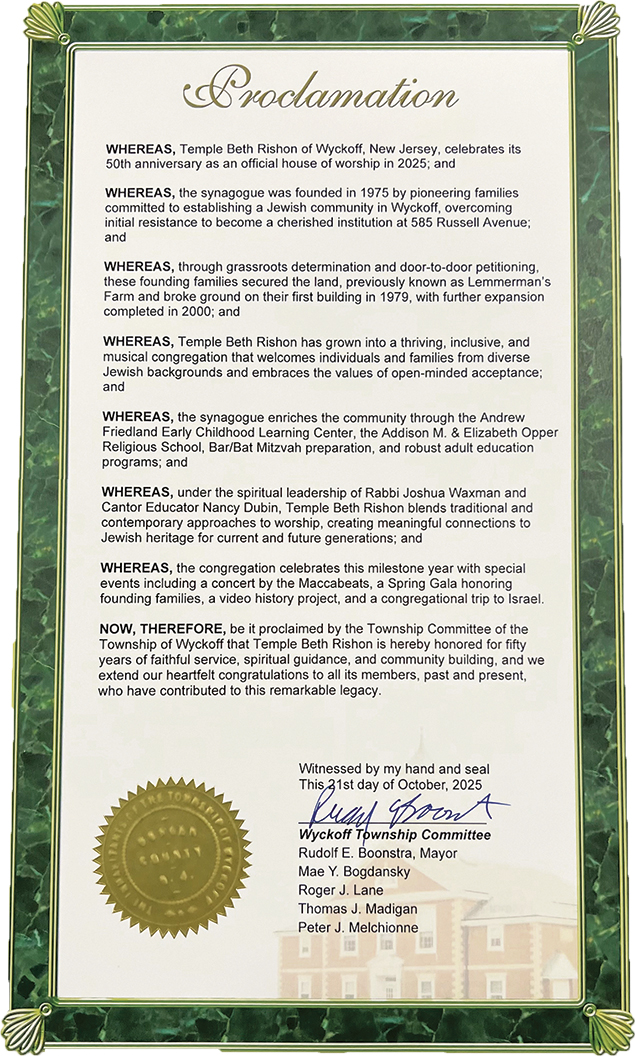
On October 21, 2025, Wyckoff Mayor Rudy Boonstra issued a proclamation commemorating the 50th anniversary of Temple Beth Rishon in Wyckoff.
“The proclamation meant the world to our current membership of 315, our past and present clergy, and our lay leaders, but I think it meant the most to our founding members who were eager to charter a synagogue in 1975,” Elena Greene, a past president of Beth Rishon, said. Five of those members still live locally, she added.
The proclamation and the anniversary were particularly moving to those old-timers because they remember how much resistance the synagogue faced when the founders tried to find a home for it in town. “Back in 1979, it was a hard-fought win to get the approval to build a synagogue in a town of over 10 churches,” Ms. Greene said.
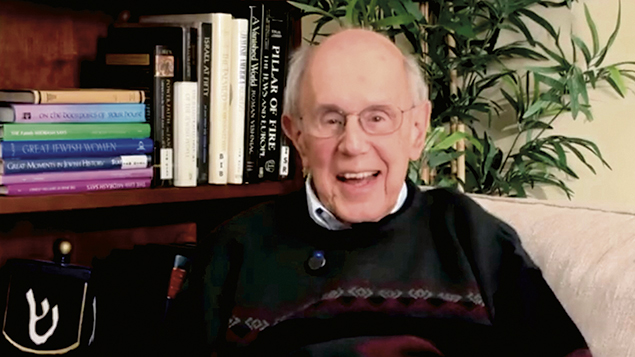
Dr. Ed Friedland, an orthopedist in Paterson, and his wife, Katie, married in 1970, and moved to Wyckoff from Paterson in 1972, before Temple Beth Rishon was created. “A lot of people coming to the area from Paterson were joining the Fair Lawn Jewish Center, but we didn’t want to go back and forth to Fair Lawn,” he said. “We got involved with the Wyckoff-Franklin Lakes Synagogue, an offshoot of the Fair Lawn Jewish Center. There were over a dozen founding members whose intent was to charter a temple in Wyckoff. They had the foresight to know that if we were going to grow and develop a Jewish community in this part of Bergen County, we needed a structure.”
According to Dr. Friedland, the late Martin Piper, an attorney from Paterson who later became a TBR president, was the driving force in getting a synagogue in Wyckoff chartered and built.
The chartering part wasn’t hard. That happened in 1975. But building a home for it was an ordeal.
“First, they needed a piece of land,” Dr. Friedland said. “Second, in order to build a temple, a minimum of five acres was required to build on. And third, since a house of worship was tax-exempt property, they needed the permission of the town to do so.” Mr. Piper thought that Russell Avenue was an ideal location for a synagogue, and at the time, the owners of the 35-acre Lemmerman Farms was ready to sell.
To deal with what it saw as a problem, the township committee decided, by a vote of three to two, to require at least 1,000 feet between the property lines dividing houses of worship. The reason for this new ordinance was because the committee said it feared traffic congestion, the loss of taxable land, and the loss of the neighborhood’s residential character. Wyckoff already was known as the “town of churches,” but if the site plans it was considering were approved, its 16,000 residents would have 14 of them in town.
In a story the Bergen Record ran in March 1978, Mayor James Sheehan was quoted as saying that he voted for the ordinance “in the best interest of Wyckoff with respect to traffic, aesthetics and environment. The issue was one of planning, not religion.”
Martin Piper, who was then the synagogue’s president, called the ordinance “patently indefensible from a constitutional and legal standpoint.” He said he was not asking for the sacrifice of good planning at the expense of the right to pray.
Soon thereafter, the Wyckoff-Franklin Lakes Synagogue members started a petition campaign. “We divided the town into sections and went door to door to the homes of Wyckoff residents to sign petitions in preparation for the second town council vote,” Dr. Friedland said. Clergy at St. Elizabeth’s Catholic Church and St. Nicholas Orthodox Church encouraged their parishioners to sign the petition during their Sunday sermons. Members wrote letters to the editors of local newspapers requesting community support. Channel 5’s local news network, based in New York City, got wind of the campaign. Its broadcast may have swayed enough local residents to sign the petition.
“The swing vote was by Henry McNamara, a committeeman, then the mayor of Wyckoff,” Dr. Friedland said. “He called me into his office and said, “I want to be mayor of the entire town, not just the Christian community.
“The plan was to build on the property sold to us by Lemmerman Farms, but Mayor McNamara apprised us that in order to establish tax-exempt status, we would have to hold a service by October 1, 1979,” he continued. “Considering the primitive nature of our structure, Mayor McNamara said he would give us a conditional certificate of occupancy provided we committed to completing our structure by December 31.
“Power and plumbing were secured, a groundbreaking ceremony was held on April 22, 1979, and the first High Holiday services in the building were held in the fall of that year. Even then, the synagogue was still a work in progress. There were no pews or carpet or heat, no bimah or ark. Folding chairs were used for seating, and members brought in house plants to make what was then an incomplete sanctuary more haimish.
“Art Kramer, a real estate developer and TBR congregant, not only acquired the land the synagogue is built on, but donated his time and money to obtain the various licenses, approvals, and permits required for the temple to be built,” Ms. Greene said. “His role in Beth Rishon’s building was paramount, and he has consulted on every structural component of the temple’s expansion.”
Four years after chartering the synagogue, its leaders changed the name from the Wyckoff-Franklin Lakes Synagogue to Beth Rishon, which means First House in Hebrew. The new name reflected all the congregation had overcome to establish itself as the first Jewish house of worship in Wyckoff.
When Dr. Friedland and his wife joined Beth Rishon, there were 32 members, and an informal group was responsible for finding a temporary space for services. While the building was being constructed, the community met for Friday night services at the Wyckoff Women’s Club; High Holiday services were at the North Haledon fire department. Within the first year, the synagogue attracted new members and grew to about 90 families.
The Addison M. and Elizabeth Opper Religious School, established in 1977, rented space at the Eisenhower Middle School in Wyckoff. The Andrew Friedland Early Childhood Learning Center was established in 1980. “We hired a student rabbi, Robert Fierstein,” Dr. Friedland said. Next, Rabbi Steven Grundfast served from 1976 to 1979; his wife, Judy, played guitar.
“Our membership was half Conservative and half Reform, and no one wanted to budge an inch,” Dr. Friedland recalls.” I knew it would be a balancing act concerning how our congregation observed Judaism. Our ritual then and now is for men to wear kippot and tallisim, and for women to do the same when they had aliyot or were reading Torah. Prayers are in Hebrew, but the service is somewhat pared down from traditional Conservatism.”
When the congregation was formed, it did not turn anyone away who was not halachically Jewish — that is, born to a Jewish mother or properly converted. “The Conservative movement agreed to send us a rabbi, but only if we agreed to extricate members who had not only helped to form our temple, but were not halachically Jewish. As a result, we became unaffiliated in our approach,” Dr. Friedland said.
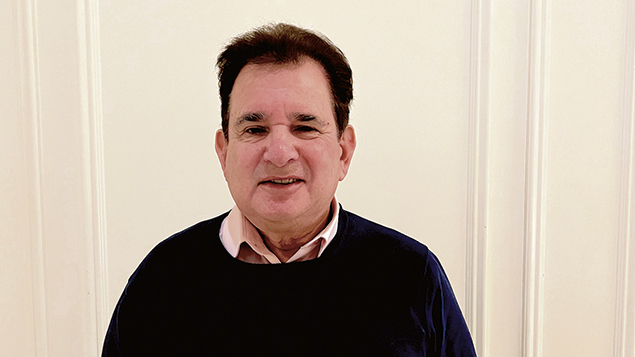
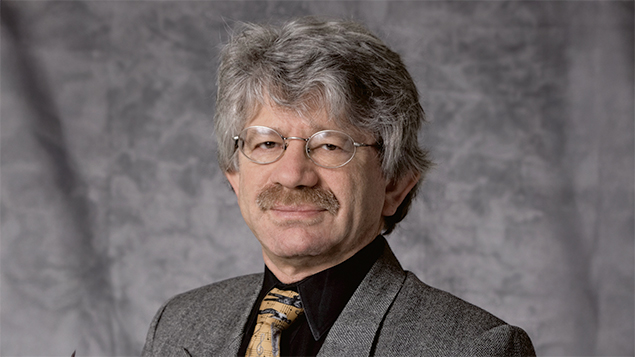
After more than a dozen rabbis briefly led Temple Beth Rishon, the ritual committee hired Rabbi Dr. Kenneth A. Emert in 1995. Rabbi Emert, who was Reform and who Dr. Friedland described as “a rabbi who was well-known for his knowledge of Jewish history and an expert in telling the story of the Jewish people,” was Temple Beth Rishon’s spiritual leader until he retired in 2017. Cantor Ilan Mamber, whom past president Ms. Greene described as a “rock star,” had been hired the year before. He was Beth Rishon’s cantor from 1987 until his sudden death at 70 in 2018.
Rabbi Emert, Cantor Mamber, the late religious school director Michelline Burke, and preschool director Hillary Posner “instilled in us a love of Judaism, a love of learning, a love of our synagogue, and a feeling that what we learned at Temple Beth Rishon would make us all feel comfortable living life as Jews anywhere,” Ms. Greene said.
Part of the fundraising process for the synagogue’s 2002 renovation allowed members to put their names on one of 12 stained-glass panels, each of which depicts a Jewish holiday. Recently, new stained-glass panels, donated by Henry and Elaine Kaufman, were installed. The design is a combination of inspiration that comes from the natural world and Psalm 150.
Rabbi Joshua Waxman, whose background is Reconstructionist, has led TBR since 2021. “In addition to the obstacles our founding members faced, I always emphasize the support of our non-Jewish neighbors in Wyckoff; specifically, church clergymen who went out of their way to make a difference for the Temple Beth Rishon community,” Rabbi Waxman said. “I hope that their unwavering support can inspire our community to think about how we can take a stand and make a difference in the lives of others.”
Rabbi Waxman reflects not only on those who have been dedicated to the TBR community for 50 years, but also new members who, unlike the founders, haven’t had to fight for their rights as Jews. “History is being written with new people,” he said. “The 50th is a landmark,but it’s not an end point. There are new members who are creating the next chapter for our congregation.”
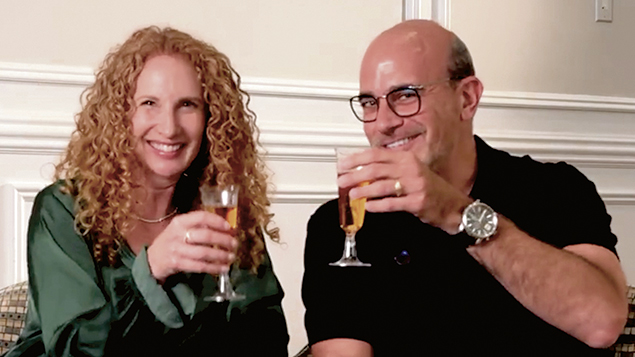
“The synagogue’s board of trustees ranges in age from parents of young families through retirees,” Ms. Greene said “Each has something to offer.”
This fall, Rabbi Waxman and Cantor Nancy Dubin, who has been at TBR for three years, recognized the membership’s spirit of volunteerism in a High Holiday address. Ms. Greene can vouch for that. Even when her children were small, she was at meetings five nights a week as a volunteer, she said.
More than a year ago, at a Lunch & Learn program at the synagogue, a few founding members spoke about the synagogue’s beginnings. As a result of that program, Ms. Greene and co-congregants Mark Niederman and Sharon Glassman produced a documentary to commemorate its 50th year. The goal was to produce a 10-minute video, but the interviews — with founding and early members, past presidents, volunteers, staff, clergy, new members, members who came from shuls that had merged into TBR, current leadership and multi-generational families — turned it into a 90-minute production. “After I listened to interviews, I understood that unless a story is recorded or written down, memories fade and details got lost,” Ms. Greene said. “That’s why we made the movie.”
Temple Beth Rishon celebrated its 50th anniversary at a gala in the synagogue’s ballroom in May. The ad journal was filled with messages of gratitude from members who shared deep respect for the rabbis, cantors, and teachers who guided and supported their children and grandchildren as they learned how to live a Jewish life.
“We’ve become a thriving and welcoming full-service synagogue that offers meaningful and thought-provoking programming,” Ms. Greene said. Dr. Friedland added that throughout the years, Jewish families were attracted to the Wyckoff/Franklin Lakes area. “In the early ’80s, we merged with Temple Beth Sholom in Ramsey and Lakeland Hills Jewish Center in Wanaque, absorbing many of their members,” he said. There are approximately five founding members who remain local and are members of TBR.
 “We are fully egalitarian, welcoming of families of all faiths, backgrounds and upbringings,” Ms. Green said. “If you are Jewish, you are welcome. From Tot Shabbat to Senior Singles, we really try to be fully inclusive, making sure that all of our members feel accepted.” While the early members of TBR were from the Wyckoff area, the synagogue now draws congregants from all over northwest Bergen County.
Dr. Friedland feels that Temple Beth Rishon is fully blended into the framework of Wyckoff. Fifty years later, it is still the only synagogue in town.
In 2008, the year before her daughter became a bat mitzvah, Ms. Greene, who grew up in a Conservative home on Long Island, became an adult bat mitzvah. Her husband, Jeff, who is Temple Beth Rishon’s president now, was raised in a Reform household in Rockland County. They sum up their commitment to TBR in three words: “It’s a feeling.”
Mr. Greene gave a talk at Beth Rishon on the High Holidays this year. This is part of what he said:
“When Elena and I first walked in the doors of TBR, with our three small children in tow, it was a feeling. In the warm embrace of a Friday night regular wishing me Shabbat Shalom or while watching the sun’s glow fading through the stained glass, it’s a feeling. It’s a feeling when I hear our preschool director Hillary’s laugh or listen to the sounds of voices singing our familiar melodies. It’s a feeling of community that members experience, whether in joy and sorrow, that they are surrounded by those in their second home. Whether you grew up coming here, have been a longstanding member, have recently joined us, or are still figuring it out, there’s a place for you here.”