

Songs of the beit midrash
Hadar’s Rabbi Deborah Sacks Mintz will sing in Teaneck
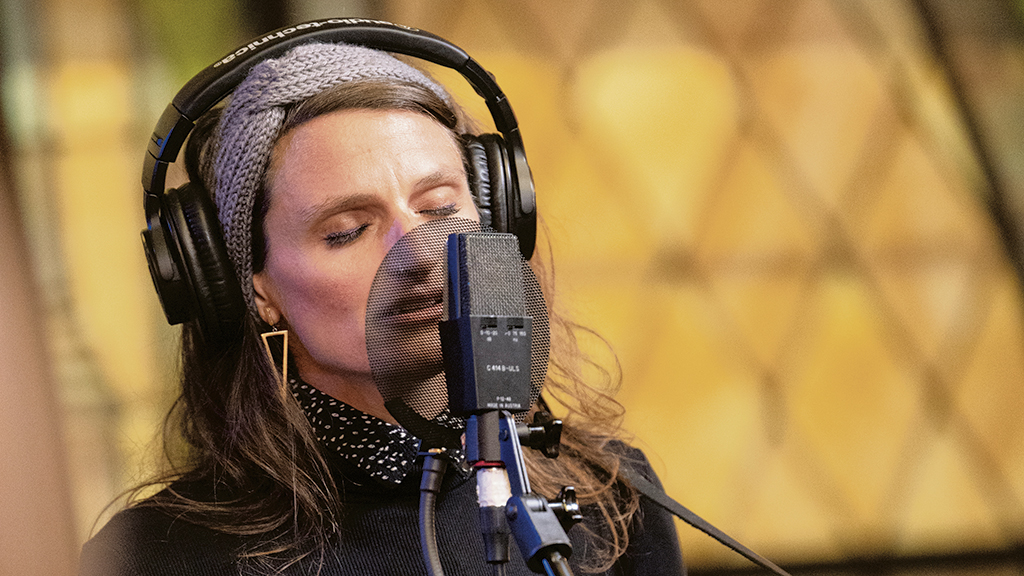
If a beit midrash were music, what would it sound like?
How do you get the sound of voices murmuring, explaining, arguing, digressing, pairs or small groups deep in conversation, deaf to the group right next to them doing the same thing, except hearing the sound below the level of consciousness anyway?
How do you capture the sounds of reverence and irreverence and daily life and intensity and daydreaming?
How do you turn it into music?
Deborah Sacks Mintz has just released a new album, “Songs from the Beit Midrash,” and she’ll perform some of those songs at Congregation Beth Sholom in Teaneck on Thursday, February 19. (See below.)
“It’s a collection of new Jewish music that is inspired by the beit midrash,” the house of study, not a library, where people are solitary, each engrossed in a relationship with the text in front of her, but a place where two people form a trio, the two of them and the text between them, she said.
Rabbi Sacks Mintz talks about her music in ways that are both emotional and intellectual, which seems fitting.
“This album is inspired by the beit midrash, inspired by the relationships built in the beit midrash, inspired by the Torah studied in the beit midrash, and inspired by the creative spiritual possibility of the prayer and the learning and the community building that happens in a beit midrash,” she said.
The name is both metaphoric and literal. Metaphoric in that it is built on the sounds of a beit midrash, and literal in that it actually was recorded in one.
Rabbi Sacks Mintz is the director of tefillah and music at the Hadar Institute, an Upper West Side-based national organization that teaches, researches, and davens with a combination of rigor, spirituality, thoughtfulness, authenticity, creativity, and commitment to gender equality as it works to enhance Jewish life. Hadar’s Rising Song Institute teaches, nourishes, and empowers musicians. It also produces recordings, including “Songs from the Beit Midrash.”
The album has its title “both to reflect the process by which it was collected and the material that’s embedded in it, and the values it reflects,” Rabbi Sacks Mintz said.
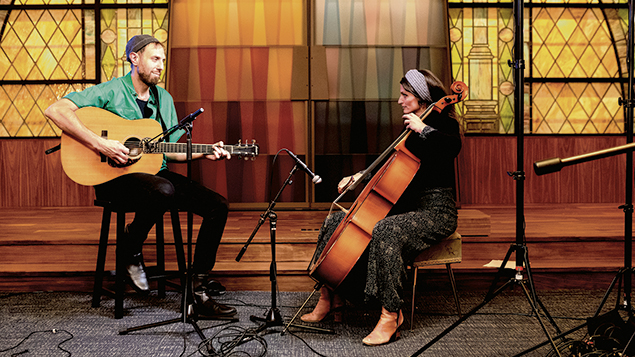
The process entailed “transforming Hadar’s yeshiva space into a recording studio,” she said. Our sound engineer, Don Godwin, is a real master at taking live spaces that are designed for the purpose of daily life and bringing equipment to transform it into a recording studio. He’s done it for nearly all the albums that come out of Rising Song records. We really value turning unused choir lofts or sanctuaries into recording studios and using some of the live energy from that space.
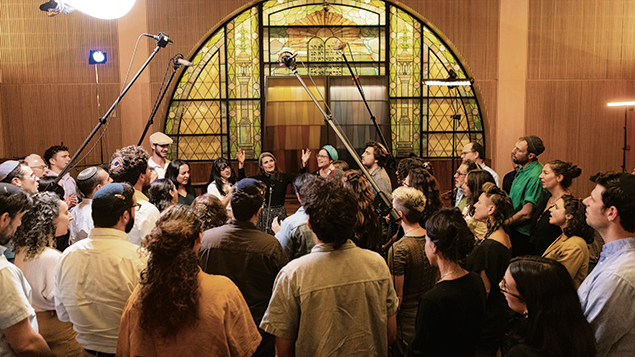
“He sets it up with all the state-of-the-art equipment needed to produce a high-level piece of musical content. We explored the different ways that a physical beit midrash is used in daily life so we could capture those sounds on an album. So, for example, we set up some of the musicians in the center of the room, where the tables might be for learning. We recorded one song gathered around a shtender” — a lectern — “to capture the sounds of people in communal prayer. We brought in an entire large niggun circle to join the band on several songs, to capture the sounds of a room full of people singing and in prayer together.” (A niggun is a wordless, repeated song.)
Most of the songs were “anchored by a small ensemble of musicians,” Rabbi Sacks Mintz said. “There are six of us. On four songs, we had a niggun circle comprised of members of Hadar’s wider singing community — students, faculty, alumni, folks who come to the daily minyan or our weekly niggun circle, friends, and local artists — to capture the soundscape.
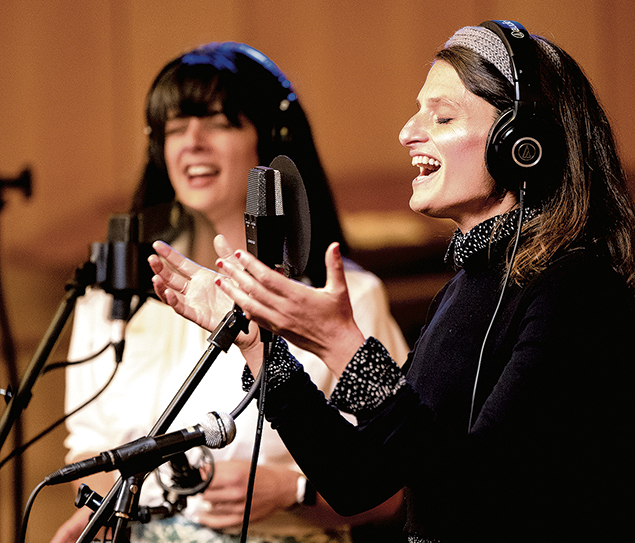
“My vision for this project was that I wanted to put out into the world the sounds that Jews really make, on a daily basis, when they gather together. It is both a way to model what that could sound like at a higher level, and to inspire people to create that sound in their own community.”
That was the process, Rabbi Sacks Mintz said. “The album was created in the beit midrash, and the beit midrash is a main character of the album. The material is very much inspired by the Torah learned in that space, the programs that happen at Hadar, and many of the relationships that have developed in that space. So the songs are a natural product of Hadar’s beit midrash.”
Then there is the material, the old texts and the new music to which they are set. “The core values of a beit midrash really are embedded in this music,” Rabbi Sacks Mintz said. “The core values are learning in partnership, learning in chavruta, learning together rather than alone.”
She wrote some of the songs in chavruta — a learning partnership — with her musical songwriting partner, Yoshi Fruchter, Rabbi Sacks Mintz added.
“And all the music was collaboratively arranged and put together by our six-person band as a real collaborative artistic process. It’s the same kind of collaboration that we see in chavruta, that involves tension and really digging deeply into the material to unearth the hidden creative layers. That’s a core part of this music, and it’s a core part of chavruta learning.
“Another value of the beit midrash is the spiritual creativity that comes out of unearthing layers of text. That is a core part of this music.”
The texts all come from the traditional liturgy, including Tanach when the liturgy quotes it, Rabbi Sacks Mintz said, and “all the songs were designed to bring out different and sometimes surprising meaning in the text that were not necessarily readily seen before. The music is the creative commentary on the texts.”
How does that work? Rabbi Sacks Mintz paused, and then she offered this example. “Yoshi and I co-wrote a melody from a line from Yedid Nefesh,” a poem that’s often sung on Friday nights, often thought of as a love song to God. “The line is ‘Eileh chamda libi, chusa na ve’al na titah’lem.’ It’s a beautiful line that means ‘These are the yearnings, the desires of my heart. Have compassion and don’t turn away from me.’
“So in this beautiful line of poetry there is a statement of vulnerability, followed by a naming of a fear of abandonment. There are two distinct thoughts that also clearly go hand in hand for the poet. But still they are distinct.
“So we wrote a melody that actually has three parts for this two-part text. The first part and the third part are designed to function as a round to lift up a third meaning in the text, which is about what happens when these two thoughts coincide, when the vulnerability of naming it and the fear of abandonment live in our beings together. So the structure of the song is statement one, statement two, and then statement three, which musically integrates the other two.”
In a way, it’s a kind of thesis, antithesis, synthesis, but in music.
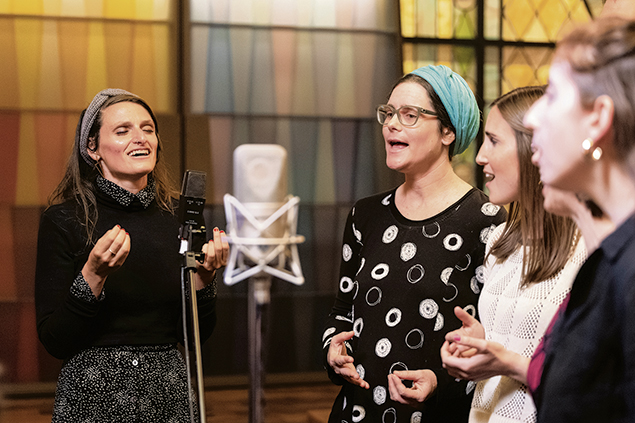
On the record, “the whole band sings the overlapping parts together, to lift up the integration of the two incredibly real and complex human experiences,” she said.
Another song on her record can answer the question about the integration of text and music, she said; oddly, that is the only wordless melody on it.
“The melody is ‘Niggun Chemla Gedola’” the phrase chemla gedola comes from Ahava Rabba, the bracha we say before the Shema in the morning. The phrases ‘ahava rabba’ and ‘chemla gedola’ are somewhat synonymous. Ahava rabba means vast love, and chemla gedola is abundant compassion. They’re two sides of the same coin. Rabba implies vastness or breadth, and gedola implies depth. So we used this to tease out a little bit the spaciousness and breadth of harmonic possibility and musical possibility in the sound of our voices.
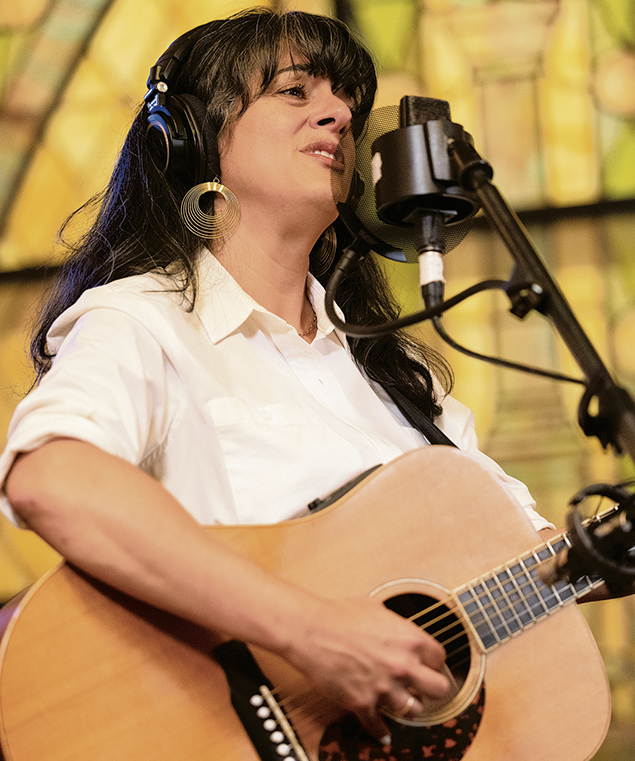
“This niggun has no words. It also has no instruments. It’s just our voices, and a little bit of our slapping our knees. And it was composed in a Dorian mode, which is a mixed major and minor mode that lends itself naturally to a very wide and complex harmonic possibility.
“We recorded this song with a large niggun circle, and I intentionally did not give them any arrangement or chord direction, so that the natural expansive harmonies would emerge naturally, even with the possibility of dissonance. We like the possibility of dissonance.
“That’s a way of teasing out the concept of chemla gedola.”
Rabbi Sacks Mintz explained that “a goal in this project, and more broadly in my own work, and in Hadar, is to explore, with a lot of focus, the intersection of Torah and song. It’s about pushing the boundaries to think creatively and critically about how we can integrate Torah into song and song into Torah when we come together to learn.”
Rabbi Sacks Mintz has put together a source book. “It’s one part song book and one part divrei Torah, and it has writing on both the spiritual underpinning of the music and the creative process.” It’s all her work, and “it’s designed for people to use to bring this music into their own communities.”
Her life now combines the passions that she felt from the time she was a child, growing up in Riverdale, “I was simultaneously entrenched in my synagogue community” — that was the Conservative Synagogue Adath Israel of Riverdale — “ and empowered to be a tefillah leader at a young age, and also putting a lot of time and love and focus on being a serious cellist.
“I grew up entrenched in the classical music and musical theater world and in my synagogue as a lay leader — I was empowered to step into adult leadership as a teen — and those two soundscapes, the sound of traditional Jewish prayer and Western musical modality — really drove me.
“I was a classical voice major at the University of Michigan School of Music, and then I transferred to focus on ethnomusicology, the study of music in faith-based communities. That led me to a long and windy path as I began to work in Jewish communal spaces, as both a musician and an educator.
“Around that time, I began my musical partnership with Hadar, which played a huge role in helping me transition my passion for music in so many levels into a framework of Jewish communal music.
“So then, after about a decade of work in different types of communal Jewish institutions, I made the leap into rabbinical school.” She studied and got smicha at the Jewish Theological Seminary. “While I was there, I expanded my professional relationship with Hadar, and after rabbinical school, I stepped into this full-time faculty position there.”
Rabbi Sacks Mintz has taken all those influences, made what is her third record with Rising Song, and now is taking it all on the road.
“I’m so excited to be at Beth Sholom,” she said. “I know that many folks in the Beth Sholom community are deeply steeped in the kinds of Torah learning, communal song, and communal tefilla that are uplifted in this music. I’ve had the opportunity to learn and sing with Beth Sholom several times in the past, and I’m so glad to share this music there now.”
The evening will not be a pure concert, Rabbi Sacks Mintz said. “My whole band is coming with me, and we will bring the music off the album into the shared space. We will be sharing the music, not performing but bringing the audience to participate with us.”
Learn more about Rabbi Sacks Mintz at www.deborahsacksmintz.com
Who: Rabbi Deborah Sacks Mintz
What: Will be in concert as she releases her record, “Songs from the Beit Midrash”
When: On Thursday, February 19, at 7:30 p.m.
Where: At Congregation Beth Sholom in Teaneck
How much: $25 for shul members, $36 for everyone else
How to get tickets: Go to cbsteaneck.org