

Rutgers Hillel welcomes a new board chair
Michael Elchoness has fresh energy and new ideas

This seems like a challenging time to be the president of the board of a Hillel chapter.
Jew-hatred is on the rise. Israel-loathing seems to be growing even faster. Even outside the Jewish world, being a college student is harder than it used to be. Everyone’s reliance on their screens, the mental-health challenges that screen addiction poses, and the hangover effects of having lived through covid isolation complicate how doomscrolling, polarization, and disillusion affect and maybe even infect all of us. Any potential Hillel leaders probably would look at that list of problems — that superficial list that skirts over many very serious problems — and decide that maybe the best thing to do would be going right to bed, huddling under the blankets, and curling into a fetal position, for say the next few years.
Other people are energized by the idea that the problems are real, but that solutions, innovation, growth, and change — good change — can come out of that.
Michael Elchoness of Livingston, the new board chair and president of Hillel at Rutgers, is one of those active, hopeful, even startlingly energetic people.
How did he get there?
Like so very many Jews, he started in Brooklyn. Mr. Elchoness lived in Midwood, where his family belonged to the East Midwood Jewish Center, until he was in third grade. Then they made the leap over New York Harbor and the Arthur Kill to Edison, where he finished growing up, and where his family joined Temple Beth El in town.
His parents weren’t particularly observant, Mr. Elchoness said, but his mother’s parents were. “They were survivors of Auschwitz,” he said. “And my mother was born in a DP camp in Germany. So I’m first-generation American on my mother’s side, and fourth- or fifth-generation on my father’s.
“My grandparents were far more observant than my parents,” he added.
His grandparents, Bluma and Sam Weitzman, both were from Poland, and they stayed in Brooklyn when their daughter, Penny, moved to Edison with her husband, Marc, and their sons — Michael has two brothers. Penny Weitzman Elchoness died when her son Michael was just one year old, and he was raised by his stepmother, Andrea, from the time he was 7. Marc Elchoness died five years ago. Michael Elchoness was close to his stepmother throughout her marriage to his father, and they remain close today.
A word about the family’s unusual last name. It sounds Sephardic, Mr. Elchoness agrees, but it isn’t. The family’s DNA is 99 percent Ashkenazi, and the name is Lithuanian, but “we don’t really know what the root of the name is, or how it changed,” he said. “We think that it was made up. And there is no possible way that anyone with that name is not related to us.”
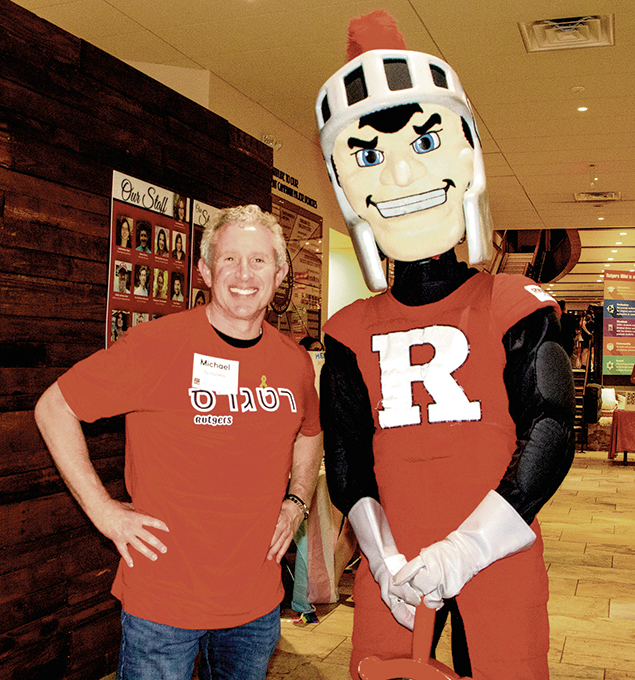
Michael went to Edison High School. “We lived about a mile and a half away from Rutgers, so when it was time to apply, I said, ‘I might as well go there.’ We used to ride our bikes there for basketball games every weekend. It’s not like my child, who applied to 2,000-plus schools. I applied to Rutgers and one or two other schools, I got into Rutgers, I said yes, and I went there.”
Mr. Elchoness had a good time at school his freshman year. Maybe too good — he realized that he was doing something wrong, so “I took myself out of school for a year after that.” That was a wise decision. When he returned to Rutgers, “I graduated in 2 1/2 years. I had a lot of fun, but because of my background and upbringing and family trauma, I am very much a play-hard, work-hard kind of guy. And as I have gotten older, the playing is less.”
Given his world view, his personality, and his way of approaching the world, Mr. Elchoness picked the most logical major possible for him. Communications. “I had no intention of doing that as a living, but I have always felt that being able to communicate well is three quarters of the battle. There are a lot of people who have wonderful ideas, but if they can’t communicate them, they’re left on the doorstep. So I always valued communications. I always knew that I would get into some sort of relationship management business — which I did — and I was interested in the nuances of communication, in how every situation calls for a different type of communication.”
He graduated in 1996, “and then I went to work,” he said. He started out in the financial brokerage business, but “when the stock market tech bubble was about to burst, I decided to get my MBA. I felt that I was really good at the relationship side of things, but I really needed to deepen and broaden my expertise.” So he graduated with an MBA from Fordham in 2002.
During that time he met and married his wife, Lauren, who comes from Oceanside, on Long Island, and they moved to Livingston. “I am the person who got a Long Island girl to live in New Jersey,” he said. “There are not many of us, and I wear that badge with honor.”
Ms. Elchoness is a large-scale corporate event planner. They have one daughter, Gabi, who has just started college upstate. The family belongs to Temple Beth Sholom in Livingston. That’s a Conservative shul, but he doesn’t think that any one Jewish stream is better than any other one. “I believe that all Jews should be able to live and practice in whatever way is comfortable for them,” he said. “I think that institutions as a whole need to continue to improve in meeting people where they are — and that is one of my main objectives with Rutgers Hillel.”
He worked in banks, mainly developing relationships, and soon found himself doing wealth management, first at Wachovia, then at other banks, as they merged and changed names and organization charts. “I had an 18-year career in wealth management,” he said. “Then I had the opportunity to work at a hedge fund.”
He also joined nonprofit boards. “I had sat on them since 2006,” he said. “The first one was Jewish Family Service of MetroWest. I’ve been on that board for almost 20 years.” He did it because “I always knew that I wanted to pay it” — that is, his success, and the kindness other people had shown him — “forward within the Jewish community. A lot of that stems from the needs in my own family when my mother passed. The reality is that a lot of the community was absent, and I did not want that to be the case for anybody else.
“I knew it then, when I was 7.”
So when he became an adult, in a position to help other people, “my involvement often became that if I could be a voice to speak up for folks who may not typically have that voice, then give me the ball and let me run with it.”
Then the world changed again. The pandemic struck. Mr. Elchoness found himself having to look for a job again. And that’s where the social skills that he’d honed over his career became strikingly useful.
“I’m very active on social media, so I posted that I have 25 years of experience in financial services and 15 years plus on nonprofit boards on LinkedIn and Facebook. My question was what do I do next?
“I wanted people to reach out to me with ideas, and they did. Over the next three months, from about May to July or August 2022, I had, with no exaggeration, upward of 75 Zoom meetings.” He often didn’t know if he’d be at all interested in the subjects of those meetings, so he’d begin by saying so.
Of the people who set up or were at those meetings, “most of them I had one or two degrees of separation from,” he said. “Of the 75, I probably knew a third of them, the second third there was one degree of separation, so that I might have known their names but had never met, and the other third — I had no idea who they were.”
All of this both used and expanded his already formidable skill as a communicator. Also, “remember that this was 2022,” Mr. Elchoness said. “There was a level of generosity when covid happened. People felt community. And they were working from home, so they could jump on a Zoom.
“I appreciated ever single meeting. I was getting calls from all over.”
But his breakthrough came from someone he knew. “Literally my second call was from a dear, dear friend I had grown up with, one of my childhood best friends, who has two sons with autism. Robert Price is the CEO of Your Choice Homecare.
“He reached out to me, asked how I was doing, I told him, and he said, ‘Do you mind if we talk?’”
The two men talked about Your Choice Homecare, which was about a year old and hadn’t quite taken off yet. “He was doing it from his basement,” Mr. Elchoness said.
Mr. Elchoness began to work with his friend. He was in charge of building relationships. The business took off.
“Basically what I do is meet family, parent groups, school districts. Last night, I did a presentation in a public library down in Ocean County. I’m also on the board of Autism New Jersey now.
“What we do is help families navigate the programs there are for their children with developmental disabilities once they age out of the system.” That happens when they’re 21, and the state no longer is responsible for their education.
“We help them get into the state Division of Developmental Disabilities. We help them choose a support coordinator — that’s similar to a case manager. And then, ultimately what we do is we handle the payroll function for caregivers, which can include family members, including parents. So the population that is best served by us are people with loved ones who have complex needs, and who are so overwhelmed by everyday life that they want or need somebody else to help them manage. And I’ve basically become that guy.
“There are people who need help pretty badly, and there are people who need someone to listen to them. And I listen to more horror stories in a week than most people hear in a year or more. And the system, while well-intentioned, is overwhelmed. Families are overwhelmed.
“I’d be kidding myself and lying to you if I said that some of these stories don’t knock me on my tuches and keep me up at night. But so many of these families didn’t have anyone to keep them on track.
“So hineni.” Here I am, Mr. Elchoness said, quoting the straightforward, deeply Jewish response that biblical characters give when God asks them directly where they are. “I have the chance to get them on track, in a business that one of my best friends started because he knew that his own children would need it.”
The position uses all the skills that he’s cultivated throughout his career.
“I’m the senior vice president of community relations, so I just meet with people all day long,” he said. “It’s all the things I’ve done in my life, on both the nonprofit and for-profit side, all in one job.”
That work, as well as his nonprofit work, is driven by the values his grandparents and parents taught him, Mr. Elchoness said.
“If I hadn’t been for them, I doubt I would spend as many hours as I do on the volunteer work we do,” he said. “I also don’t know if I hadn’t had 17 years of experience at that point on the Jewish Family Service board I would have been able walk into Your Choice Homecare and add the value to it that I feel I’ve added.
“It’s being able to speak the language, being able to put your passion and your care into words. Looking back, I know that knowing during your whole childhood that you didn’t have a mother was not easy.” But maybe because of that, “I’m able to empathize with people.”
Mr. Elchoness also continued his work on nonprofit boards. Not only did he sit on the boards of JFS and Autism New Jersey, he also was on the Jewish Federation of Greater MetroWest’s board for about 15 years, until just a few years ago, he said. He also sat on some committees, including allocations, which he chaired.
“About 10 years ago, there was a lot of antisemitism at Rutgers. I was on the federation board, and speaking to a lot of people, and I kept hearing about problems Rutgers Hillel was having with security.” He got the federation to help.
That soon got him on Rutgers Hillel’s board. “I was the Rutgers guy,” he said, but when he was a student there, he hadn’t done anything Jewish. He thought that might be a problem, but the other members of the board thought he would be a perfect fit. It was exactly his deep Jewishness, his pervasive Rutgers-ness, along with his lack of connection to Hillel, that made him particularly appealing.
Mr. Elchoness joined the board as Hillel’s new building was going up, and he helped with that. “And I did a lot of listening,” he said. “And I realized over and over again that I didn’t fit in, because I didn’t see the role of Hillel and my duty to it the way I saw that other people did.
“And that’s why I stayed.”
What?
“I stayed because I didn’t fit in,” he said. “I realized that when I look at the population at Rutgers, or in Livingston — what percent of people in Livingston are observant? It’s not that high a percentage. But many Jews live there because they think it’s Jewish to live there, and they maybe go to services on the High Holy Days, or maybe they don’t, but they’re Jewish because they live here.
“I realize that these people were assets who still were untouched. On the board, we always talked about how we can re-engage people who have graduated. How do we bring everyone together? Whether they’re Reform or Conservative or Orthodox? We know that other people disagree with us, but do we always have to disagree with each other.
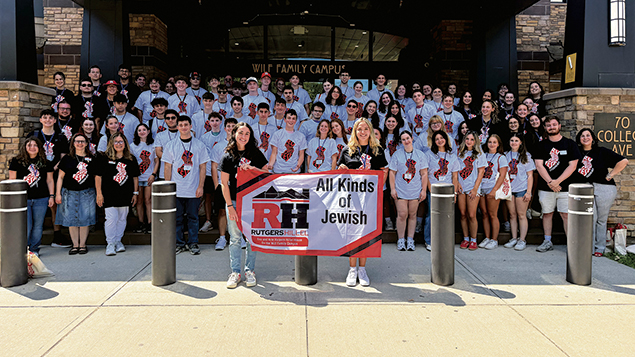
“Maybe I’m a simpleton, but I don’t think so. I truly believe that as Jews, we could do better at supporting each other and ourselves.”
He’s been on the board almost 10 years now, and on the executive committee for about five, Mr. Elchoness said. “We had a change in CEOs, and I wanted to bring in someone like Lisa” — that’s Lisa Harris Glass, who took on that job in July 2023. “She has a strong grasp of the financials and is able to raise money, and there is no Jewish community without outside investment.
“When I look around at a board meeting, whether it’s Jewish Family Service or the Jewish Federation or any other Jewish event, I realize that far more people than we know have a fingerprint on Rutgers, whether they went there undergrad, or went to law school or business school, whether their kid or one of their parents went, you’re talking enormous numbers of people. And a lot of those people are in leadership.
“We do ourselves a disservice by thinking of Rutgers Hillel as Rutgers, rather than as Hillel. It’s the Hillel that you need to invest for next year’s next decade’s, next century’s leaders. That’s how you built the foundation at Hillel.
“When they first asked me to be the next president, I wasn’t sure. I had never wanted it. It’s not my thing. I didn’t ask for it. To be honest, I really got brought to it.
“But really, at the end of the day, I realized that we have an opportunity now, maybe, to come together.”
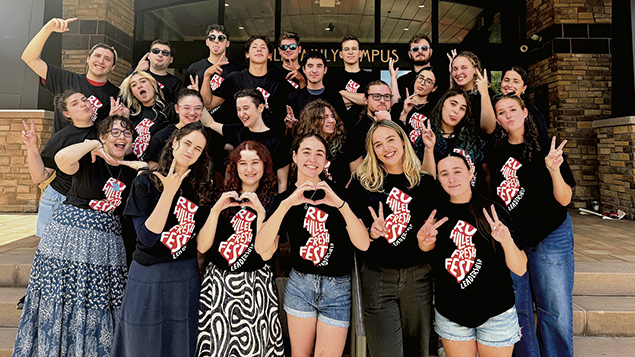
The students he meets “blow me away,” Mr. Elchoness said. “When you ask an undergrad a question, they sound like they already went to law school. There are so many incredibly bright, talented people here who are worthy of investment. That’s why I took the job.”
There are about 6,000 Jews at Rutgers now, Mr. Elchoness said. Estimates once said that about 80 percent of Rutgers students stay in New Jersey, he continued; that number may no longer be accurate but it remains high. “So these students are future Jewish leaders. Future federation presidents. So give them opportunities to engage and to lead right now.”
Hillel needs financial support, of course, he said, but it also needs donors’ time and attention. It needs internship programs, where students can learn from mentors and make connections. That’s something that Hillel can and should do, he said.
“And I always want students to feel like they belong. I want them to always feel safe. I want them to have a secure place to live and to be, wherever they are on their Jewish journey.”
Ms. Glass, Rutgers Hillel’s CEO, was brief but decisive as she talked about Mr. Elchoness, and her view of his strengths matched his.
“I think that Michael has more energy than any three people I know,” she said. “He is a master networker, and he has such a passion for our mission.
“I just think that he is the right leader at the right time.”