

Bringing unity to the community
On Juneteenth, there’s hope among both Jews and African Americans in Teaneck
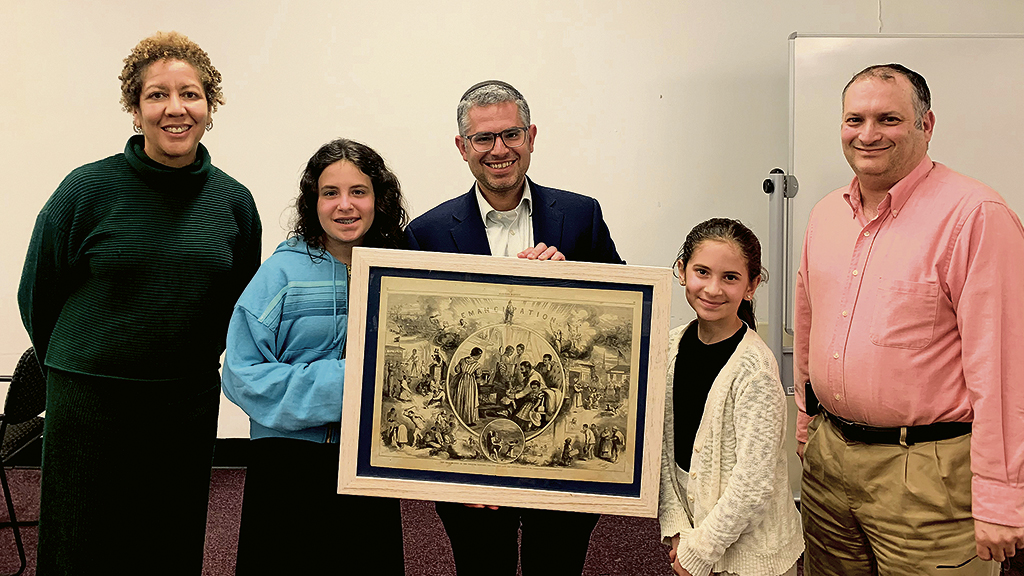
Last month, Yigal Gross of Teaneck and his family gave the township’s public library a gift.
Mr. Gross is a lawyer; he’s also a history buff with a deep interest in both Jewish and American history. That interest became a passion about 10 years ago, he said, “when we started to have kids. That’s something that focuses you on the past and the future, because it makes you aware of yourself as not just a person who exists in the present but the product of the past and a creator of the future.” So he started exploring his personal history and he also started collecting old newspapers.
Those newspapers “were related to key historical American and Jewish events,” Mr. Gross said. “I have a newspaper from the Dreyfus trial.” Alfred Dreyfus, a French military officer whose misfortune was being Jewish, was convicted of treason against France in 1894; he was released from harsh overseas imprisonment in 1899, reconvicted but pardoned then, and finally exonerated in 1906.
“I have the cover page from Yidiot Achronot,” an Israeli daily, “when the U.N. approved the partition plan in 1947,” he said. He also saved newspapers from more recent catastrophes, including the assassination of Israel’s Prime Minister Yitzhak Rabin in 1995, and the attack on the World Trade Center in 2001. He has a copy of both the Jerusalem Post’s and the New York Times’ coverage of Egypt’s president, Anwar Sadat, visiting Israel in 1977 and shaking Prime Minister Menachem Begin’s hand, an act of political and personal courage that heartened Israelis and their supporters around the world.
He also has a collection of the work of Thomas Nast, the political cartoonist who basically created the biting, trenchant art form. Much of it was published in Harper’s Weekly.
“I found Harper’s magazines from the Battle of Gettysburg, and many of his works about Tammany Hall,” the deeply corrupt New York City organization that controlled City Hall for decades, Mr. Gross said.
The artwork he and his family donated to the library is possibly the most valuable in his collection. It’s from the January 24, 1863, issue of Harper’s Weekly, a magazine that was one of the country’s first, best, most widely circulated, and most respected publications (we’d call it a platform today), from a time when weekly magazines were among the most reliable ways for people to get news. “Its readers did not just read about the Battle of Gettysburg, they saw it,” Mr. Gross wrote in the speech he gave to the library’s trustees.
The drawing from Harper’s Weekly that the Grosses gave the library is called “Emancipation of the Negroes — The Past and The Future.” Its center, in a circle labeled “Emancipation,” shows a well-dressed, well-adjusted Black family, living the life that any respectable middle-class family should have been living then. That central circle is surrounded by nightmare of images of enslaved people being sold, beaten, abused, and dehumanized, but it’s the circle — of decency, love, and goodness — that first draws the viewer’s eye.
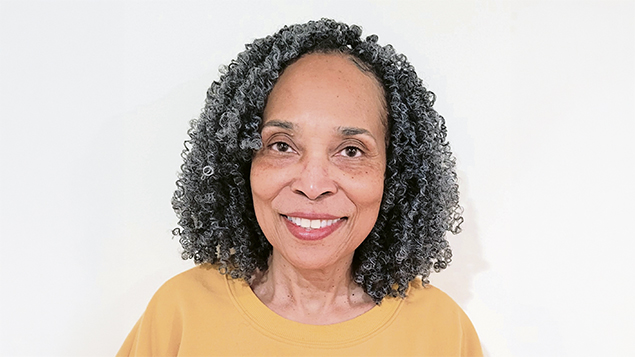
It was in response to the Emancipation Proclamation, the executive order Abraham Lincoln issued on January 1, 1863, freeing enslaved people in the Confederacy.
Because it was hard to get news from one part of the already vast country to the other back then, particularly when powerful people had an interest in not spreading that news, it wasn’t until two and a half years later — June 19, 1865, two months after the Civil War ended — that the last enslaved people, in Galveston, Texas, heard about it and were freed. That’s the genesis of Juneteenth, the federal holiday we celebrate on Friday.
Mr. Gross, who is an Orthodox Jew, decided to donate the artwork to the library in response to a situation that had roiled Teaneck for years. It’s a highly local issue — two groups wanted to mark acts of real evil that had devastated their communities. The Jewish community is working on a memorial to victims of the Holocaust, and the African-American community is working on a memorial to victims of slavery.
There is room for both, as Mr. Gross and many other Teaneck residents have said, but the problem, unsurprisingly, is about how to fund them.
That problem “has sparked tension including in online forums and at municipal meetings, which has alarmed many, including me,” Mr. Gross said in his remarks to the library trustees. “No one should wonder whether one subcommunity gets special treatment. No one should question whether profound events like slavery or the Holocaust are worthy of being memorialized, when the obvious answer is that both should be.”
The specifics of the controversy are particular to Teaneck, but the larger issue is far broader. As Mr. Gross put it, “both communities are fighting the same fight,” and they “are not parallel or competing fights, but interdependent… history has taught us that all minorities — and Black and Jews in particular — tend to share the same fate.”
“I think there’s a real hunger to figure out how to lower the tension in Teaneck, and to bring people together,” Mr. Gross said. “I think that people are tired of the divisiveness. We are tired or pointing out what it is that we have to fear from one another.
“In the 1960s, Jews were very active in the civil rights movement, but in recent years we have turned inward. I understand it, but the consequences are that the world isn’t sitting still for us, and if we are not going to be part of it, it will move on without us, in ways that we don’t want it to, and that will be counter to our interests.
“Insularity isn’t healthy for us. I think that everyone loses out when we disengage. And it falls on us, on regular residents, to step up and do something.”
The Nast cartoon that Mr. Gross gave the library is particularly relevant because of Bergen County’s history of slavery, and because of the library’s connection to it, he said. He suggested talking to someone far more knowledgeable than he about that.
Toniette Henry Duncan has lived in Teaneck since 1979, when she moved there from her native Alexandria, Virginia, to take a job with the post office. She spent her career there in the human resources division and retired, eight years ago, as a district complement coordinator.
Since she retired, she’s been taking online courses at Southern New Hampshire University — she’ll graduate with a degree in general studies and an emphasis on civic engagement in a semester. She’s taken many courses in government and in history, and all that has whetted her already alert interest in the history of the Black community in New Jersey.
The Emancipation Proclamation did not free the enslaved people in the North, she pointed out, and slavery did not end in New Jersey until 1866, the year after the Civil War, when the state’s governor, Marcus Ward, ended it. Bergen County had more slaves than any other county in the state, according to historians; at one point about 20 percent of the county’s residents were enslaved.
Now, she’s a member of the Teaneck African American Cultural and Historical Committee. The group is working on marking and preserving the cemetery that held the unmarked graves of enslaved people and the Lenape Indians who also lived in the area, before they were exiled and sent out West. It’s possible that some of the white landowners were buried there as well; that’s not clear.
The committee is working with a landscape designer to enclose that historical burial ground, on Pomander Walk, with plants native to the area. Because the site is a cemetery, nothing can be planted on it, but it can be surrounded by greenery, so the human remains below the surface can be embraced in death as they never were in life.
The burial ground leads down to the Hackensack River. It’s a beautiful site, a small meadow, ringed by trees, patrolled by vigilant geese. (That part’s not so beautiful.) About 20 years ago, it was sold to a developer, who had plans to build on it, but the land was saved, and it’s now the property of the Meadowlands Conservation Trust.
There are some census records from Teaneck; Ms. Duncan has pages from the beautifully handwritten 1860 census. White men’s occupations are listed; white women are marked as “wife” or “widow,” and Black people are called “slave,” “indentured,” or “apprentice.” (Although indentured servants and apprentices aren’t generally thought of as enslaved Africans, often they were, Ms. Duncan said; those words had more than one meaning.) It’s not clear where the people counted in that census were buried.
The library is connected to the institution of slavery because in small towns, everything is connected if you look back far enough.
The library began in 1913, as a project of Mrs. A. N. Jordan — that’s all of her name that we know — who’d gotten some books from her brother-in-law, the story goes. She loaned the books to local kids. The do-it-yourself library grew, as adults joined their children. Soon, members of the Women’s Political Union secured state funding for it. It grew; in 1922 it was incorporated, and it needed a building.
They bought an old cabin for $2,000. That cabin, formally named the Slone (or Sloane, because the records are imperfect) House, was called “the old slave house”; there were no official documents but recorded testimony from local people whose memories showed that enslaved people had lived there.
The demand for the library continued to grow. The building, converted from old slave house to book house, was sold for $17,000. Some of it remained for some time, but then it was sold, the building was raised, and a gas station was built there. Eventually, the library, in its new site, became the institution it is today, but its roots remain in that old house.
And that brings us back to Yigal Gross’s gift.
Ms. Duncan wanted to see it, she said; she wanted to be sure that it was not a caricature. It’s not, she said; it’s a respectful and powerful image of a Black family. That’s important, she said.
“I hope that at the end of the day, we all learn,” she said. “I just hope that at some point, it will bring unity to the community.”