

Attention! HUA at West Point
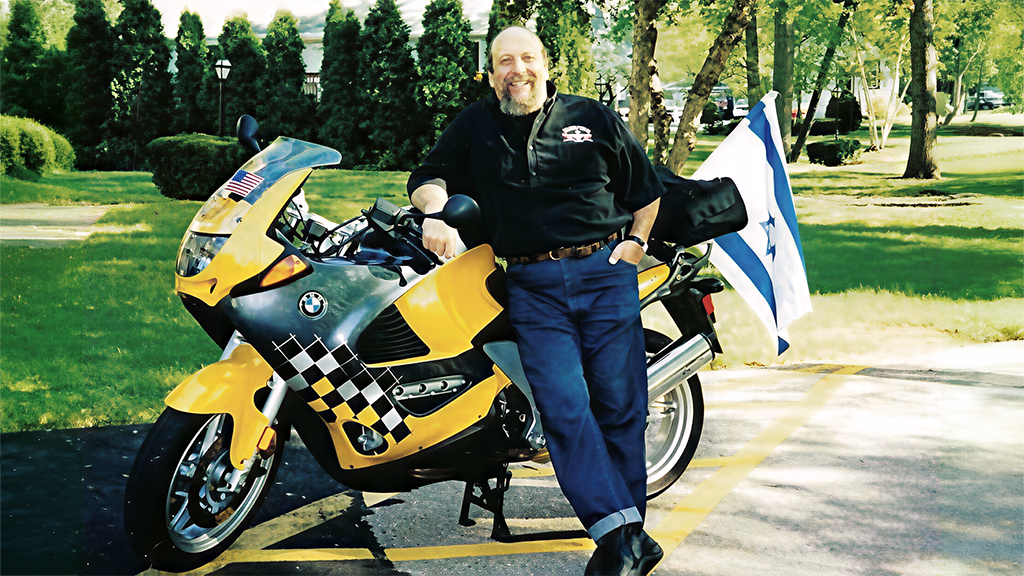
Bobby Lash and I were riding back roads a few years back when, by coincidence, we ended up at West Point. That trip made me see Abraham Lincoln in a completely different light. We all know where he stood on slavery, but I never read, nor did I ever hear, anything that connected him and the Jews.
Then we learned.
“HUA,” (pronounced, HOO-aaaah), Rabbi Huerta said in a soft voice. (He pronounced it HOO-aaaah.) “HUA.”
The shul at West Point sits high on the side of a cliff, built into the rocks, overlooking the Hudson River. Strange place for a shul, I thought. You can hardly see it. As a matter of fact, if you didn’t know it was there, you’d miss it.
It’s a modern-looking building with the Luchot HaBrit — the Tablets of the Covenant; in other words, the Ten Commandments — standing high and proud on its façade. That’s what we spotted; that’s what made us turn our bikes around and go up the hill to check it out.
We walked in and headed toward the soulful sounds of a saxophone being played somewhere in the building. Immediately to our left there was a picture of Abraham Lincoln. (How do we know that Abe Lincoln was Jewish? He was shot in the temple. Sorry. I couldn’t resist.)
Neither Bobby nor I gave that picture a second thought. Maybe we should have.
There were Chagall lithographs on the wall, and many posters of Jewish women who made stunning contributions to the world.
We walked down a corridor, hearing the sax getting louder, and at the end of the corridor there he was; six foot five, 275 pounds, standing on the bimah, his music resting on the shtender (the lectern), playing the saxophone.
We stood in the doorway silently waiting for him to finish. When he did, he looked up at us, and the three of us nodded hello.
There was no way we’d have known who he was: Hispanic, dark features, salt-and-pepper hair peeking out from under a black beret and his name tag, reading Huerta. He extended his hand. “Huerta,” he said. “Rabbi Carlos Huerta.” “You’re the rabbi here?” I asked. “HUA,” he said in a soft voice, and I was sure that he wasn’t talking about a girl standing on the corner of Bay Parkway and 86th Street in Brooklyn, snapping the gum she was chewing. HUA.
“Hi,” I said. “I’m Cantor Lenny Mandel from Congregation B’nai Israel in Emerson, New Jersey. Then I introduced my friend Bobby Lash, a barrister from Toronto, Ontario. “Hua,” Rabbi Huerta said again.
What started on a beautiful Friday morning with my old friend Bobby and me taking a motorcycle ride through the back roads of northern New Jersey and lower New York State ended up a glorious learning experience.
Bobby, who I met at Camp Bayview in 1953, and his wife Nedda, who rode with YOWIES (Yids on Wheels) up in Toronto, had come down for a visit. Because I had two motorcycles, Bobby brought his riding gear down with him, and so we rode.
That morning, we hopped off Route 80 onto County Road 513 (CR 513 starts in Frenchtown, near the border with Pennsylvania, and goes all the way up to West Milford at Greenwood Lake). We rode around Greenwood Lake, up one of the 17s through Harriman State Park and Seven Lakes Road.
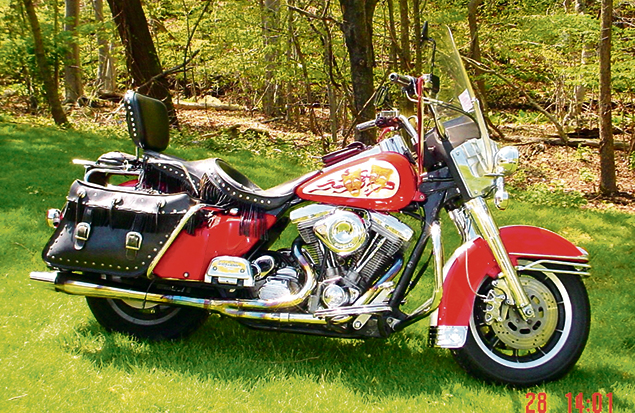
Bobby rode my 2001 BMW K1200 RS and I rode my 1989 Harley Davidson FLHS, zipping the entire ride. We ended on Route 6 when I saw a signpost. We turned at that sign and continued on an 11-mile jaunt, stopping when we came to a concrete barricade.
The guard at the barricade, a United States Army Ranger sergeant carrying a submachine gun, asked us for our licenses.
Bobby was a bit slow to find his. “C’mon,” the now-impatient soldier said. “C’mon. Show me your driver’s license or a military ID card.”
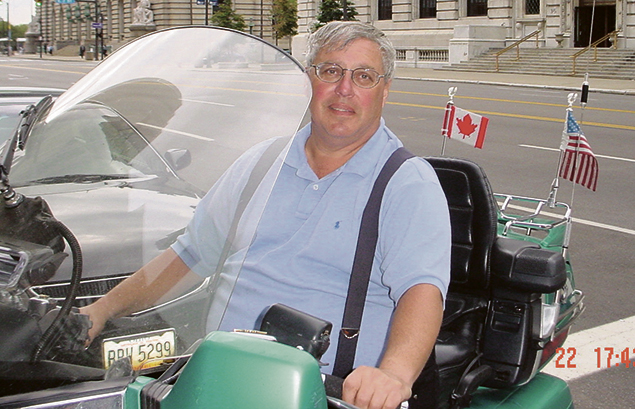
The sergeant already had mine, but he prodded Bobby with the muzzle of his gun. Bobby looked up at him. “I’m a goddamn ally,” he screamed. “For God’s sake, I’m a Canadian. Do you want to see my health card?” We thought that was pretty funny, submachine gun notwithstanding, but then Bobby found his license and the sergeant let us on the base.
We were at West Point, the United States Military Academy, and Rabbi Huerta stood on the bimah of the synagogue there wearing camouflage fatigues, pants bloused into spit-shined combat boots, a gold leaf on each lapel that signified his rank — he’s a major — and the insignia of a Jewish chaplain — the tablets that Moses brought down with him from Mount Sinai — on his beret. It was splendiferous. And what made it even more so was the fact that the symbol for each of the ten was done with the letters of the Aleph Bet — the Hebrew alphabet.
I’m sure that most if not all of you have seen pictures of West Point, so you know more or less what it looks like. You can see the Cadet Chapel, a landmark building overlooking the Hudson, the minute you come into West Point. It has been in many movies, and it’s one heck of a view.
Bobby and I rode up to the chapel, parked our motorcycles, and walked in.
The interior is magnificent, with gorgeous stained-glass windows, huge organ pipes, and what looks to be 100 yards of pews.
There was a small sign that asked all visitors to say a prayer to God, and as we walked up the aisle I recited one of the early morning blessings that is chanted every day in traditional synagogues.
The acoustics are incredible, and I suppressed an overwhelming desire to sing out a rousing hi ge diggy di, or Etz Chayim He.
I asked Bobby where he thought the Jewish cadets prayed — not knowing that he was wondering the exact same thing — and we looked in all the small side rooms, concurring that there must be some catacomb where they allow members of the Tribe to worship their God.
We left the chapel, got back on our bikes, and headed down the road to the Hudson River when I saw the Ten Commandments, on a small building perched on a hill and written in Hebrew. We turned around, rode up the hill, and we were at the shul. The shul. You can’t imagine what we felt, and Rabbi Huerta was overjoyed to be able to show us around.
He is a Brooklyn-born Sephardic Jew, who received his semicha in Yerushalayim, and he is observant, in a setting of absolute egalitarianism. There are two refrigerators, sinks, and microwaves, one for dairy and the other for meat, and he gleefully showed us the backyard, cut out of the side of the cliff, where they build a sukkah every year and would have their first wedding soon.
There were 35 Jewish cadets out of the 4,100 at West Point (4,100 is the number mandated by Congress) and about 65 staff and their families. The synagogue was funded and built by some Jewish cadets who graduated West Point in the 1950s, became very successful, and wanted to make sure that there was a building, rather than a room somewhere, where Jews could pray.
It’s a thrill to see the names, most of them famous, on the buildings at West Point. Household names: Eisenhower Hall, the Patton and MacArthur monuments, Doubleday Field, and, of course, the Lichtenberg Tennis Center, named after the Lichtenberg brothers, Herb, USMA ’55, and Alan USMA ’51. Unbeknownst to most, the Lichtenbergs also funded the floor and the sound systems in the Catholic church and the Cadet Chapel.
It was a wonderful day, but Rabbi Huerta had to teach a Hebrew class — half the class is not Jewish — so, with hugs and lots of thanks, we headed for the door.
I told him that I’d like to come up on an erev Shabbat to daven with them. HUA, he said.
The H in HUA is for heard, the U for understood, and the A for acknowledged.
Abe Lincoln’s picture? Well, Honest Abe certainly was not a member of the Tribe. No sirree. He was however, the president who abolished the military law mandating that an army chaplain be of “good Christian character.”
Thanks, Abe, you lived up to your namesake, our father Abraham.
HUA.
Cantor/Rabbi Lenny Mandel, who left the wilds of Manhattan almost 50 years ago and lives in West Orange, has been the chazan at Congregation B’nai Israel in Emerson for the past quarter century.