

The gift of Chabad and gatherings
Remembering an extraordinary evening and an extraordinary life
I attended a farbrengen once in my life, when I was a young married woman. I do not remember exactly what year it was, and some of that evening’s details are vague. It was, however, an experience that I will never forget.
Farbrengen is the Yiddish word for “gathering.” Simply explained, a farbrengen is a joyful gathering, most notably in the Chabad-Lubavitch chasidic movement, that focuses for an evening on a Jew’s spiritual growth, prayer, singing, words of Torah, and thoughts about the importance of loving your fellow Jew. All these things, of course, are mixed with l’chaim drinks and tasty food to accompany the assortment of different liquors.
But this was no ordinary farbrengen. It was held at 770 Eastern Parkway, the synagogue and world headquarters of the Lubavitcher rebbe, Rabbi Menachem Mendel Schneerson z”l, the seventh leader of the Chabad-Lubavitch chasidic movement. In truth, the invitation to attend was extended not to me but to my husband’s father, Dr. Meyer Bieler, and to my husband, Bruno, by the rebbe’s personal assistant, Rabbi Yehuda Krinsky. My mother-in-law, Esther, and I were simply very lucky tag-alongs.
When we arrived, the two men entered the door to the main floor of the synagogue. My mother-in-law and I walked upstairs quickly to the women’s section. I clearly remember how very crowded it was, how every woman was trying with all her polite but determined might to push her way to the front of the women’s section, hoping to share the pleasure of the remarkable activities downstairs: the awe-inspiring Lubavitcher rebbe speaking, the joyous singing, the words of Torah, the camaraderie, the pure delight of being in the presence of Jewish greatness.
Because greatness defined the rebbe.
I smile remembering my mother-in-law’s reaction to it all. She was this petite, quiet, refined little lady, a woman unaccustomed to such a “happening.” She observed it all with much amazement and a good deal of bewilderment. I held her hand the entire time; I didn’t want her to lose her footing and I certainly didn’t want to have us separated in the crowd!
I never asked why my father-in-law had received this invitation, but hindsight provides the likely explanation. In the 1960s and the early 1970s, as far as I can recall, Dr. Meyer Bieler was one of the medical directors at New York Blue Cross/Blue Shield. Although he was raised in a very religious home in Poland, the man I knew as my father-in-law, while quite knowledgeable, was not an observant Jew. But he loved Chabad. I do not know why. I also have no knowledge of how Rabbi Krinsky knew about my father-in-law and his role at Blue Cross. What I do know is that if there was a sick child (or perhaps a sick parent) in a Chabad family who needed health insurance but didn’t have it, a call was made to Dr. Bieler, who always tried his best to take care of the problem.
And Dr. Meyer Bieler was very good at taking care of problems.
With full confidence I state that my father-in-law never asked for anything in return. But before Purim for many years, he received a large, beautiful basket filled with mishloach manot from the rebbe. And of course there was the gift he often received before Sukkot. Meyer would chuckle while telling how one year, he returned to his office and was told by his non-Jewish secretary that a young boy delivered a gift from “the rabbi.” She dutifully told the boy to place the “broom” and the “lemon” on his desk. There, of course, was my father-in-law’s Sukkot gift, a beautiful lulav and etrog from the Lubavitcher rebbe.
It was always obvious to me that my husband shared his father’s love of Chabad. Again, I never really asked Bruno why. I was definitely consistent in my failure to question.

We moved to Teaneck in January 1974. Friends of Lubavitch of Bergen County was established in March 1981 and was first housed in the basement of the home of Rabbi Yisroel Brod, the first rabbi chosen to lead the organization. It didn’t take long for Bruno to connect to Rabbi Brod and his mission. And it most definitely did not take Rabbi Brod long to connect to Bruno, a guy who was smart, creative, engaged, supportive.
But it was the man who replaced Rabbi Brod, after Rabbi Brod announced he was making aliyah, who truly impacted our lives. In July 1982, Bruno sat at his first board of directors meeting with a small group of other men in Rabbi Brod’s dining room (definitely a step up from the basement). That evening, they interviewed and hired Rabbi Brod’s replacement: Rabbi Mordechai Weiss. Mordechai reinforced our deep appreciation of the Lubavitcher rebbe’s mission; equally important, he became our lifelong treasured friend.
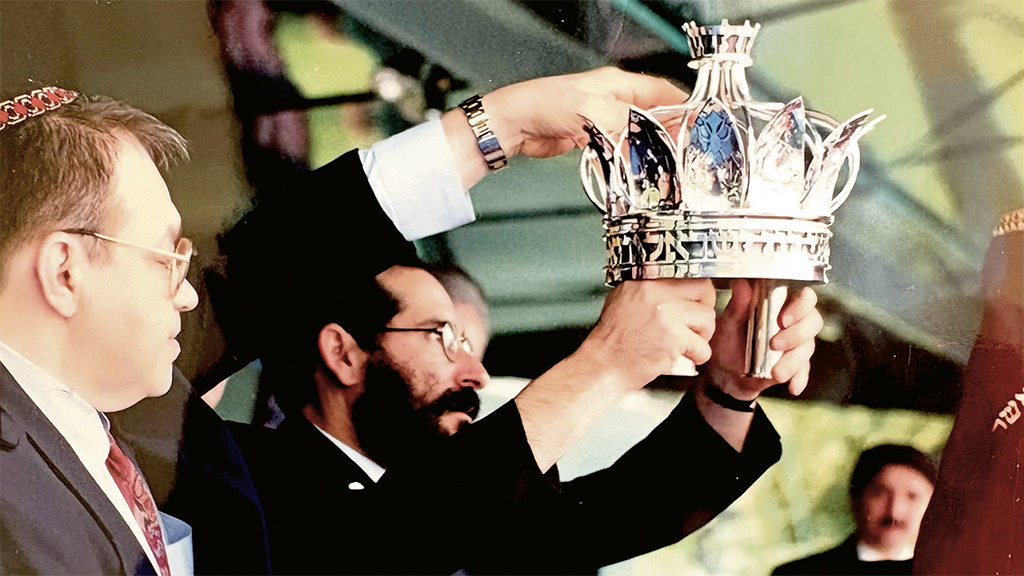
So many people, of course, were impacted when the rebbe died on June 12, 1994, two years after suffering a serious stroke. Months later, a group in Bergen County commissioned the writing of a sefer Torah to commemorate the rebbe’s upcoming first yahrzeit. Bruno told Mordechai that he wanted to purchase the keter, the sterling silver crown that would adorn the Torah. And that is precisely what he did, with some friends joining him in that endeavor. That Torah and its beautiful keter serve the Chabad House to this very day.
My husband’s innovative thinking and love of Chabad continued to blossom. He envisioned a Chabad adult education program, where a participant would receive college accreditation for courses taken. Bruno died in November 1999, but Mordechai carried that dream forward. In Spring 2000, Chabad’s Jewish Learning Institute was established, and the pilot program was dedicated in my husband’s memory.
Today, JLI is called the Rohr Jewish Learning Institute and is a division of Chabad’s educational arm. It offers adult Jewish courses all over the world on Jewish history, law, ethics, philosophy, and rabbinical literature. It also develops curricula specifically for women, college students, teenagers, and seniors. In 2022, it had more than 400 chapters in 28 countries.
And my memories of Bruno and Mordechai’s friendship abound. They would often hug when greeting each other. Smachot were happily shared. When my mother lived with us for 11 years, Mordechai found Chabad office work for her that could be accomplished remotely. And though the Weiss family made aliyah in 2003, Mordechai and I have stayed in touch and often find time for coffee or lunch whenever I travel to Israel. And he never forgets to call me on both Bruno’s and my mother’s yahrzeits.
I now have lived more than 26 years without Bruno, but our shared appreciation of Chabad continues. First, Friends of Lubavitch in Bergen County has continued to thrive for the past 23 years with a caring leader in Rabbi Ephraim Simon. Whenever I turn to him, he is always gracious and helpful. Kind, caring, devoted, he is a man recognized for his remarkable goodness in donating a kidney in 2009 and a portion of his liver in 2019 to save the lives of two strangers.
And then there is Chabad in other countries. A year ago, a good friend of mine was getting married on a Saturday in the French countryside, and I was considering making the somewhat complicated trip. “I present two rather large problems for you,” I bemoaned to my friend, who is not a religious Jew. “I cannot violate the Sabbath with elevators, electric keys, and other such things, and I can eat only strictly kosher food.” Her caterer suggested a kosher caterer in France. But who can verify this information, I wondered for all of one minute.
I sent two emails. One was to the chief rabbi of France and one was to the executive director of Chabad-Lubavitch in France, Rabbi Yossef Gorodetsky. I never heard back from the chief rabbi, but Rabbi Gorodetsky responded the very next day. He was remarkably helpful and okayed the kosher caterer, along with some advice on how to manage. Then I asked him a question totally unrelated to the wedding. “For many years I worked in the executive office of a worldwide Jewish organization called the American Jewish Joint Distribution Committee — the JDC. Occasionally we partnered with Chabad in Brooklyn regarding programs around the world. My connection was Rabbi Sholom Gorodetsky, a very special gentleman. Did you perhaps know him?”
“That was my father,” he responded. “And I remember him talking about you.” A remarkable connection.
But aren’t Jews of all flavors and traditions everywhere often connected to Chabad? Surely we are part of the Lubavitcher rebbe’s dream that Chabad could be a piece of us whenever we needed it. Jews travel to places around the world, confident there will be a Chabad House to guide them if they need advice, a place to pray, a good kosher meal, a Shabbat table. We never stop to think that it was the Lubavitcher rebbe’s concept of shlichut, emissary work, that is a brilliant example of how to search out every Jew with love.
The rebbe asked his shlichim to leave their familiar communities in order to foster or create Jewish life in all four corners of the globe, even in the most distant or remote locations. It often required significant sacrifice from his emissaries and their young families, but it allowed Jews traveling everywhere to find comfort and a piece of godliness in a home away from home. Even when terrorists murdered Rabbi Gavriel and Rivka Holtzberg, the directors of the Chabad Center in Mumbai, India, in 2008, young Chabad couples were not dissuaded from fulfilling their holy mission.
Most of us surely have stories to tell. When my son Shmuel was a young man traveling with his friend in Rome and Barcelona, they turned to Chabad. When Shmuel was older and traveled to Panama with his wife and daughters, their Shabbat meal was in Chabad. My Israeli grandson Gershon shared his experience of davening with many other Israelis on Rosh Hashanah at the Chabad in Vietnam. And he spoke with such appreciation of Rav Binyamin and the delicious food served each Shabbat in Chabad during his five weeks in Tokyo. Gershon described the scene where 50 to 60 people were enjoying a Shabbat meal while Rav Binyamin walked around the tables, telling funny stories, encouraging his guests to share their stories as well. Beyond that, Rav Binyamin happily shared his home and guest room with my grandson on one of those Shabbatot.
Sometimes, rather than going to Chabad, Chabad comes to us. Over 14 years ago, my daughter Dena and her family were flying from Israel to the United States. The plane lost an engine and made an emergency landing in Amsterdam, where all the passengers were put up in a hotel for two days. Chabad brought food to the hotel for all the Israelis. Then they provided a sefer Torah in the hotel for Shacharit davening. And when they learned that one of the boys was flying to America for his “bo bayom” (Hebrew for “on that day”), which is the actual day a Jewish boy turns 13 years of age, the family celebrated in the hotel minyan with Chabad, a planeload of Israelis, and a Chabad sefer Torah.
None of these stories surprise me. It was all part of the rebbe’s plan. When a Jew is with Chabad, no matter the country, he or she feels in some way that they are “gathering” with family. We feel a little less like a stranger in a strange land. Perhaps that is what Meyer and Bruno sensed about the Rebbe and Chabad. A special gathering of family. It is most assuredly a farbrengen of a different sort, but an extraordinary farbrengen nonetheless.
Tzivia Bieler and her late husband, Bruno, moved to Teaneck in January 1974. Retirement eight years ago brought her greater freedom to play, read, travel, and enjoy more time with grandchildren and great-grandchildren in United States and Israel. Alone time during covid brought her back to her love of writing.