

The dark secret of ‘Among Neighbors’
Filmmaker documents the post-Holocaust killings of Jews in a Polish town

“Among Neighbors” is a horrifying tale of the post-Holocaust murder of Jews in Gniewoszów, a small rural Polish town where Jews and Catholics had lived side by side for centuries. (It will screen at the Teaneck International Film Festival on November 9.)
The film was 10 years in the making, and while its genesis is far more benign and its denouement much happier (and sadly cannot be revealed here), it is the film’s center, the eyewitness testimony of Catholic witnesses, that will break hearts.
In a Zoom interview, filmmaker Yoav Potash tells me, “In terms of my process in making [the film], it was reborn and re-envisioned three times.” It started with Anita Friedman and her youngest son, Aaron Friedman Tartakovsky.
Ms. Friedman is the daughter and he the grandson of a Holocaust survivor from Gniewoszów. They visited the town in 2005 and were rudely denied entry — Mr. Potash says one of the locals even pushed Aaron — when they tried to visit the former synagogue, which now is the town firehouse.
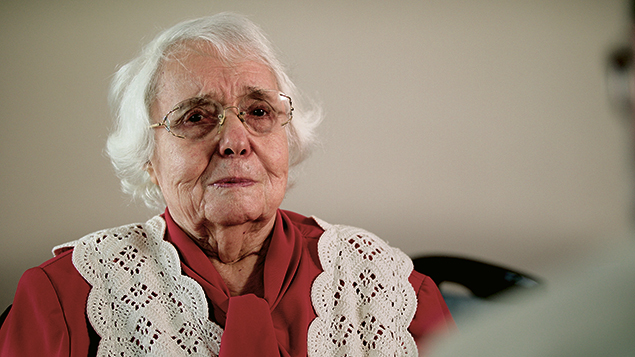
But they refused to be bullied and returned again and again. “They made the decision we’re not going to let them stop us from visiting this town because our family lived here for hundreds of years,” Mr. Potash said.
The mother and son were determined to rededicate a now-defunct Jewish cemetery in order to preserve the memory of the Jewish community there. It took time to build trust with locals and to bring in experts to help, “people that work in Jewish life in Poland, the head rabbi, and people who work in Jewish genealogy.”
“Finally,” Mr. Potash recalls, “in 2014, Anita called me and said, ‘You want to go to Poland?’” Ms. Friedman is the executive director of the Jewish Family and Children’s Services of San Francisco, the Peninsular, Marin, and Sonoma Counties in California, one of the largest family service institutions in the United States. The two had collaborated on a series of short films about notable Jewish figures in the Bay Area.
She wanted him to film the rededication of the cemetery. “I was curious about this lost world of Jewish life in Poland,” Mr. Potash said. “I always imagined a kind of ‘Fiddler on the Roof’ existence, whether it’s real or myth. I wanted to know more about that. So I said, ‘Yes, I’ll come.’
“And when I got on the plane to go to Poland, I was thinking I’m making a short piece for Anita and Aaron and their family. But I’m also going to try to interview some of the old people who live here to see if they remember any of the Jews, just to give the dedication ceremony a little more context.”
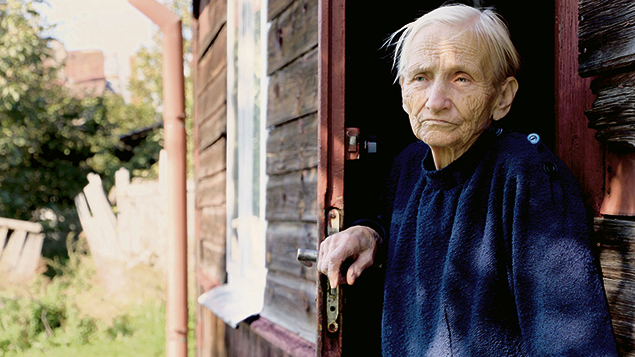
Among the people he met was Jenina Jawarske, who stood in her doorway as she admitted that Poles killed Jews after the war.
“I felt this was different from the Holocaust stories I heard. In some ways, this wasn’t even a Holocaust story. This was a post-Holocaust story. So that was the first rebirth of this project, because from that point on, I said to myself and I said to Anita and Aaron, this isn’t going to be just for your family. This is going to be a short documentary about this town’s dark secret.
“And already the film kind of got elevated in my vision and in my mind and in my heart to a new level.”
Mr. Potash returned home and began work on what he anticipated would be a half-hour documentary, all the time staying in contact with Jewish agencies in Poland, letting them know he was looking for anything in terms of documents and photos about this little town called Gniewoszów.
About a year after he began filming, the Jewish Historical Institute in Warsaw received a hand-written letter from Pelagia Radecka, who said she’d spent time in the town because her grandfather lived there. According to Mr. Potash, Ms. Radecka wrote:
“I saw Jews murdered there six months after the end of World War II. I am looking for a boy named Janeck Weinberg, because he survived those murders. His parents were killed, but he survived, and I’m trying to find him. And I want to tell you my story to set the record straight.”
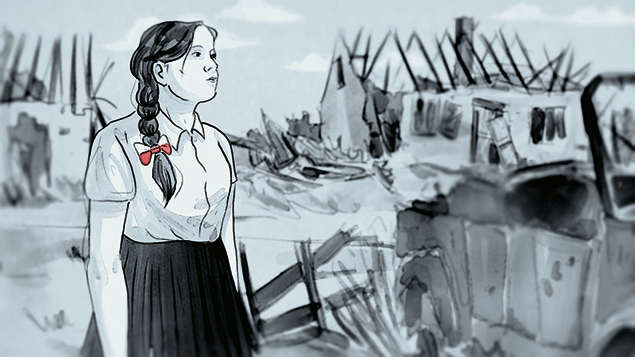
Pelagia no longer lived in Poland, but she went back there and spoke to the filmmaker on camera. “‘That’s the house where the Weinbergs lived,” she said in the film. “This is where my grandfather lived.’ And of course, over two days of interviews, she unloaded this story, which she was burning to tell because she had held it in for decades and was traumatized by it.
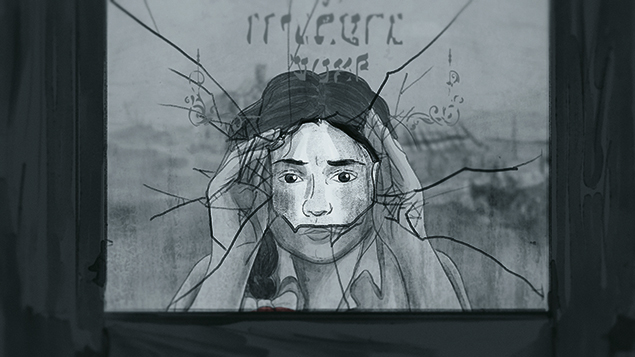
“Once I had the interviews with Pelagia and was able to read through the translations of them, watch and rewatch the footage, and put her story in order, I realized I had something really amazing and powerful on my hands,” Mr. Potash said. “Pelagia took what I heard other people admitting, elevated and deepened it, because she knew the victims so very well. She was very fond of them and she was the most direct eyewitness of those murders. She brought this incredible emotional depth and specificity.”
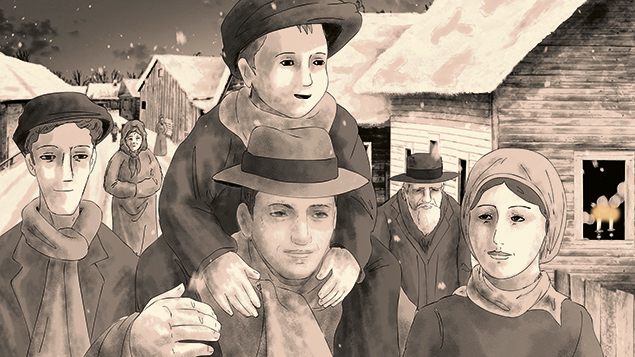
Believing archival footage would not provide the emotional impact the story required, Mr. Potash made an interesting decision. He chose to “to make the leap to use animation as a way to depict her memories.”
He also got in touch with the family of Harry Lieberman, the noted Polish-Jewish artist who began painting when he was 76, turning his memories into Grandma Moses-type primitive renderings of Gniewoszów, the shtetl he left as a child.
“They were the ones who said to me, ‘We have a family member who grew up in that town, survived the Holocaust, and is still alive. You need to talk to him. His name is Yaacov Goldstein.’

“That was a huge moment for me, because he was the first Holocaust survivor who I had found who was from this town. At that point, I had already been working on the film for four years, but to have the opportunity to meet a survivor and get his perspective, I knew it was going to be very significant.”
Mr. Goldstein had published a memoir, “Against All Odds: How I Survived the Holocaust and Other Things on My Way to the Newly Created State of Israel.” It was obviously written in Hebrew, but Mr. Potash got an English translation from the author.
“I was able to read his story even before I interviewed him and really understand what a powerful, unique, and important story it was,” he said.
“I will just say I’ve interviewed many Holocaust survivors over the years, making short films for Jewish agencies, but having done that, when I read about Jacob’s experiences, I was able to meet him face to face and hear his story. I was absolutely blown away and captivated.”
There were two developments that grew out of their meeting. First, he and Ms. Friedman were able to get “Against All Odds” published in the United States. Secondly, he had to go back to the drawing board again for his film. “It was sort of like I was building a bus in a garage,” Mr. Potash said. “Then I realized I had to take the bus apart piece by piece on the floor of the garage and rebuild it as a double-decker bus.
“At that point, we added a three-hour version of this movie. And believe it or not, it was really good. But I knew no one would sign on to watch a three-hour movie. I toyed with the possibility breaking it up into episodes and doing it that way. But eventually, we realized that no, we’re just going to have to make some hard choices and kind of trim and cut things down.”
In that process, though, he made a discovery that led to a happy — or at least happier — ending, which cannot be revealed here.
Working on films with Holocaust survivors has changed Mr. Potash’s relationship with his faith. He was brought up in La Jolla, Calif., in a household led by an Israeli-born father who believed it was important to check most of the boxes.
Conservative Hebrew school and bar mitzvahs for his sons? Check.
Celebration of the major holidays at home? Check.
Celebrate them in shul? Well, not so fast.
Because of his involvement with survivors, however, “I’d say my level of involvement has gone mostly up,” Mr. Potash said. “I was even dabbling with Orthodoxy at one point, but eventually realized that’s not me. I’ve come to a place where my wife and I and our family belong to a Conservative shul in Berkeley, Congregation Netivot Shalom, and we go there pretty regularly.”
But the proof of the pudding: “I build a sukkah every year.”
“Among Neighbors” opens in New York on October 10 and will be shown at the Teaneck International Film Festival on November 9. The film is being sponsored by the Jewish Standard at the Teaneck Film Festival.