

‘The Big Cheese’
Jersey native Adam Moskowitz stars in documentary about addiction and dairy
There’s a very tender moment in “The Big Cheese,” a documentary that opened in New York last week, where Adam (Mr. Moo) Moskowitz, sitting on the deck of his summer home in Asbury Park, asks his daughter Mia if she likes the cheese he brought home.
She tells him no, and when he asks why, she gives a very specific answer: it smells “like daddy’s farts.”
Now that’s gotta hurt.
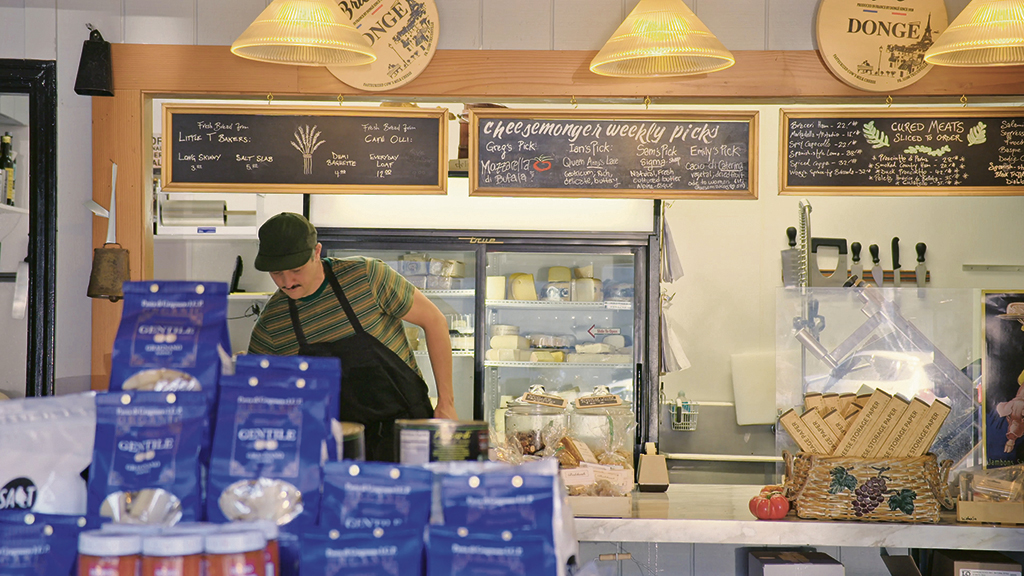
Mr. Moskowitz is a third-generation cheese importer who has spent much of the last 15 years working to raise the profile of artisanal cheese and the people who sell it.
It is his passion, a personal mission, because, as he tells me in a Zoom interview, “cheese saved my life.”
Mr. Moskowitz’s grandfather, Benjamin, was a butter and egg distributor in downtown Manhattan. “That obviously is dairy, and being in dairy led to him being one of the first importers of cheese into the United States,” Mr. Moskowitz said.
Mr. Moskowitz’s father, Joseph, went into and expanded the family business. “He was a pioneer in what we call specialty cheeses. My father was part of that movement.”
Until then, Americans tended to subsist on Kraft slices and American cheese, which of course was looked down on by the French, who preferred cheeses that smelled like Mr. Moskowitz’s farts. But slowly American tastes began to change.
Time passes. There’s tsuris, Mr. Moskowitz joins, leaves, and several years later rejoins the family business, after a harrowing descent into drug and alcohol abuse — more on that later. And most important for the film, he starts Cheesemonger Invitational, a biannual competition to determine the best cheesemonger in the United States.
Cheesemongers are unappreciated, in part because many if not most work behind deli counters, earning minimum wage. They generally are assumed to be clerks rather than the category experts they really are. My impression of them, based on the film, is that they are luftmenschen, men with their heads in the air, seemingly unconcerned about the necessities of day-to-day life.
That’s said jealously, not critically. Many people go their entire lives without finding that kind of passion. And it’s not as though cheesemongers don’t have the capacity to do something else. The hoops CMI contestants jump through reveal not only an extremely high level of dedication, but intelligence as well.
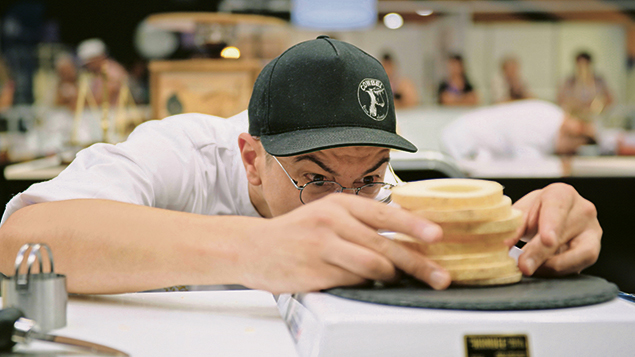
They must take a written exam; show they can cut to weight — that is, if a person requests an eighth of a pound they must deliver an eighth of a pound; take a blindfolded taste test and identify a cheese, give its country of origin, and even estimate when it was made; and finally they must create an attractive and enticing cheese display.
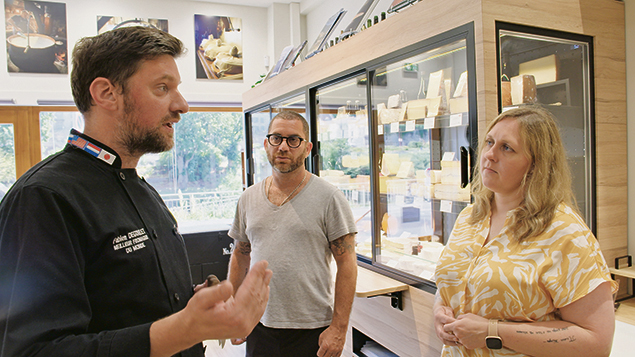
The first CMI was in 2010. Three years later, Mr. Moskowitz’s friend Rodolphe Le Meunier, a French cheesemonger, took the concept international, founding Le Mondial du Fromage. It also runs every two years and Mr. Moskowitz brings the top two finishers of his event to France, all expenses paid. (CMI is a nonprofit, sponsored by several artisanal cheese companies.)
“The Big Cheese,” a documentary, covers the 2023 CMI and Le Mondial. It should be noted that no American at the Monidal has ever placed in the top three before, so the stakes are high for the participants — and the filmmaker.
The competitions were exciting and fun to watch, like a championship sporting event. How can you not like a documentary where one of the participants says: “It has a lot of flavor but is also a very quiet cheese”?
But I was equally entranced by Mr. Moskowitz, who has short hair and is bearded and heavily tattooed, like a Brooklyn hipster who might actually say: “It has a lot of flavor but is also a very quiet cheese.”
Now he lives on the other side of the bridge, but his roots are in New Jersey. “I was a wandering Jew through south and central New Jersey,” he told me. “I lived in Cheesequake. I know. That’s funny. Matawan. Old Bridge. And I graduated from Manalapan high school.
He belonged to Temple Sholom in Aberdeen, where he became a bar mitzvah.
His first job after college was in the family business. “I lasted like nine months because it’s a very difficult business,” he said. Also, Mr. Moskowitz’s relationship with his father was tenuous at times.
Through a friend, he landed a job at Yahoo, moved to New York, and rode the Internet bubble until it burst. He was a high-flying millionaire at 23 and back to earth at 25.
I wondered if this was when he turned to drugs. “Technically,” he answered. “I was born an addict. I think most people have an addict voice inside them. It all depends on how it’s nurtured. Some people get addicted to work. Some people get addicted to sex. I got addicted to numbing myself through drugs and alcohol.
“It was exacerbated during that period, first because of the excess of wealth and then the loss of wealth. There were two really good reasons to try to numb yourself. But to be blunt, I think I was an addict my whole life.”
“Next,” he continued, “I became a painter, poet, DJ. I lived in the East Village. I love music and I love poetry, so it made sense that I become a rapper.”
Ironically, it was rapping that led to a rapprochement with his father.
“That was wild. My dad never left his backyard, except to go to Europe on business, and yet he would come to New York City and show up at all my gigs.” The sex, drugs, and rock’n’roll Mr. Moskowitz rapped about were not exactly within his father’s normal bandwidth.
“I thought I was embarrassing him, so I asked, ‘Why do you keep showing up?’ His response really blew my mind.
“He said, ‘You think I see a rapper, but what I see for the first time is an entrepreneur. You told me last year you wanted to be a rapper. You made a product, a CD, and now you are marketing and promoting your product. You’re an entrepreneur.’ That kind of blew my mind, and I had a pivotal moment with him.
But it was his grandfather’s death that prompted Mr. Moskowitz’s return to the cheese business. He needed money — being an entrepreneur is expensive — so he took a job selling cheese at the Formaggio Essex in the Essex Market in Manhattan.
“And that’s where cheese saved my life,” he said.
According to Mr. Moskowitz, cheese is primal. It makes us smile; that’s why we say cheese when someone takes our picture. “It helped humans get through long winters and arduous journeys.”
It may sound corny, but Mr. Moskowitz found his calling in cheese after all.
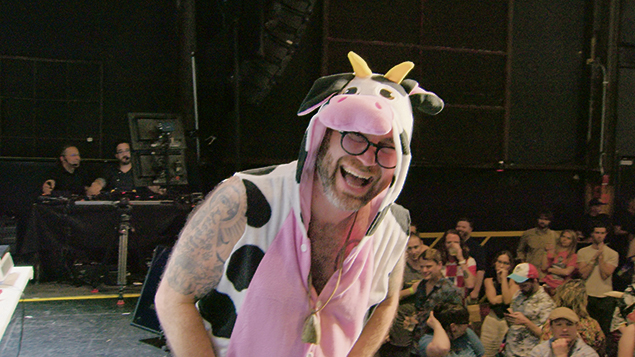
In 2007, when a deal to sell the family company, Larkin Cold Storage, fell through, “I was given the opportunity to buy it,” he said. Three years later, he started CMI; the film shows him strutting in a cow outfit, mootivating his audience.
He and his wife Jessica — they met on JDate — married in 2010; his children Max, 12, and Mia, 10, round out the family. He finally reached sobriety in January 2019, but still the demons that haunt him refused to be exorcised.
“About 100 days into recovery my system got out of whack and I went into a very dark depression I suffered through for about three months,” he said. “Basically, every day I wanted to die. I wanted to kill myself.”
He asked his son what he thought of his father and Max replied, “I’m scared of you,” Mr. Moskowitz reported.
“I would walk around the warehouse trying to figure out the best place to hang myself,” he said. “I suffered with the Jewish guilt of who’s going to find my body, and I’ll never forget the very vivid moment where I realized if I jump in front of the 7 train, then none of my friends or family or co-workers would have to discover my body.
“That was quite the revelation. So, yeah, I was planning with pills, I was planning with a rope. I was planning knives. I was planning with gas. But it was with the train that really got me to the place of let’s get it done.”
It wasn’t as if he kept his feelings secret. “I’m a talker, so I was very candid with my wife about my suicidal ideation.” En route to the train station and “excited” that he’d resolved the body discovery problem, he called Jessica to tell her “the good news. She was really upset because she didn’t want me to do it. She told me that my daughter was too young and she would not remember me.
“And to this day, I still I don’t know why that worked. But it stopped me, and I went home.”
The conversation stops momentarily, and I ask if he has any regrets opening up like that in the film and in greater depth to me.
“No, man,” he said. “Why? If you have one foot in the past and one foot in tomorrow, then you’re shitting on today. I’m very grateful for all the wins and losses, all of the pain and suffering and all of the successes and failures of my life.
“So, no, I do not have any regrets, because all of that has allowed me to be who I am today. I’m in a place where I can share my story, and however painful that might be, maybe other people can find hope, strength, and light from it.”
As he’s saying all this, his eyes start to tear up. At one point in the film, when he’s at a CMI session, he makes a speech, telling the audience that he’s available to speak to anyone having mental health or addiction issues. It is a highly charged moment in the film and more so now, in real life, as he continues:
“I cannot go back in time and whisper that life is gonna get good. But what I can do is maybe help someone struggling, and maybe help them get to a place similar to where I am today.”
His tears are flowing faster now. “I’m grateful and fortunate for the support system I have, for you. Look, you’re giving me an opportunity to be vulnerable as a grown man, and I share my story in the hope other people may not be hurting themselves.”
Without getting specific, there were CMI winners at the Le Mondial du Fromage and Mr. Moskowitz had one, too. On Father’s Day, two years after he first questioned his son, he did so again. But this time Max’s response had changed.
He said: “You’re funny. You’re fun. You’re kind.”