

Old characters, new lives
Novelist Allegra Goodman talks about ‘Apple Cake’ growing into ‘This Is Not About Us’
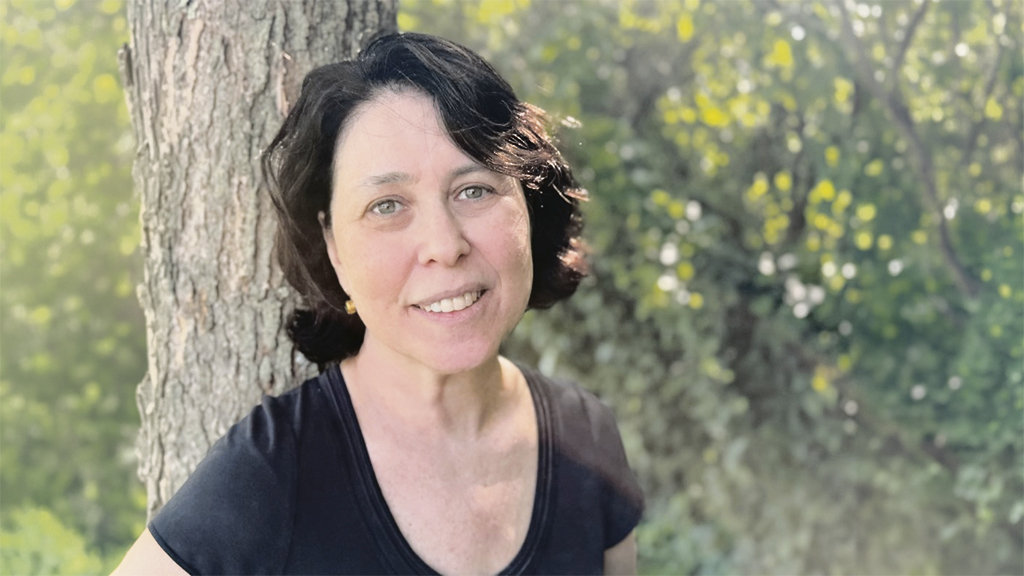
About a decade ago, author Allegra Goodman wrote a short story called “Apple Cake” that appeared in the New Yorker. In it, Jeanne, the youngest of the Rubinstein sisters, lies on her deathbed.
Flower arrangements sent by well-wishers fill the room. The mums, already wilting, make her feel “she wasn’t dying fast enough.”
Her family hovers there every day, hoping to provide comfort. But, perhaps inevitably, a long-simmering conflict arises, in this case between Jeanne’s two older sisters, over a dessert.
During the course of the story we get to know the Rubinsteins: the sisters, the nephews and nieces, and their families. It is filled with Ms. Goodman’s now well-known adeptness with words and her ability to build characters so real they might live next door. In short, the story was complete.
Until it wasn’t.
Ms. Goodman kept coming back to it, writing additional “chapters,” many of which also were published in the New Yorker and now are collected in book form, in “This Is Not About Us.” Like all its predecessors — “Kaaterskill Falls” (a National Book Award finalist), “Isola” (a Reese’s Book Club selection) and “Sam” (an I Read With Jenna selection), it has received rhapsodic reviews.
I Zoomed with Ms. Goodman, 59, to discuss her work and life.
She was born in Brooklyn but moved to Hawaii when her father, philosophy professor Lenn E. Goodman, was offered a position at the university there. Her mother, Madeleine, was a graduate student at the time; after she earned her Ph.D., she became an assistant professor of general studies and women’s studies and eventually became the dean of academic affairs for the entire University of Hawaii system.
Ms. Goodman described her family as closer to the Conservative movement. “We went to synagogue,” she said. “We kept a kosher home. But we were not Orthodox.
“It was a very tiny Jewish community. There were very few of us. We had no kosher butcher there. We got all our kosher meat shipped in from Long Beach, California; we had an extra freezer where we kept it. This is before Chabad was established in Hawaii, so there wasn’t much in the way of institutional Judaism there. But there were a few families.”
There was never any doubt about where her career was headed. “I always wanted to be a writer,” she said. In fact, she wrote her first novel when she was 7 years old. It was called Choo Choo. “It was about a train,” she said. “A little fairy tale I wrote and illustrated.
“I think our class in second grade had a project where our teacher actually made these little books. We wrote the text, and then she typed it. Then we illustrated the pages, and she bound them. She covered them with contact paper and made titles. So to us it felt like books, and since I was already interested in becoming a writer, I consider that my first book.”
Becoming a writer was apparently not a problem; it was beshert. Ms. Goodman was preternaturally gifted. Her first story was published in Commentary magazine when she was still a high school senior. A collection of stories, “Total Immersion,” came out while she was a senior at Harvard. But it’s her next book, “The Family Markowitz,” that is of special interest here.
Like her new book, “Markowitz” is a collection of interlocked stories about a Jewish family. The two books share a number of other characteristics. The people in them are familiar, and their problems are relatable. In its angst-free manner, both are old-fashioned novels, in a very good way.
I wondered if Ms. Goodman had any worries about repeating the family saga told in the form of a collection. “I wasn’t concerned by that at all,” she replied. “I actually really like the form, so I looked forward to working with it again.”
In fact, she says, as she wrote “Apple Cake,” “I was interested in making it the beginning of this book right away when I wrote it.”
She wasn’t exactly sure where the book was going. “I knew I wanted to explore the lives of each of the family members that appear at Jeanne’s sickbed in ‘Apple Cake,’ but I didn’t know where they were going to lead me at that point. That evolved over time.”
Ms. Goodman does not have favorite characters. “I enjoy it when my readers have a favorite, and I love hearing which ones they relate to and which ones they identify with. I get all kinds of comments from people about my characters. But I don’t have any kind of relationship to them as a writer.”
When the book ends, so does Ms. Goodman’s relationship with the people in them. “They totally come alive for me, and I take it as a great compliment when people wonder what happened to them,” she said. “People have asked me, ‘What’s gonna happen to Phoebe?’ ‘What’s gonna happen to Lily?’ I don’t spend a lot of time speculating about what will happen. I just sort of send these people out in the world. From my perspective, I’ve said what I have to say about them, so I set them free.”
Sometimes it’s best not to know what the future holds. “This Is Not About Us” takes place in the world before October 7, at a time that Rob Franciosi, who reviewed the book for Commentary magazine, calls “an inflection point.” The characters in it have no idea what the future holds. It is what Ms. Goodman told me was “an elegy for a time before October 7,” clearly a blessing.