

‘Don’t be an idiot. Get in the boat’
Danish-born, Israeli-bred director guides Union-based performing arts company

American Theater Group, the Union-based performing arts company, is very likely the first in the state — and perhaps even the nation — to have a former Israeli tank commander as its producing artistic director.
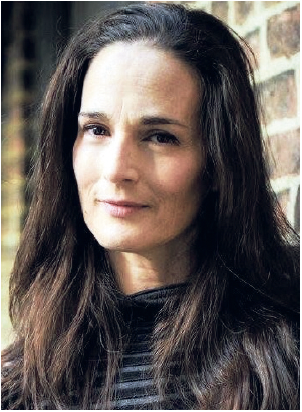
That would be Charlotte Cohn of South Orange, the Denmark-born, Israeli-raised, opera singer wannabe, and Actors Studio graduate who was appointed to the post last month, in part thanks to a stick of gum.
Given that background, it seemed clear early on that Zooming with Ms. Cohn was going to be a wild, interesting — and historical — ride. We start early in the 17th century. “My father’s family is part of a long line of Danish Jews who were brought into Denmark from other areas of Europe by decree of the king,” Christian IV, Ms. Cohn said. “Denmark was suffering financially, and the Jews were going to help us with that, and they did.
“So my Danish Jewish heritage is very long, and my grandfather was very high up in politics and diplomacy and was very close to the king.”
That would be Georg Cohn, who argued Denmark’s case in front of the International Court of Justice in 1933. As a result, the court belatedly awarded the country full control of Greenland. (The United States had recognized Denmark’s sovereignty over the island in 1916, as part of a deal in which the United States bought islands in the Danish West Indies, which, ironically, is not too far from the Gulf of America. But I digress.)
Ms. Cohn continued: The Nazi invasion of Denmark in 1940 “was very different from anywhere else. There was no segregation of the Jews. No ghettos. There were no yellow stars. They sort of just came in and slowly took over the infrastructure.”
But in 1943, she added, all that changed. “The Nazis said we’re taking your Jews. And the Danish resistance came to be and fought back.”
It organized a flotilla of boats that transported the majority of the country’s Jews to Sweden in just a few days. “It’s a lovely, positive story of the Holocaust,” Ms. Cohn said. “It is the only country in Europe where 95 percent of the Jews were saved.”
Interestingly, Georg didn’t want to go, convinced his high position would protect him. “The story goes that my grandmother said, ‘Don’t be an idiot. Get in the boat.’”
Ms. Cohn’s father, Herluf, was 12 at the time and was mostly concerned that he had to celebrate his bar mitzvah in Sweden. At the war’s conclusion, the family returned to Denmark, and a grown-up Herluf became involved in organizations that supported the fledgling state of Israel. On one of his trips to the Holy Land, he met — and fell in love with — Nira Jacobson, a Sabra army officer assigned to take him on a tour of a base.
“He courted her for two years, writing her letters, which is what people did back then,” Ms. Cohn said. “They married in Denmark, lived in Denmark, and had four girls.” Ms. Cohn said she is the youngest of the four, which is the closest she came to discussing her age. In any event, in 1973, the family made aliyah, “just in time for the Yom Kippur War.”
Ms. Cohn went on to do more than her mandatory IDF duty, which typically would be two years for women. After her basic training, she attended the Israeli equivalent of officers candidate school and became a commander in a tank training base in the Negev. After five years in the IDF, she moved to New York to study opera.
“I started singing classical music when I was 12,” she said. “We were a very musical family. We grew up singing. I saw Zeffirelli’s version of ‘La Traviata’ and that kind of blew my mind. We had classical music around the house. My father was a big fan, and we had a lot of vinyl. But it never caught my attention as much as this film did. I thought this is what I want to do.
“So I started singing with the children’s choir in Jerusalem. We sang at all the big holidays, and I was the solo soprano. We traveled the world representing Israel.”
But in the States, despite landing some small roles, Ms. Cohn grew disillusioned with the world of opera. “The fantasy of opera singing was a little bit more magical and romantic than the reality,” she said. “I did a few little operas here and there, but I didn’t enjoy that world and lifestyle. You have to be very regimented, there also was a lot of politics I didn’t enjoy and got caught in the middle of. So it soured me a little bit.
“But I love the stage. I love performing. I love story telling. So I got very attracted to just straight acting.”
Her timing couldn’t have been better. She’d been studying language and teaching English as a second language at the New School, and James Lipton had just started a master’s program called the Actors Studio Drama School, affiliated with the famed acting school.
After graduating from the program, Ms. Cohn landed roles in both Broadway and off-Broadway productions, directed plays in New York and at regional theaters around the country, produced some, and even wrote one. That was “The Sound,” about her father’s experience escaping Denmark, which recently concluded a brief run at the JCC of Rochester, N.Y. In short: she became a playa.
She met James Vagias, who co-founded ATG in 2012 and was the organization’s producing artistic director, at an industry function. “As a producer, you get invited to a lot of readings of new works,” she said. “I was invited to one and Jim was there. We didn’t know each other, but we sat next to each other.
“There was a break in the reading, and he asked me if I had a mint or something. I gave him a stick of gum, and that was the moment where we started our relationship. A mutual friend was there, and he turned to her and said, ‘Would Charlotte be a good fit for ‘Canned Goods’ as the director?’ That woman said yes. Then he interviewed me for the directing job and I met with Erik Kahn” of Tenafly, the intellectual property lawyer and painter who wrote the play.
“Canned Goods” is about a Nazi false flag operation. Given Ms. Cohn’s background, it seemed a natural fit to everyone involved. “And the rest is history,” she said.
I wondered what she told the ATG board that got her the job. “I told them this is the most amazing time they’ll ever have. No.”
Instead, she told them about her extensive experience, including working with nonprofits, and about her plans to focus on New Jersey artists and crew with programs she calls Spotlight on New Jersey.
“I already did one Spotlight program,” she said. “It was playwrights. That was the first thing I did. I started July 1, and then on July 6, 7, and 8 we presented three new plays by local playwrights.”
Ms. Cohn hopes to increase the number of annual offerings from three to four or five. Another goal is to get a permanent home. ATG shows now play in both the Union Arts Center and the Sieminski Theater in Basking Ridge.
Her first production, “Destroying David” (October 9-18 in Union and 23-25 in Basking Ridge), a one-man show about a crack in the 500-year-old statue in Florence, was an easy choice. She’s directed the play before. Oh, one more thing: she’s married to the actor/playwright, Jason Odell Williams.
“I’ve come full circle,” she said. “I was an Orthodox kid and then I married my goy boy. When I left Israel and came to New York, I became ultra-secular. I didn’t want to have anything to do with Judaism.
“Well, guess what? It caught up with me.
When her daughter, Imogen, now 20, was born, Ms. Cohn wanted her to experience being Jewish, not just read about it. “So we became members of the Stephen Wise Free Synagogue in Manhattan. She was there is the early childhood center and she was a bat mitzvah there.”
“I found myself coming back as a traditionalist. I love the traditions of Judaism. I love the history of Judaism. I am a proud Jew. A proud Israeli. And I just feel like we’re under attack.”
Ultimately, that brings us back to “The Sound,” the musical based on her father’s World War II exodus from Denmark that she’s working on now, in whatever free time she can find. “It’s uplifting and inspiring, and it really shows how the people of Denmark and Sweden came together for the Jews,” Ms. Cohn said. “And isn’t this a good time to tell that story?”