

‘All sitting together, learning side by side’
Local YU students complete summer research internships in Israel
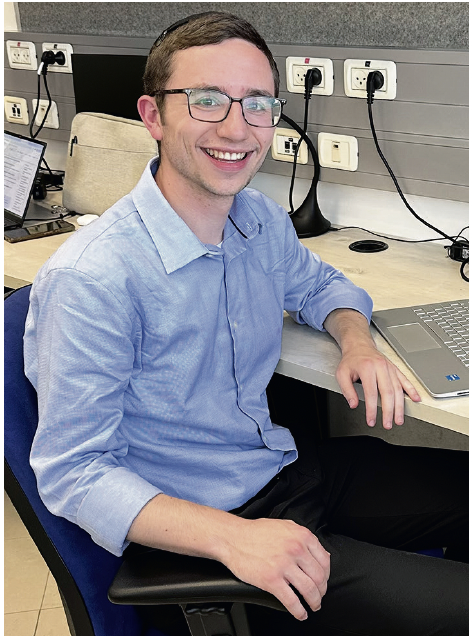
Chanan Schreiber of Bergenfield is one of 24 American and British Orthodox college students who just completed the seven-week Summer Science Research program at Israel’s Bar-Ilan University, jointly sponsored by Yeshiva University.
He had spent extended periods of time in Israel before, but until this summer, he’d never been immersed in the multicultural coexistence atmosphere that few visitors get to experience.
“It was really meaningful to sit in a packed Bar-Ilan library,” Mr. Schreiber said. “There is the peaceful silence of people hard at work, people of all different types — women and men; Israelis and Arabs; Jews, Muslims, and Christians; religious, cultural, and non-religious; soldiers and civilians — all sitting together and learning side by side.”
Over the last 16 years, the internship program has brought nearly 500 undergraduates to Israel for hands-on advanced scientific research at BIU. The university is in Ramat Gan, about an hour’s drive from where the interns are housed on the Jerusalem campus of New York-based Yeshiva University.
The selected participants represent a variety of colleges and always include young men and women from Bergen County. This year’s cohort included students from YU’s Yeshiva College for men and Stern College for women, Brandeis University, Rutgers University, SUNY-Binghamton, Cooper Union, and Manchester University in England.
Among the four locals this year was a trio of 22-year-old friends — Mr. Schreiber plus Yaakov Suldan and Yakov Halstuch, both from Teaneck. The three friends graduated together from the Torah Academy of Bergen County, spent two gap years together at Yeshivat Har Etzion in Israel, and went on together to Yeshiva College. The fourth is Chanan Zaider of New Milford. All four hope to make aliyah in the future. All four, like the other students in the program, are undergraduates.
Mr. Schreiber, the son of Rabbi Avie and Navi Schreiber, is a psychology major. He was placed in Professor Omer Linkovski’s brain research lab.
Shaked Seker, a graduate student who worked with Mr. Schreiber in the Linkovski lab, said, “Our project focuses on understanding how using AI chatbots affects individuals with high levels of obsessive-compulsive symptoms. Chanan was helping us evaluate whether AI actually improves the quality of their writing, and if there is a gap between their objective performance and how they subjectively feel about their work.
“Chanan has been a fantastic asset to the team,” he continued. “His dedication to the project and his thorough approach to evaluating the data have made a significant impact on our workflow.”
It was Mr. Schreiber’s first research experience. “Although I’m strongly leaning toward the clinical side of psychology, research experience is important no matter what I go into,” he said. “Being in Bar-Ilan gives me an experience of working and researching in Israel, and the relationships I created are potential steppingstones for my future here.”
He noted that when his great-uncle studied at BIU in the 1960s, the university consisted of just two buildings; it now comprises more than 100. “Thanks to Rabbi Ari Zivotofsky and Professor Arlene Gordon, the directors of the summer program, the experience has been really enjoyable and meaningful,” he said.
Rabbi Zivotofsky suggested that the interns use their long morning commute to learn Torah collectively, an activity that helped bond them together. The program also offered optional lectures by BIU scholars, evening programs, Torah learning, and Shabbatonim, as well as field trips to the Teperberg Winery, Israel Aerospace Industries, the National Library of Israel, and the Volcani Center for Agricultural Research. Students also had some free days to travel or hike around other parts of Israel.
Mr. Schreiber and his friends said they had no hesitation about coming to Israel at a precarious geopolitical time. Their post-high school studies coincided with the October 7, 2023, Hamas terrorist attack that ignited the ongoing multifront war, so being in Israel now doesn’t faze them.
“If anything, I specifically wanted to be in Israel this summer, and that’s why I found this opportunity,” Mr. Schreiber said.
Mr. Suldan, also a psychology major, interned in the lab of linguistics Professor Sharon Armon-Lotem, working with Professor Carmit Altman from the Faculty of Education.
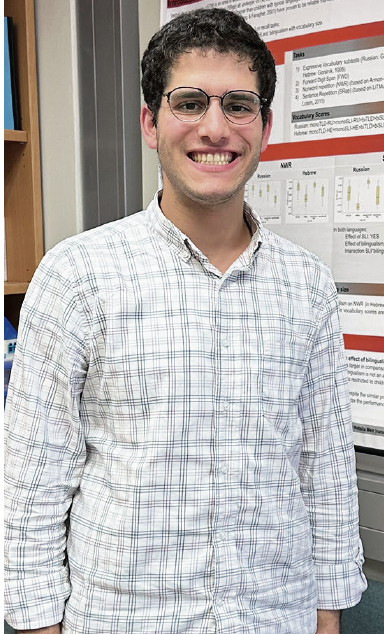
One of his tasks was to help doctoral students research bilingual narrative intervention, a speech therapy approach that uses storytelling in two languages to help bilingual children develop their skills in both languages. “I find it fascinating that helping a child improve in one language can also lead to progress in their other language,” he said.
The son of Drs. Dora and Zalman Suldan, he plans to pursue the clinical side of psychology and felt it was valuable to establish connections in the general psychology field in Israel.
“My favorite part of the program is being constantly surrounded by so many intellectually curious individuals,” Mr. Suldan said. “Programs like this tend to draw from a self-selecting group of students, all of whom are interested in spending their summer furthering their education. What makes this program different is that it allowed me to do exactly this while also spending time in Israel.”
Another YU psychology major from Bergen County, 21-year-old Chanan Zaider of New Milford (yes, there were two Chanans and two Yakov/Yaakovs), worked in the Pediatric Rehabilitation Research Lab directed by Professor Tamar Silberg.
He took part in an ongoing project investigating the biopsychosocial mechanisms underlying functional neurological disorder in children and adolescents. This study is being done in conjunction with the pediatric rehabilitation unit at Sheba Medical Center.
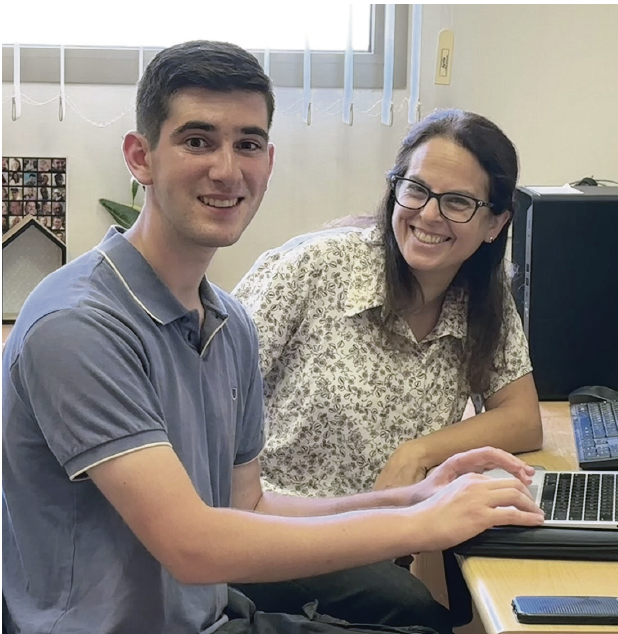
“Chanan contributed to a systematic review and meta-analysis examining cardiac autonomic regulation, with a particular focus on heart rate variability in healthy children compared with children experiencing functional neurological disorders and psychosomatic symptoms,” Dr. Silberg said. “He was involved in developing the study protocol, screening the scientific literature for eligible studies, and extracting statistical data from published articles for inclusion in the meta-analysis. In addition, he actively participated in the laboratory’s regular research meetings, where ongoing projects, study design, and scientific findings are discussed.”
Mr. Zaider said he found the topic fascinating, “and I’ve learned a lot from the work I’ve taken part in. This was one of my first real-world research experiences, and it merged my interests in Israel and psychology. To see how the process of research unfolds and to be part of that process made me appreciate how much goes into it, how much it takes to produce the conclusions that have advanced the field of clinical psychology.”
He enjoyed lunchtime lectures from Bar-Ilan faculty, for example Rabbi Zivotofsky’s talk describing his trips to visit Jewish communities throughout Africa.
The son of Arik and Miriam Silverberg Zaider, he graduated from Frisch in 2023 and completed a gap year at Lev HaTorah. Being in Israel on October 7, he said, only deepened his connection to the Jewish state and his Jewish identity. “Despite everything going on, I remember feeling safe and feeling part of the Jewish nation in ways that definitely influenced my trajectory.”
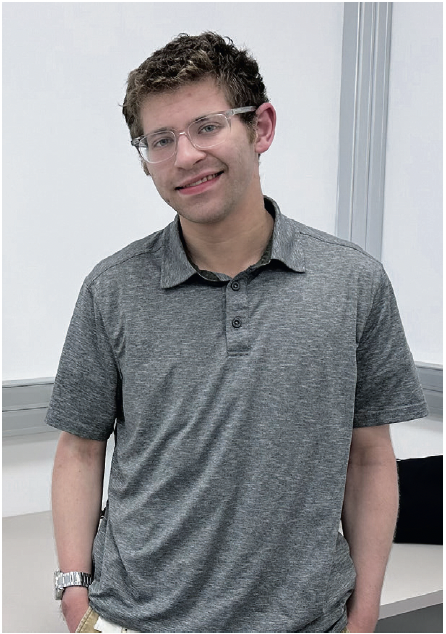
The only one of the four local participants not going into psychology is Mr. Halstuch, a computer science major and the son of Shoshana and Zev Halstuch. He worked in Dr. Dor Atzmon’s software engineering lab.
“Yakov worked on a new method for solving problems whose solution consists of a set of actions to be executed,” Dr. Atzmon said. “Examples of such problems include puzzles like the Rubik’s Cube and navigation tasks like those for an automated vehicle.”
Mr. Halstuch summed up his pathfinding algorithm project as a “search for a good solution for very large problems that could take years to solve, in less than a minute. The research internship is a very nice program, and I’ve enjoyed experiencing computer science in a non-class setting. It showed me there is a possibility of doing research that I would enjoy.”
The BIU–YU Summer Science Research Internship is administered through Bar-Ilan University’s International School. Professor Gordon matches the participants with faculty and graduate mentors on projects that align with each one’s academic interests and career aspirations, spanning fields from artificial intelligence and engineering to neuroscience, chemistry, and life sciences.
“One of the most rewarding aspects of this program is watching students gain confidence as researchers while forming lasting relationships with their faculty mentors and peers,” she said. “They leave with new scientific skills, a deeper appreciation for collaborative research, and memories that stay with them long after the summer ends.”
The BIU-YU Summer Science Research Program, supported by Dr. Mordecai (z’l) and Monique Katz, the Irving I. Stone Foundation, and the Zoltan Erenyi Charitable Fund as an investment in the next generation of scientists, will start accepting applications for the 2027 cohort later this year.