You’re never too old, right?
90-year-old psychologist and his daughter put on a show together
You can take the boy out of Brooklyn, but you can’t take Brooklyn out of the boy.
New Jersey is Brooklyn-adjacent enough for many of us to know how true that is. But what about a boy who hasn’t left Brooklyn, and who, to be not cruel but blunt, is no longer a boy, because at 87 you’re a complete grown-up?
The Brooklyn boy, who was 87 three years ago, is Howard Mase, a psychologist and executive coach — no, he has not retired, because why would he, when his work gives him joy? — is starring with his daughter, the actress, singer, songwriter, playwright, and performer Marla Mase, in a two-person show called “Being Somebody: A Father/Daughter Tale of Growing Up Brooklyn.”
The two will perform at the JCC MetroWest in West Orange on Thursday, March 26, at 1 p.m.; they’ll also be at the public library in Springfield on May 3. They’ve got dates scheduled in the Catskills and in Brooklyn, and more are on the way.
“The story starts when my mom, Roberta, passed away in December of 2022,” Ms. Mase said. “She had been bedbound for 4 1/2 years with Lewys body dementia, and my father had been taking care of her. He is a natural caretaker.”
It’s a brutal disease. Roberta Mase lived with it for about 11 years. “It started slowly,” Marla Mase said. “At first, she just saw a little girl sitting on her bed.” There was no little girl. Over time, she saw more and more nonexistent people — she hallucinated them — and eventually she died of a combination of Lewys and covid. Even after her mother could not longer talk, “she still knew where she was, and she knew that she was very loved,” her daughter said. “My parents were together for 66 years.”
Howard Mase’s childhood was spent in Bensonhurst and then in Boro Park; later he and Roberta lived in Canarsie, and Marla wasn’t far away. Very Brooklyn. Although he did live in Arkansas for six months and in Louisiana for another six months, courtesy of the U.S. military, he said.
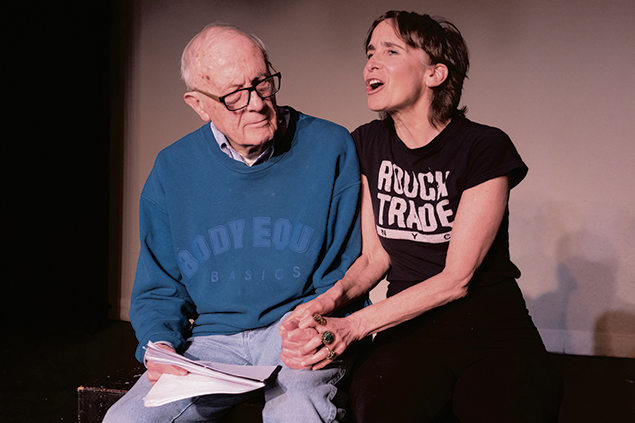
So after Roberta died, “we were sitting shiva at my house, and Elizabeth” — that’s Elizabeth Browning, a performer, director, and acting coach who is good friends with Marla — “came over for shiva.” Sort of. Ms. Browning had been at Ms. Mase’s funeral, and it was Shabbat, so it wasn’t really shiva, but “she told me that she heard a voice telling her to go to shiva, so she did.” Unsurprisingly, she was the only person there then.
And then, Ms. Mase asked her father to read her friend some of the stories he’d written.
So, some backstory. Dr. Mase had written these stories, as he calls them — shorts bits of memoir — when he was in his late 40s and early 50s. “They are coming-of-age stories,” he said. “Friends would come over, and I’d read them, and we’d talk.” The stories were pointed, poignant, and funny.
“Let me give you some background on those stories,” Dr. Mase said. “When I was in my 50s, in 1984, I dealt with some health issues. I had non-Hodgkin’s lymphoma, and I spent a year in chemo and then I got back to work. And yes, given the amount of time that’s passed between 1984 and 2026, I have a fundamental confidence that it’s gone.
“It was around 1988 when I started thinking about myself and my life, given that I had been dealing with these life issues. And then I had a big aha — and I know that I am not the first person to say this, and certainly I know this as a psychologist — when I realized that a fundamental way to look at life is to realize that it is all about change.
“That starts when we are born, learning to walk and to talk. Then we move on to school, finding and building relationships. And then we’re young adults, and we’re finding someone we love, and then we get married, then we have children.” All are life changes; everyone experiences at least some of them, and life’s challenge is in handling them.
“So I started to get into thinking about my life, and about universal themes, themes that happen in just about everyone’s life. I wrote stories about my experience with change and growth and moments that made a difference in my life.
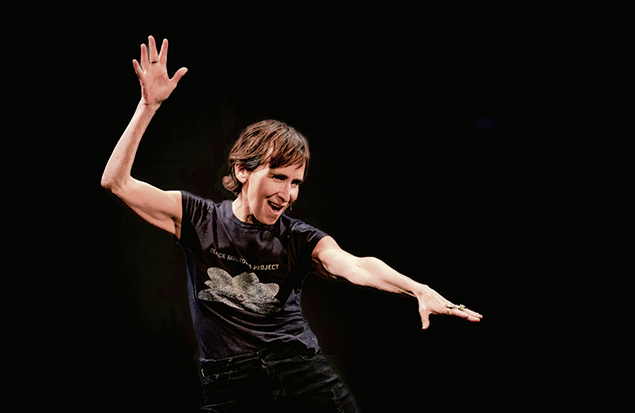
“I was writing and writing, but it wasn’t for publication. I wasn’t a writer. But all of a sudden I had 14 stories written — this was pre-computer, even pre-word processor, and so they’re all handwritten — “and another 500 or so that I could write. And then I said enough. I did my thing, I wrote, and then we talked about them when people came over, and then I put them away in a drawer.”
Later, when his wife developed dementia and his was more and more bordered by her illness and his caretaking, his life changed again. And then, when she died, it was clear that more change necessarily was about to come.
So when she, Ms. Browning, and her father were alone in her parents’ house on the Shabbat of her mother’s shiva, Ms. Mase thought about her father’s stories again.
“My father had an expression, ‘Where do you get your love from?’” Ms. Mase said. Among the many places where Dr. Mase gets his love is his stories. So she suggested that he read some of them out loud to Ms. Browning.
“I read her the stories, and she is suddenly laughing and crying, and then she said, ‘Howard, there is a show in this thing,’” Dr. Mase reported. Ms. Browning, after all, is a director, and his daughter is a performer, so that idea came naturally to them.
“And I said, ‘Who are you kidding?’ I am not a guy who stands on stage and memorizes lines.
“And then Elizabeth said the magic words. ‘You can bring your script on stage.’”
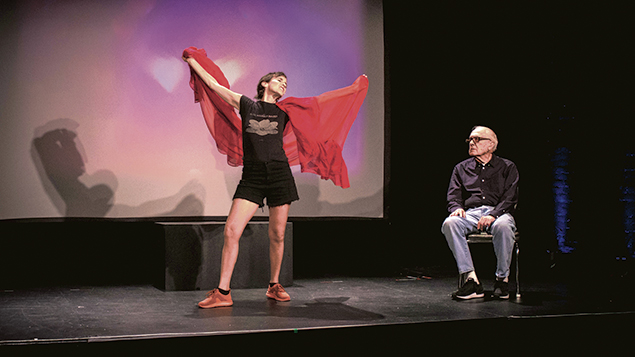
And that was that — except, of course, for all the arranging. Which was not nothing. But somehow everything worked out.
“It was miraculous,” Ms. Mase said. “My dad losing my mom made him willing to do things he wouldn’t have done before.” Those things included driving up to Peekskill for rehearsals.
As Marla and Howard Mase worked on the play, Ms. Browning realized that although Dr. Mase did intend to memorize his lines — and given that he’d written all of them, had read them out loud many times over many years, and now was saying them over and over again, he did not really need the security of the script even though he was glad to have it — he had an innate sense of theatricality that made him easy to direct.
And “it’s all about adapting to change,” Dr. Mase said.
“It’s also about aging,” he continued. “I am 90, and I don’t believe that I act as if I am 90, if acting 90 means just sitting around. But it affects my work as a psychologist and executive coach. I often work with people who are thinking about retiring. I ask them how they will replace the love they find in their work. It is a solid question and raises interesting responses.”
The show that the pair presents is Dr. Mase’s stories, which alternate with Ms. Mase’s stories or songs. His mainly are about growing up in Brooklyn in the 1940s, and hers is about growing up there in the 70s. “My stuff is more over the top, more Brooklyn,” she said. “His are more questioning.” They’re both very Jewish because that’s the world they grew up in; hers go into detail about how the whole world then and there was either Jewish or Italian. “Who were those Protestants we heard about in shows?” she asked.
The themes they touch on are universal, but it’s the specifics that add energy and humor. “Just about every time that we’ve done the show, when it’s over I go and mingle. And just about every time, someone has come over to me and said, ‘That story you told? That happened to me.’”
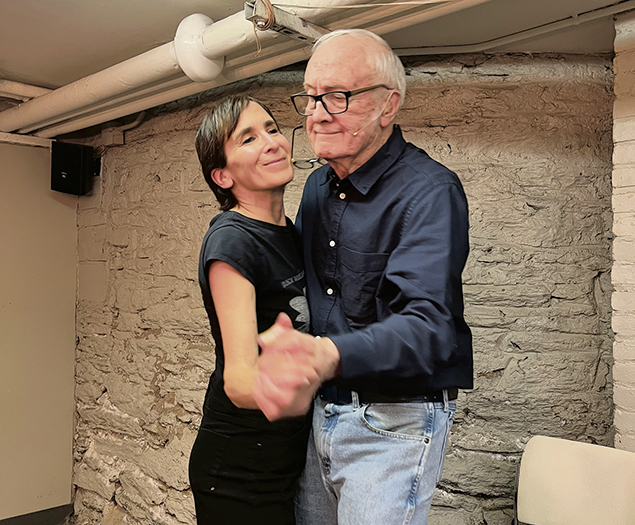
And then there’s the undercurrent that runs beneath both of their work. “The unspoken part that people love is that this is a real father and a real daughter doing a show together,” she said. “They see the real love. People often tell us after the show that it makes them miss their father, or wish that they’d had a father like mine, or a relationship like ours. It brings up so much about people’s family history — what they had and what they miss and what they wish they had.”
The two of them are onstage through the performance; one listens as the other holds the stage. Ms. Mase’s themes generally echo her father’s, in a different style and tone. “There’s just one part that we do together,” Ms. Mase said. “That’s the one part that I wrote recently,” Dr. Mase added. It’s about Roberta Mase’s death, and bring the real-life characters they play into the present. It shapes the performance into an arc.
“I have a strong belief in the power of storytelling and of being in a community,” Ms. Mase said. “That’s why I love theater so much. If you can tell your story standing in a room, sharing it with a community, it makes people feel closer. We need that more and more and more. There is so much power in being together. And I don’t only want to tell my own story. I want to hear other people’s stories too.”
They returned to aging. “If you are physically healthy and mentally sound, you are never too old to be young,” Dr. Mase said. “That is one of the upfront messages of the show,” Ms. Mase added. “Here is a 90-year-old man, vibrantly telling stories. He discovered something new when he was 87.
“I started doing music in my early 40s,” she continued; she’s since put out many albums.
“One final thought,” Dr. Mase said. “I think that happiness is having something to look forward to.” “I don’t disagree, but this is the father/daughter thing,” Ms. Mase retorted. “I believe more in this present moment.
“And,” she added, putting the obvious into words, “we are very close.”