What would David do?
Remembering a beloved father on what would have been his 98th birthday
Today would’ve been my father’s 98th birthday. The last time he and I celebrated the date of his birth was on October 15, 2012.
My father, David Miller, was 84 then, and almost unrecognizable if you knew what he used to look like. His frail, gaunt frame and pallid skin tone belied an exuberant spirit, and he loved his birthday and wouldn’t have missed the chance to enjoy the festivities with me.
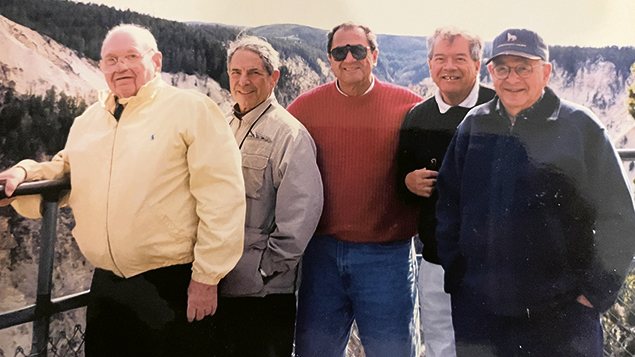
As I held the door open for him to Fair Lawn’s local haunt, The Brunch Club, my father walked with purpose to the booth that his favorite waitress, Rose, led us to. He was eager to enjoy his usual fare at what had become his usual breakfast spot. He, my late father-in-law, Paul, and their three buddies — Ed, Lionel, and Sy, all from Fair Lawn — had been enjoying weekly Saturday morning breakfasts at the luncheonette, which stood at the corner of a busy strip mall on Fair Lawn Avenue for decades.
The group, affectionately known as the “breakfast club,” enjoyed lively conversation, laughs galore, and harmless jabs that kept each other on their toes. At the end of each week, each tossed $20 into a kitty, overseen by an appointed treasurer who tallied the till at the end of the calendar year. The money collected went toward the cost of a group vacation to Eastern Europe, Las Vegas, Southern California, the national parks, Iceland, or Israel.
The beloved restaurant is long gone, and so is the strip mall. So is my dad. But the memory of that sweet morning remains fresh in my mind.
I’d invited my friend Peter, a retired scientist from Wyckoff, to join us, and Dad was thrilled. I’d connected the two a few years earlier because of their shared interests in history, geography, culture, and literature, their similar political views, their similar senses of humor, and eerily, the similar bouts of cancer that they’d both survived. When Peter and Dad met, they became so engaged in conversation and so enamored by each other’s company that onlookers were known to pay their bill. It was only when they’d be ready to leave that their server would inform them that the “nice man sitting next to them had covered it.” People enjoyed observing the two converse so freely and with such pleasure.
It is perhaps my father’s ability to initiate and engage in meaningful conversation that I miss the most. There was nothing he couldn’t talk about. He was an attentive listener who heard what you said and remembered what he’d heard; often he asked follow-up questions during later conversations, reflecting his investment in your career, your relationships, your day-to-day experiences and your life. He had a knack for making everyone feel welcome, special, understood, and heard. His ability to express himself openly was unlike that of many men his age. He wasn’t afraid to show you how much he loved you. He said it with his words, he demonstrated it in his affection, he wrote it in his letters, and he always meant it.
For 35 years, as its principal, he judiciously oversaw middle school students at Thomas Jefferson Junior High School as they clumsily navigated the uncharted waters of adolescence. With precision and fortitude, he ran a tight ship. Students feared him, teachers respected him, the community applauded him. His stern facial expressions, postures, and gestures were the signs of a tough disciplinarian. At home, my brother and I always knew when he was disappointed or angry. Everyone aimed to be on his good side, including my husband, Jay, who coincidentally endured three years of junior high school under Dad’s tutelage. With reverence (and prudence) he continued to call him Mr. Miller throughout our married life.
Dad’s advice, though not always solicited, was thoughtful and wise. He was certain to consider all angles and seemed to know intuitively when a path I might be choosing was not necessarily one that might turn out best. He believed in taking chances and learning from experience. In later years, when the challenges I was facing were not ones he’d experienced himself, he trusted me to figure it out, even if it meant he couldn’t protect me when things went south.
Whether it was my bold and impulsive move to Los Angeles immediately after college, a complicated relationship that had no chance of going anywhere, an illness resulting from an influenza vaccine that could and should have been cared for at home in New Jersey by my parents, but instead resulted in my recovering (suffering) alone, or an equally impulsive relocation to Boston that for too many reasons to count was quite simply wrong, he took a back seat and didn’t judge. Looking back on some of the decisions I made in my life and the resulting fallout, I wonder how I survived. Perhaps it was knowing in my heart that whenever I wanted or needed him, he’d be there to embrace me with open arms and provide a soft place to land.
When I moved back to New Jersey — and closer to my parents — a decade later, my father marveled at the thoughtful way I conducted my job search; my knack for balancing business travel with a budding relationship; my skills in planning a wedding and buying a home; my ability to care for a premature baby, research and manage the medical care of a child born with a rare disease, raise our three sons, and respectfully support the cadre of relatives who were moving into later stages of life and needed a smart and resourceful advocate. He inspired me to stretch my mind and natural talent further than I’d ever have without his influence and support.
On this day, as I look back on the catalogue of memories of my father that my mind holds dear, I reflect on how he chose to celebrate life. He refused to be brought down by gossip. He greeted toll booth workers and gas station attendants with the same warmth and good cheer that he did his colleagues. Like his late father, Simon, a skilled glazier, who alongside his brothers joined a crew that climbed 750 feet to install glass in Boston’s Prudential Center, Dad believed in the value of hard work. He cherished his relationships with his wife, family, and friends, and lived Jewishly, hoping to pass down the traditions and rituals that were important to him and to his children and grandchildren.
My father was book smart and street smart, an avid reader, a learned educator, a defender of our country, a connoisseur of classical music and opera, a collector of stamps, a well-respected school administrator, a skillful mechanical drawer, a talented singer. He understood the world — geographically, culturally, linguistically, historically, and politically. He didn’t always make the best decisions, but when he made them, he stood by them, rarely faltering or second guessing.
His friendships stood the test of time, and, I’d like to think I’ve inherited his ability to make and be a friend. I rely on my friends to support me in a way my late parents used to; looking to them for guidance and direction while navigating the changes in my adult life. I often wonder: what would David do as I find my footing with my newly retired husband in the house, consider how to make important healthcare decisions, budget for collecting Social Security, update our wills and advanced directives, reconcile frightening cancer diagnoses befalling my friends. and deal with the pain of unexpected losses. I talk to him often — sharing my worries, fears, and uncertainties. While doing so, thoughts swirling in my head, I believe he knows I’m struggling. WWDD? What would David do?
In a stroke of sheer luck, I somehow was able to save one of the last voice mail messages he’d left on our land line before we disconnected our service. The kids, of course, knew how to save the recording to my computer. Even without listening, his signature tagline remains in my head: “I’m here if you need me.”
I can hear his voice proffering advice in slogans: “Leave well enough alone,” “Don’t think so much,” “Know your worth,” “Use your head,” “Slow down,” “Let your husband wear the pants,” “Tell your kids you love them,” “Buckle your seatbelt,” “Watch your pocketbook,” “Zip your jacket,” and his personal favorite that covers any scenario possible: “Keep it under 100.” Maybe these reminders are familiar to every daughter who loved her father, but to me, they represent the touchstones of a man who taught me that I was strong, I was smart, and I could do hard things.
So on October 15, 2026, the day he would’ve turned 98, what would David do? LIVE.