‘Vilna’ explores the moral quandary of the Judenrat
The tag line for the new Holocaust play “Vilna,” now at the Theatre at St. Clement’s on West 46th Street, is “If God created monsters, He also created heroes.”
The heroes playwright Ira Fuchs refers to are two historical figures, Motke Zeidel and Yuri Farber, who were part of the “burning brigade.” The Nazis sent this group of 80 men and women to the Ponar killing fields outside of the city of Vilna to dig up and burn corpses, so there would be no evidence of the Nazi slaughter of civilians. The women were responsible for cooking and laundry; the men excavated and burned many thousands of bodies, sometimes coming across the corpses of people they knew.

Knowing that they would be killed whenever they completed their grisly work, some of the men decided to dig an escape tunnel. Most of the escapees were shot as they ran from the tunnel, but eight survived the war, my uncle among them. Recently, a group of scientists and archaeologists discovered the remains of the tunnel using specialized equipment called Electric Resistivity Tomography. That effort was described in an episode of the PBS science series “NOVA” titled “Holocaust Escape Tunnel.”
The play “Vilna” begins long before — too long before — when Motke and Yuri are schoolboys. We see the embedded anti-Semitism among the Poles (Vilna was part of Poland at the time) when Motke’s elegant physician mother must bribe an official to enable her husband to continue his glove manufacturing business. Yuri, an orphan, joins the Zeidel family as he and Motke become best friends at school. The boys’ personalities are lightly sketched: Yuri is a by-the-rules straight ahead boy, destined to be an engineer; Motke is the looser, more-resistant-to-authority type. He eventually becomes a lawyer.
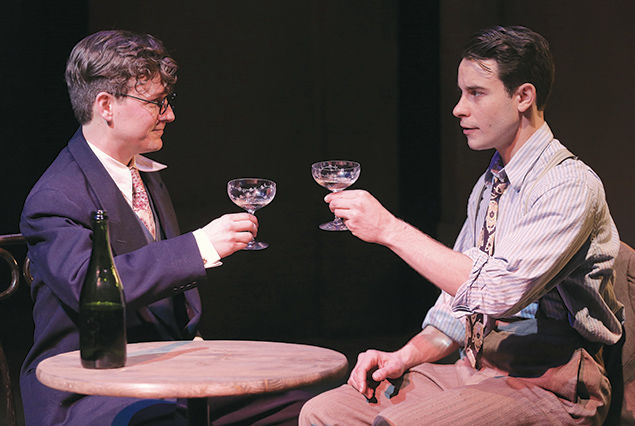
The most original and intriguing aspect of “Vilna” is Fuchs’ bold choice to make heroes of members of the Judenrat, the Jewish governing council of the ghetto. In most survivor communities, these people who collaborated with the Nazis were considered traitors and worse. Fuchs makes the reasonable, if chilling, argument that many more Jews would have died of hunger, disease, and plain wretchedness if the Judenrat had not organized bathhouses, soup kitchens, hospitals, schools, and other community services, and enforced strict adherence to the rules. The fact that the Judenrat also provided the Nazis with selections of Jews to be killed and cooperated with thugs and criminals to maintain order is presented as a necessary sacrifice for the greater good.

“Being a Jew is like gravity, it always pulls you back,” a Vilner rabbi tells Motke when he objects to studying his bar mitzvah portion. The same is true of the Holocaust. No matter how many books, films, plays, or TV series are produced, there is always some new tale that pulls us back in. And in these days, when the familiar crude anti-Semitism of the first half of the twentieth century seems to be making a comeback, it’s useful to be reminded of where it once led.