‘The person you met was the person there was’
Remembering Rabbi Eliezer Diamond’s struggles and triumphs
Rabbi Eliezer Diamond of Teaneck, who died on December 11 at 73, was a hard man to contain in any one obituary.
He was a master teacher; it is objectively true to say that he was beloved by his students because the vast outpouring of love, grief, and gratitude that met the news of his death make that truth inescapable.
He had a complicated life, plagued by internal challenges, at first star-crossed and then blessed by love, moving across theological barriers, guided by a palpably deep spirituality and a jaw-droppingly broad body of knowledge that embedded him deeply in the Jewish world.
Elliot Diamond was born in Long Beach, off western Long Island’s south shore, in 1952; his brother, Melvin, followed three years later.
Those prototypically 1960s Jewish names didn’t stick with the brothers for long. One summer at Camp Moshava, they decided they would go by their Hebrew names. When their parents came to pick them up and asked for Elliot and Melvin, the counselors said; “Who?” They went home with Eliezer and Menachem. And that was that.
Long Beach, like most of Long Island then, was Jewish and Italian; the Jewish community there was strong, Rabbi Diamond’s widow, Rabbi Shelley Kniaz, said. His father, Rabbi Edward Diamond, grew up in Newark, and “sometimes he’d sneak out to hear Joachim Prinz,” the German-born rabbi who was active in the civil rights movement, a friend of the Reverend Martin Luther King Jr. and the leader of Temple Bnai Abraham.
Later, Edward Diamond was ordained at Rabbi Moshe Feinstein’s yeshiva, Tifereth Yerushalayim, on the Lower East Side. “He was a pulpit rabbi for six months, and then he became a public school teacher in Long Beach,” Rabbi Kniaz said.
His wife, Gladys Weiss Diamond, was a pharmacist. “She went to Columbia during the war,” Rabbi Kniaz said; the war was World War II. “The school was integrated, and the students would go out together. At least one of the women was Black, and she wasn’t allowed into a restaurant, so they all left.”
After they married, Rabbi Kniaz reported, Rabbi Diamond talked his new wife into teaching chemistry at the school where he worked. It would be convenient; they’d have the same schedule and the same days off. Ms. Diamond tried it and hated it but stuck it out, and after the first year she loved it, and students loved her.
So, teaching — and being beloved as a teacher — also ran in the family.
Going back a generation, Gladys’s mother, Blanche Weiss, was “a character,” Rabbi Kniaz said. She was born in Poland, but her father was recruited to be a kol bo — a religious leader who could do more or less anything, in her father’s case act as “the chazan, the shochet, the melamed, the everything” — in County Cork, Ireland. Eventually they came to the United States, but she kept her Irish accent. “She was really out there, and Eliezer adored her,” Rabbi Kniaz said.
She and her husband, David Weiss, lived close to the Diamonds, and Eliezer used to love visiting them. She took Eliezer on his first rain ride, from Long Beach to Island Park and back – a 20-minute round trip. He remembered the rattan that covered the seats of those already-very-old cars.
As public-school teachers the Diamonds did not become rich, but the teachers’ union was powerful, and they were able to afford to work hard all year, moonlighting at second jobs, but take the entire summer off. They had a small house in Long Beach and a bungalow in the Catskills.
And through a benefit the union won for its members, “they got perks like free trips to Europe,” Rabbi Kniaz said. “They loved to travel, and they traveled all over. Both his father and Eliezer went to the Soviet Union to meet with refuseniks when Eliezer was in college. I think the first time he went to Israel was in 1963 — really early — and they had to make three stops in a diesel plane to get there. You could smell the fuel, he said. They were there when the Six-Day War broke out.
“So Eliezer had a lot of experience that he got through traveling. This family, which lived so modestly, did so much traveling.”
Although Rabbi and Ms. Diamond both taught in a public school, they wanted a day school for their sons. So, “three years before Eliezer was going to start kindergarten, they founded the Hebrew Academy of Long Beach,” Rabbi Kniaz said. When he started, the school went up to second grade; it added a grade a year. “His father did the same thing with high school,” she said. “He was a co-founder of the Mesivta of Long Beach.”
The school had been envisioned as a place where secular studies would flourish alongside Jewish ones, and it began that way, but eventually “the rabbeim started taking over and moved the school to the right.” Her husband told her a story about “sitting at the piano, playing a Beatles song by ear, and the rabbi asked him what he was doing. ‘Playing the piano,’ he said. The next day there was no piano.”
Rabbi Diamond drew the inspiration for his book “Holy Men and Hunger Artists: Fasting and Asceticism in Rabbinic Culture,” which Oxford University Press published in 2003, from that experience. “He was very drawn to it, because people there walked the walk,” Rabbi Kniaz said. “He said it was like a Jewish monastery. They were so devoted to Talmud Torah. His thesis was that Jewish asceticism was not a goal in itself but rather a byproduct of wanting to spend all your time and resources on Talmud Torah.
“He started there as a rebel, but by his third year he was becoming one of them, and his father pulled him out,” she continued. His father had been working as a guidance counselor at Yeshiva University and arranged it so that his son would skip his senior year of high school and start at YU.
“He majored in English literature there, and he went to rabbinical school. He was ordained there. He was at the rav’s shiur, and that’s where he really fell in love with Talmud.”
It was then, though, that the bipolar condition that he’d had all his life, and that remained undiagnosed until he was in his 40s, began to bedevil him, Rabbi Kniaz said. And he also developed problems with alcohol, problems that eventually led him to a turning point in his life. Through a residential dual-treatment facility, AA, and a halfway house, he began a life in recovery.
It was also at that point, right after he was ordained, that Rabbi Diamond decided to work toward a doctorate in Talmud at the Jewish Theological Seminary. It was a hard move — many people saw it as a defection, even as a betrayal.
“There were scholarly questions that Eliezer couldn’t ask at YU, and paths of study that he could not take at YU,” Rabbi Kniaz said. “The role of women increasingly bothered him, too. He met with Ismar Schorsch,” the chancellor of JTS, “and Rabbi Schorsch said, ‘Come here. We’ll get you funding.’”

Still, it took him a year, and some broken friendships, to make that move. “He ended up with a foot in each world,” Rabbi Kniaz said.
Meanwhile, his brother, Menachem, moved in the other direction. He’s the rosh yeshiva at Chofetz Chaim in Jerusalem, the father of 10 children, and the grandfather of an even larger number of grandchildren. These differences did not divide them; the two families always have been close.
So Rabbi Diamond began to teach at JTS. “That’s where I met him the first time,” Rabbi Kniaz said. She was a student in his Mishnah class at JTS in the fall of 1985. That was her second year of rabbinical school; she was ordained in 1988. Rabbi Diamond was then teaching at Drisha, the modern Orthodox school founded to offer women advanced text study — now it admits men too – and they ran into each other. He suggested she apply to Drisha, but she was ready to take some time away from school at that point.
The next time they met was after a string of missed phone calls and voicemails. They were both divorced, but she didn’t know that. “I got a message from Eliezer on my answering machine,” she said. “He had a reputation as a very compassionate, caring person. He would write long letters to students if he thought he had hurt them. I thought that he called me because he had heard that I had recently divorced and thought I might need support.
“It took us months to connect. I had been looking at a job in Baltimore, and I knew that he had been teaching there. So I asked him about the Jewish community there. Later, he told me that he had an ethical dilemma. If he told me the truth, I might move to Baltimore. If he didn’t tell me the truth, well, then he wouldn’t be telling me the truth. So he compromised. He told me the truth about Baltimore, but in a very flat tone, with no enthusiasm.
“And we had a long conversation about Baltimore.”
When they finally established that neither of them was married, Rabbi Diamond asked Rabbi Kniaz out on a date.
Their first date was to the theater; she’d bought a subscription for two, so that she could go with a guest. The play was “Oedipus Rex.” “We held hands,” she said.
“And then he asked me out again. Our second date was at Abigael’s,” a kosher restaurant in midtown, “for dinner. I got there on time. He was late. And I knew exactly what must have happened. He must have forgotten where we were supposed to meet. He was the perfect example of the absent-minded professor, and remember, this was before cell phones.”
What to do?
“I used the phone at the restaurant and left a message on the voicemail at his office, here’s the address, here’s the number, but he didn’t think of calling in for messages. He went to where he thought Abigael’s was, but there was a treif Chinese restaurant there. He didn’t know what to do.
“So he went to a pay phone and called a live operator and said, ‘You have to help me. I have to meet this woman. I don’t have the address.’ She asked him the restaurant’s name but he didn’t know it. But, he said, it is a kosher restaurant, and he told her the neighborhood.”
She found it.
“So I was sitting at the bar for 45 minutes, and the bartender kept asking me if I was sure that he was coming, and then they gave me the phone, and I said, ‘I’m still here, and I will look out the window for you.’
“Eliezer always came to class with tons of books and papers flying all around him, like a cartoon character, and I see him across the street, running past the restaurant, looking like that, and I say, ‘Eliezer, I am here.’”
They got married about a year later. “It was so bashert,” Rabbi Kniaz said. They lived downtown and belonged to Town and Village Synagogue, which they loved. “It was the first time Eliezer heard a woman chazan, and although he accepted it, he had to get used to it. But Cantor Lorna Wallach was an incredible davener.”
The question of egalitarianism increasingly bothered him, Rabbi Kniaz said.
Their son, Matan, was born in 1998, and Rabbi Diamond’s older four children were with them on weekends, Jewish holidays, and in the summer. The couple decided that they needed more space. They moved to Teaneck and joined Congregation Beth Sholom there. “It’s a wonderful shul,” Rabbi Kniaz said.
Their house is on Magnolia Road in Teaneck; it’s a short street with an unusually close group of neighbors. They’re so close, in fact, that they have a name for themselves. Moshav Magnolia. And it’s not as if everyone on the block is Jewish. They’re not. But that feeling of sort-of-communal living, where everyone knows and cares about everyone else, is real there, and the culture is so baked in that when houses turn over, the new neighbors join the older ones and the culture survives.
Rabbi Kniaz listed some of her husband’s speaking and teaching engagements. There are too many to list here. It is an impressive list. Until 2024 he was the Rabbi Judah Nadich Professor of Talmud and Rabbinics at JTS; he also often was a speaker in residence, where he was sought after for his combination of erudition, warmth, and humor, and for his singing voice. “He was very funny,” Rabbi Kniaz said.
Rabbi Diamond adored his children and was extremely proud of them. He doted on his seven grandchildren. His greatest joy was visiting them, hosting them, and babysitting for them. He was fortunate in that most of them lived relatively close to him. “Aviva and her husband, Matt, live in Fair Lawn; they have three kids,” Rabbi Kniaz said. “She’s an RN. David served in the IDF and studied in Israel. He teaches Hebrew at the university in Tucson, Arizona. He has one son. Tova is a physician’s assistant and also has three children; she lived in Cherry Hill but now she’s moved to Bogota, Colombia, for two years. Her husband, Andrew, is in the foreign service and was posted to the consulate there.”
“Yoni is a prosthetist. He treated wounded Ukrainian soldiers here in the States and in Poland. Matan made aliyah in 2019. He served in the IDF, in an Arabic-speaking unit, and he’s studying social work at Ben Gurion University in Beer Sheva.”
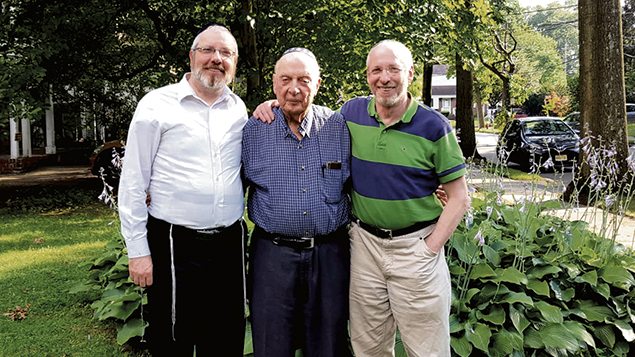
Rabbi Edward Diamond stands between his two sons, Rabbis Menachem and Eliezer, in Teaneck in 2022.“There are several themes that I hear when people talk about Eliezer,” Rabbi Kniaz said. “They said that he was an outstanding teacher, and that he was a mensch. And he felt that the Torah has a direct importance in our lives. For him, studying Torah was not an esoteric, abstract study. It always had meaning that could be applied to our lives.
It’s all about connections, with people and with students and with the Torah and the Talmud and the tradition and with God, and Rabbi Diamond did it straightforwardly, clearly, and with love. He didn’t do it easily, he always was informed by his own struggles — he couldn’t not have been — and he always kept working at a problem until he found the solution, driven by everything he knew.
Barry Lichtenberg lives in Teaneck; he knew Rabbi Diamond from Beth Sholom, and he also was a student at the Mesivta of Long Beach, although he was some years behind him. Mr. Lichtenberg spoke at Rabbi Diamond’s funeral.
Rabbi Diamond “was a singular religious personality,” Mr. Lichtenberg said. “He bridged the yeshiva world and the historical world, and he taught two generations of JTS rabbis.
“He was a rebbe. JTS has great scholars and teachers, but not so many rebbes. Other rabbis would call him for personal, pastoral, halachic questions, and he could speak to them in a way that others could not.
“One of the reasons was that his life was full of challenges, and he emerged from that with an ability to talk to people in a way that few others could. And he really was a very unusual man. He listened, he responded, he had firm opinions — very firm, very passionate opinions — and he respected what you had to say in a very deep way.
“You could really confide in him, because he had been there.”
Shai Held, who was ordained at JTS, where he studied with Rabbi Diamond, is the president, dean, and chair in Jewish thought at the Hadar Institute.
“The first thing I’d say, and I know that this might sound a little cliched, is that he was an incredibly sweet, gentle person.
“Here’s the thing. Eliezer’s life was not easy. He struggled with depression. He struggled with alcoholism. He was pretty open about it. He was just the most real person. He was utterly devoid of pretense. The person you met was the person there was.
“The word I use for it is the Yiddish word emesdikeit.” Emes — emet in Hebrew — means truth, so emesdikeit is truthfulness. Realness. Authenticity. He embodied it.”

Because of his bipolarity, Rabbi Diamond sometimes was overwhelmed with depression, and his students saw it. “There was one semester when he was my teacher when it was 50/50 about whether he was going to show up in class.”
Another student of Rabbi Diamond, now a rabbi himself, wrote: “One day he’d give an amazing class in Talmud, and he was so alive and so passionate. And then the following week, we’d assemble in his classroom around his desk, and he’d be sitting with a can of Diet Coke, and he would not be able say a word.
“This too is Torah.”
“I loved him,” Rabbi Held said. “He was incredibly real. He never hid the fact that life was hard for him/
“The thing I found so moving about him and Shelley is that if you don’t believe in redemption, you never saw Eliezer and Shelley.
Rabbi Julia Andelman of Teaneck was both a student of Rabbi Diamond’s and directed many of his videos as the director of community engagement at JTS. She knew Rabbi Diamond for 25 years; she met him when she was in rabbinical school. “Eliezer was a powerful spiritual teacher and role model for me, as he was for hundreds and hundreds of other people,” she said.
“And he also was the architect of every one of my life cycle events.”
That began when she was installed as the rabbi of a shul; it also encompassed her wedding, her son’s bris and naming ceremony, and her divorce. Because Rabbi Andelman wanted to mark each of those occasions both halachically and in a way that was unmarred by the gender dynamics that they generally include, each took a great deal of thought, care, and creativity. Rabbi Diamond took her need to mark her transitions in that way very seriously, and he was successful.
He also davened beautifully — “it was completely in his blood and his genes and his soul,” Rabbi Andelman said. “And the nusach wasn’t a technical thing with him.” It was, instead, a way to lose himself and look for God.
“He set a very high bar for all of us.”