‘The Only Living Pickpocket in New York’
Noah Sagen explains his very Jewish, last-of-his-kind protagonist
Director Noah Segan has hit it out of the ballpark with his second full-length feature.
Mr. Segan’s first, 2022’s “Blood Relative,” was a funny and at times poignant movie about a road trip taken by a middle-aged man and the teenage daughter he just discovered he had. The man, Francis, is Jewish. And oh, he’s a vampire.
The film was inventive and well received by critics. But given the economics of the business, it did not receive a wide theatrical release
Now comes the just-released “The Only Living Pickpocket in New York,” the best picture I’ve seen this year and already justifiably mentioned as an Oscar contender.
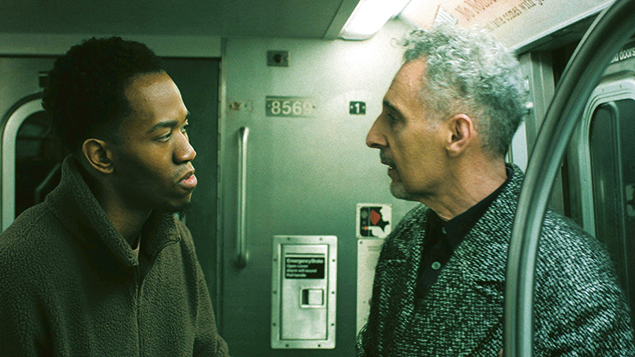
It stars John Turturro as Harry Lehman, a master pickpocket who has outlived his time. In his prime, people carried cash, not plastic. He didn’t have to worry about wallets that contained air tags or cell phones made worthless because they can quickly be reclaimed at the press of a Find My Phone button.
Still, Harry gets by — until he breaks into a rich kid’s car and discovers a gym bag with a cash-rich wallet, a USB stick, and a gun. They are the belongings of Dylan Diamond (Will Price), the scion of a ruthless crime family. Dylan and his pals track down Harry’s address, break in, and hold his very ill wife hostage until he returns the USB stick, the computer key to a crypto account.
But the stick’s long gone, and we watch as Harry races around the city — he hits all five boroughs — to find it. And though I know it’s a cliche, New York is a character. There is something special about the energy of a film shot in the Big Apple, often guerrilla style, with a camera hidden under a coat. And it’s made even greater by the performances of two quintessential New York actors, Turturro and co-star Steve Buscemi, a Bronx pawnbroker who buys Harry’s ill-gotten gains.
And that is what most of the reviews I’ve read are all about: Harry’s exciting chase around the city to reclaim the USB stick. If they mention Harry’s relationship with his wife, it is only in passing. Rosie (Karina Arroyave) is in a catatonic state, and the tenderness and the devotion with which Harry treats her, the tenderness with which he carries her up and down the stairs of their apartment building, the warmth he lavishes on her, never receiving a response, is to my mind the singularity that makes this film great. Without it, it would just be a movie about a grifter aging out of a job.
But Harry’s interactions with Rosie not only establish him as a mensch, but make sense of everything leading to the surprise and dead solid perfect denouement.
I Zoomed with Mr. Segan about this and other subjects, including his childhood as an actor.
“I acted as a kid in real bit parts,” Mr. Segan said. “I think my parents approached it as an extracurricular activity for your kid. We were not athletes in my family, so whatever anyone did, it was cerebral. We never took it more seriously.”
But that changed. He discovered he enjoyed being on set. Ultimately, Mr. Segan decided to forego college and joined “the show business circus.”
He worked for a cinematographer and supplemented his income by taking whatever acting job came along. A turning point in his life occurred when he met Rian Johnson of the “Knives Out” films, “Star Wars: The Last Jedi,” and “Looper,” among others, who cast Mr. Segan in his first film — and every film he’s helmed since then.
By outward appearance it would seem that Mr. Segan was a success. It would seem.
“It depends on your definition and metric of success,” Mr. Segan said. “For a lot of my life, as a single guy with not very expensive tastes or a lot of overhead, I was able to survive as an actor. But I was never successful enough to be able to support a family.”
He married TV writer and producer Alison Bennett, and when they had their daughter, he decided to stay home and be a house husband and daddy. He understood that “in coming from independent film, nothing gets done unless you wear multiple hats.”
So he spent much of this time writing scripts. At the end of the year, he had about “four scripts in the hopper,” including “Blood Relative.”
I wondered where the idea for that script came from.
“I think the idea originally was to write about my culture and what happens when you become a father,” he replied. “Everything had to start with a character who all of a sudden discovers that he became a father, which is what I was going through.
“Then I thought about vampires, because that’s sort of how I felt. I’d spent a lot of time staying up late and partying and getting into all kinds of stuff. And now here I am and I’ve got a family and I love them. It’s a different form of life.
“Then of course there is that sense of otherness that has long been associated with Jews, the blood libel, the prejudices that have dogged Jews forever.”
During that fertile period at home, Mr. Segan also wrote an early draft of “Pickpocket.” “I wanted to talk about someone who was caught between two worlds,” he said. “Someone who was out of time, literally and figuratively, how they face the world as it changes around them.”
I mentioned how key the relationship between Harry and Rosie was to making the film work. “I appreciate that,” he said. “And if you talk to Karina or John, I think they would believe the same thing. It’s about a man who has been very selfish but here he is at this moment, dedicating his life to caring for someone he loves, and that is a very effective storytelling device.”
I suggest that the older people become, the more heartfelt — and realistic — their relationships are. “Quite frankly, that is something John and I have talked about,” Mr. Segan said. “Both John and Karina have had personal experience not much dissimilar from what happens in the film.”
There were only two questions left.
First, is Harry Jewish? “You don’t think a guy named Harry Lehman is Jewish? He’s got a mezuzah on his door.” That of course left it up to me to mention that on those old buildings in the Bronx, every apartment had a mezuzah on the door.
Mr. Segan concedes the point, but notes that “the opening scene is at B&H dairy,” the kosher restaurant that is a New York institution. End of argument.
Finally, Rian Johnson’s production company produced the film, and I wondered if he was upset because Mr. Segan didn’t cast him in it.
“First of all, I can’t tell you what, but he does have a cameo, so you may have to watch it once or twice,” Mr. Segan said. “I also let hm direct one shot. There’s a shot of a microwave. It’s a static shot, and I said to Rian, ‘I need you to call action.’ So you see there was still a little bit of collaboration happening there.
“Maybe if I get to make another movie, I’ll give him a major speaking role.”
To set the record straight, not only did Mr. Johnson get to say “Action,” he was also allowed to say “Cut.” What a pal.