The Jews of St. Eustatius
From their Caribbean island, they helped spur the American Revolution
Who knew? Caribbean Jews and the American Revolution? St. Eustatius?
“The First Salute” at the Weitzman National Museum of American Jewish History in Philadelphia is a landmark exhibition focusing on the integral role that Jews played in the American Revolution. It has been cleverly described as “Hamilton meets the Pirates of the Caribbean,” and this special display will be on view through April 2027.
The Weitzman is only a short walk from Independence Hall, where the Declaration of Independence was signed 250 years ago. The museum is the perfect venue for this very important exhibit honoring the country’s semiquincentennial. It spotlights a momentous chapter in history that is not just a Jewish story but an American one. It has been in the shadows for too long — but it is now receiving the recognition it deserves.
“Before 1825, the largest Jewish communities in the Americas were all in the Caribbean,” Dr. Laura Arnold Leibman said. She’s a professor of American Jewish studies at Princeton University and one of several scholars who worked on this consequential exhibition. Though it’s not well-known and often forgotten, the tiny Caribbean Island of St. Eustatius, affectionately called Statia, is only eight square miles but was a robust center of international trade in the eighteenth century.
According to Dr. Leibman, St. Eustatius had “twice the Jewish population of either New York or Philadelphia.” Indeed, about a third of the island’s European population by 1776 was comprised of Jews (primarily Sephardim), who were all too familiar with European persecution, especially given the Alhambra Decree expelling “Jews and Jewesses” from Spain in 1492. In 1496, Portugal adopted a similar policy.
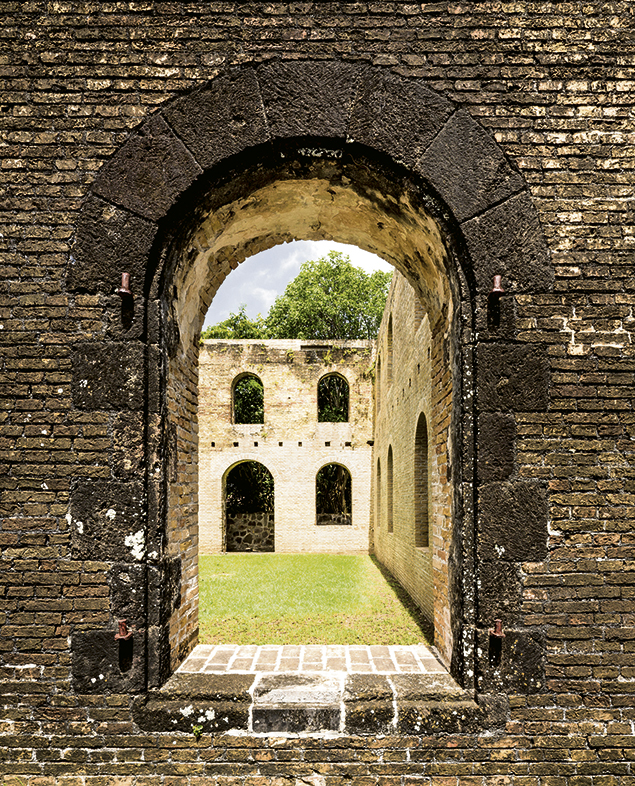
Under Dutch rule, the Jews of St. Eustatius enjoyed freedom of religion and trade; they established an active community that bolstered a vigorous economy, contributing to the island’s reputation as “the greatest emporium upon earth.” In 1730, a Jewish cemetery was founded in Oranjestad, the island’s capital and largest town. A two-story synagogue named Honen Dalim (Gracious to the Poor) was built there in 1739 and was visible to ships approaching the port of Oranjestad. As merchants, traders, ship owners, and financiers, the Jewish islanders appreciated the commitment to “life, liberty, and the pursuit of happiness” and used their ecosystem of commercial associations to smuggle gunpowder, weapons, and other goods to aid the American revolution.

The governor of St. Eustatius, Alida Francis, spoke at the museum in late April and proudly acknowledged: “The Jewish community of St. Eustatius did not stand at the margins of history. They helped move it. … Eustatius was not a footnote in the American story. It stood near the foundation of the fight that gave birth to the United States.”
Just three months after the signing of the Declaration of Independence, the Andrew Doria, one of the first ships the Continental Congress authorized for use in the newly established navy, sailed from Gloucester, New Jersey, into the deep harbor of St. Eustatius, flying the Grand Union flag. Its mission was to deliver a copy of the Declaration of Independence to Johannes de Graaff, the island’s Dutch governor, and to buy cloth, arms, and ammunition for the Continental Army. On November 16, 1776, when the American brigantine arrived at the main entrance of Oranjestad, Captain Isaiah Robinson of the Andrew Doria authorized a 13-gun salute for the 13 new states. In response, Governor de Graaff ordered the firing of his cannons from Fort Oranje. This was the very first recognition of the sovereignty of the United States by a foreign government; it has become known as the First Salute.
The museum display includes a historic cannon and three 18th-century cannon balls from St. Eustatius. Although historians can date them, they cannot be certain that the cannon was fired as part of the island’s formal tribute, but it’s likely that it was.
By early February 1781, a squadron of 15 British ships from the Royal Navy, carrying several thousand troops, invaded St. Eustatius. British Admiral George Brydges Rodney commandeered the island, targeting the Jewish community. He called for a “day of reckoning for the Jews … they cannot too soon be taken care of.” The island’s Jewish residents sent a protest letter to Admiral Rodney, claiming “numbers of families are now helpless, disconsolate, and in an absolute state of indigence and despair.” Unmoved, the admiral compiled the “Rodney Roll,” a list of male inhabitants and their inventories. (The museum display includes a copy with the entry for Moses Myers, a merchant who became insolvent due to Rodney’s raid; eventually he moved to Virginia.)
In quick order, Jewish men were imprisoned or deported on charges of treason. Homes were looted, warehouses were emptied, and the synagogue was destroyed. In April 1781, Admiral Rodney insisted: “Had it not been for this infamous island, the American rebellion could not possibly have subsisted.”
Admiral Rodney’s actions and words suggest a mix of avarice conflated with antisemitism as the motivation for such harsh treatment of the island’s Jewish population. He was so consumed and preoccupied with plundering and punishing the Jews on St. Eustatius that he delayed action and missed intercepting the French fleet that was making its way to North America to aid George Washington. This ultimately led to the British surrender at Yorktown that ended the American Revolution.

There are a lot historical documents contextualizing Jewish alliances across the Caribbean to North America and Europe. For example, after a devastating hurricane hit St. Eustatius in 1772, an appeal was sent to Jewish communities throughout the Atlantic. The exhibit includes a receipt from Honen Dalim thanking Congregation Shearith Israel in Manhattan for its “pious donation.” The headstone of Hannah (née Robles) Mears is another reminder of the interconnection of the island’s Jewish residents. Hannah was the wife of Samson Mears, who was born in New York but relocated to St. Eustatius where he became a prominent goldsmith and silversmith; she probably was related to Jacob Robles, the last chazan of Honen Dalim.
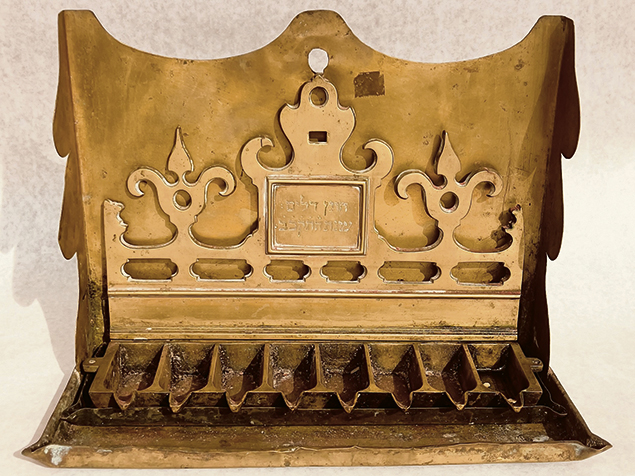
It is interesting to see several rare artifacts of Caribbean Jewish religious life. That includes the sterling silver besamim (spice) container from Amsterdam that was given to the historic Mikvé-Israel-Emanuel Congregation in Curaçao in 1706. The brass bench-style Chanukah lamp inscribed Honen Dalim 5522 (1761) also is significant. After the British invasion of 1781 it was moved to St. Thomas for safekeeping, and it might be the only surviving Jewish ritual object from St. Eustatius.
Speaking at a reception at the exhibition’s opening, Governor Francis said: “We honor not just an island, but an idea: that even the smallest place can help shape the course of history; that even the quietest voices can echo across centuries.”

It is in the cemetery but not at her gravesite.
By the early 19th century, the last of the island’s Jewish community was dispersed around the Caribbean and the Americas.
The exhibition concludes with a compelling video showing St. Eustatius today. Evoking the Jewish past of this Caribbean island and its foundational relationship with the United States, there are views of the surviving outer walls of Honen Dalim and the Jewish cemetery with its entrance gate. Seated in the space that had been the synagogue’s sanctuary, a vocalist, accompanied by a guitarist and harpist, sings the meditative and resonant lyrics written by Leonard Cohen in “If It Be Your Will”: “I will speak no more…. From this broken hill, all your praises they shall ring. If it be your will to let me sing.”
Dr. Fred B. Adelson of Cherry Hill, professor emeritus of art history at Rowan University, earned his Ph.D. in art history from Columbia University. He has curated exhibitions and contributed essays to museum catalogs, and his writing has appeared in the New York Times, Courier-Post, Philadelphia Inquirer, and New Jersey Monthly.