Taking a Torah to a new home in Poland
A group from Fair Lawn gives a gift to a small shul in Warsaw
A sefer Torah — a Torah scroll — isn’t precious only because of the words written on it.
Those words are black fire on white fire.
But they’re also part of a physical object.
A sofer — a scribe — painstakingly writes each of the 304,805 letters in a sefer Torah. This is a task for which perfectionism is not encouraged. It is demanded. The words are written on animal-skin parchment, with a quill pen, using special ink, which must, among other specifications, be able to move with the parchment when it is rolled and unrolled.
When a Torah is damaged — when, say, the ink that is made to withstand being rolled and rerolled eventually fades or flakes — it must be fixed or buried. It cannot be used if it is imperfect — that makes it not kosher — and it cannot be discarded. It must be buried, as if it were a human body.
Because each sefer Torah is a handmade work of love and art and self-discipline, each one has its own story.
There are many communities in the world that do not have a sefer Torah. Many of them are in Europe, in places where synagogues were vandalized or destroyed during World War II.
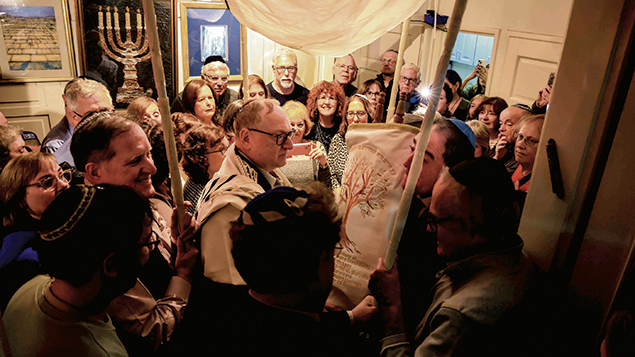
There also are many synagogues that have more sifrei Torah than they can use. There are many reasons for that situation; one of them is when shuls merge and each brings a few to the combined community.
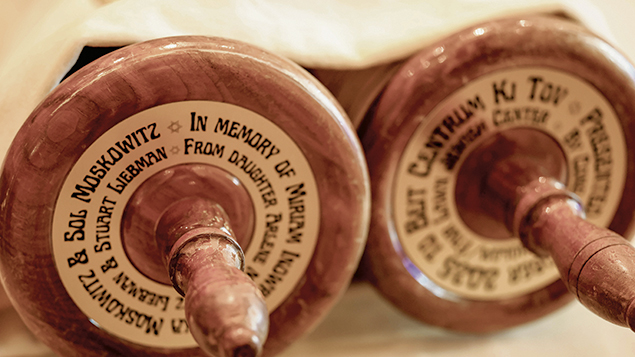
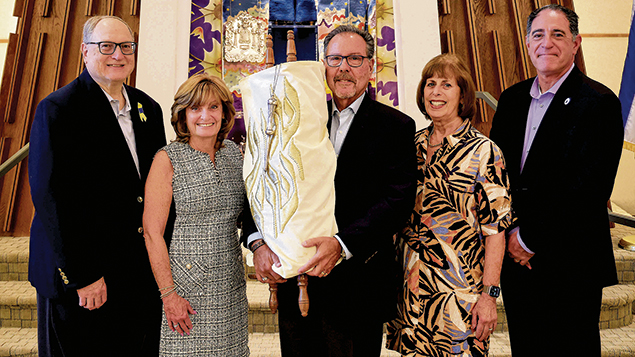
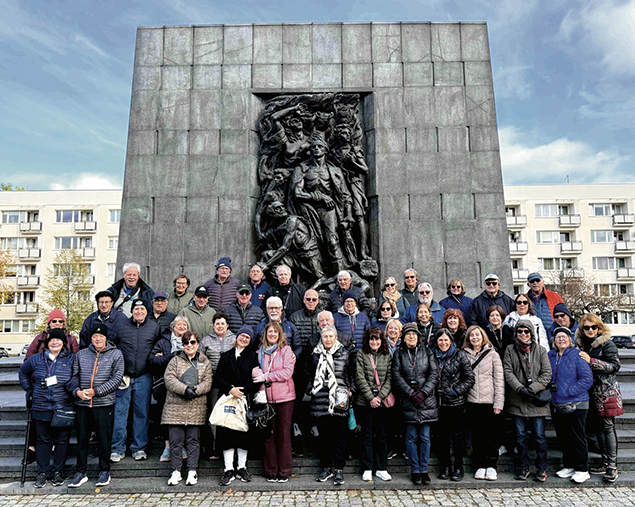
That’s the position that Congregation B’nai Sholom/Fair Lawn Jewish Center found itself in after Temple Beth Sholom and Fair Lawn Jewish Center/Congregation B’nai Israel merged about two years ago. The new shul had more sifrei Torah than it could use — as the result of not just the most recent merger but other, earlier, ones, it had more than 20 — and its leaders knew that there are communities that have none, or fewer than they need. So in October, a group of 40 people, all shul members, went to Poland to donate one of their extra Torah scrolls to Ki Tov, a Masorti synagogue in Warsaw. (B’nai Sholom is Conservative; the Conservative movement is called Masorti outside North America.)
The donated Torah came from eastern Europe, so, broadly speaking, it was returning home. It was donated by Arlene and Stuart Liebman in memory of Arlene’s parents, Holocaust survivors Sol and Miriam Moskowitz, who were born in Poland.
Neil Garfinkle is the president of B’nai Sholom. He’s a lifelong resident of Fair Lawn. “I grew up as a member of Temple Beth Sholom,” he said. “I had my bar mitzvah there. And now I’m president.”
He’s a retired Holocaust educator; he taught high school history as well as the Holocaust at George Washington High School, right over the George Washington Bridge in Washington Heights, for 30 years. He’s the veteran of many trips to Germany and Poland with the Holocaust and Jewish Resistance Teachers Program, which was created by Warsaw Ghetto survivors and spearheaded by survivor Vladka Meed in 1984. Mr. Garfinkle started taking the trips when he was a fairly new teacher, “and 16 years later, from 2015 to 2018, I was asked to lead it,” he said. “It was incredible.”
Mr. Garfinkle is not the child of survivors. He didn’t even focus on the Holocaust until he took his first trip. “I was a young teacher, 29 years old, and I had just gotten engaged,” he said. “When you’re not married and you don’t have kids and you are a teacher, you can do things like that. It looked like an amazing opportunity, so I applied.” And he was accepted.
Ms. Meed, who had been stuck on the Aryan side of the ghetto during the uprising, was a powerful person. “She changed my world,” Mr. Garfinkle said. “I was a history teacher, but she made me want to focus on the Holocaust. I became a fellow at the Holocaust museum in Washington. I do what I can. So when they asked me to lead the trip, it was like coming full circle.”
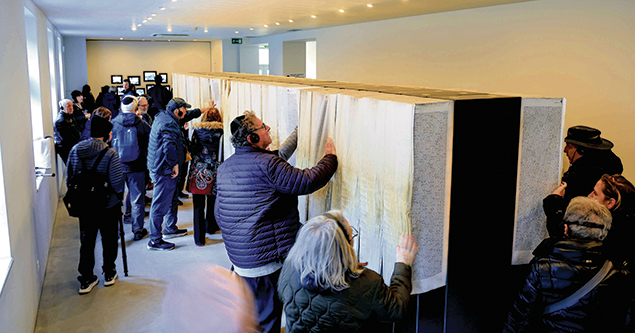
The Fair Lawn trip to Poland and Germany included a stop at Auschwitz. “It was my sixth time there,” Mr. Garfinkle said. “I am president of the congregation, and I was able to lead the trip.
“I was the youngest person on the trip” — he’s 55 — “and I was the only one who had been there before. Many of the others were children of survivors. They had felt they should go, knew they had to go, but hadn’t wanted to go, and then they said, ‘Let’s go with Neil.’”
The group went to four concentration camps, and “we debriefed after each one of them,” he added.
Now that he’s retired from teaching, “I’m working as a museum educator for the Museum of Jewish Heritage” in downtown Manhattan, Mr. Garfinkle said. He loves this volunteer position. “I can give a tour, and if little Johnny on the tour is a pain in the butt, I don’t ever have to see him again,” he said gleefully.
Thinking about the tour again, “leading the congregation was just so special,” he said.
Steven Montag is a past president of the Fair Lawn Jewish Center. He’s from Queens and his wife is from the Bronx — a mixed marriage! — but they’ve lived in Fair Lawn for 38 years. He’s the son of a Holocaust survivor, Esther Meppin Montag, and it is that inheritance that impelled him to take this trip.
“My mom was from Kielce, which is on the road between Warsaw and Krakow,” he said. In a way, the stop there was also an accident — or perhaps it was a gift. The trip planners knew that their bus would have to stop somewhere between Warsaw and Krakow, because Polish law mandates that a bus driver can’t be on the road for more than two hours without taking a break. “I mentioned to the tour leaders that it would be amazing and wonderful for me personally, and for the group in general, to stop in Kielce.
“It’s historically important, because that’s where the pogrom of 1946 — after the war ended — occurred.”
In 1940, Jews made up about 35 percent of Kielce’s population, Mr. Montag said. “It was an important city, with a great synagogue. A lot of rabbis came out of Kielce.”
His family had been affluent and middle class, he added. “My grandfather managed an ironworks factory. Other family members worked in retail.”
In 1941, the Germans pushed the city’s Jews into the ghetto they created there, and then they shipped more Jews, crowded them all into a small, necessarily unsanitary space. In August of 1942, the Germans liquidated the ghetto, sending the Jews they felt could not be useful slave laborers to Auschwitz, Treblinka, and other death camps. They completed the liquidation in three days.
Those useless Jews included anyone 14 or younger. “One of the things Kielce is known for is the memorial to the 45 children who were gathered, brought to the cemetery, where a hole was dug, and they were shot and killed on the spot,” Mr. Montag said. “One of those children was my great-aunt’s child. My grandmother’s maiden name was Zilberstein — she was Eva Zilberstein Meppin — so my aunt, who married into the family, was Guta Zilberstein.
“At the time, the Zilberstein family had 11 brothers and sisters. Three of them, my grandmother, my great-aunt, and my mother, survived.
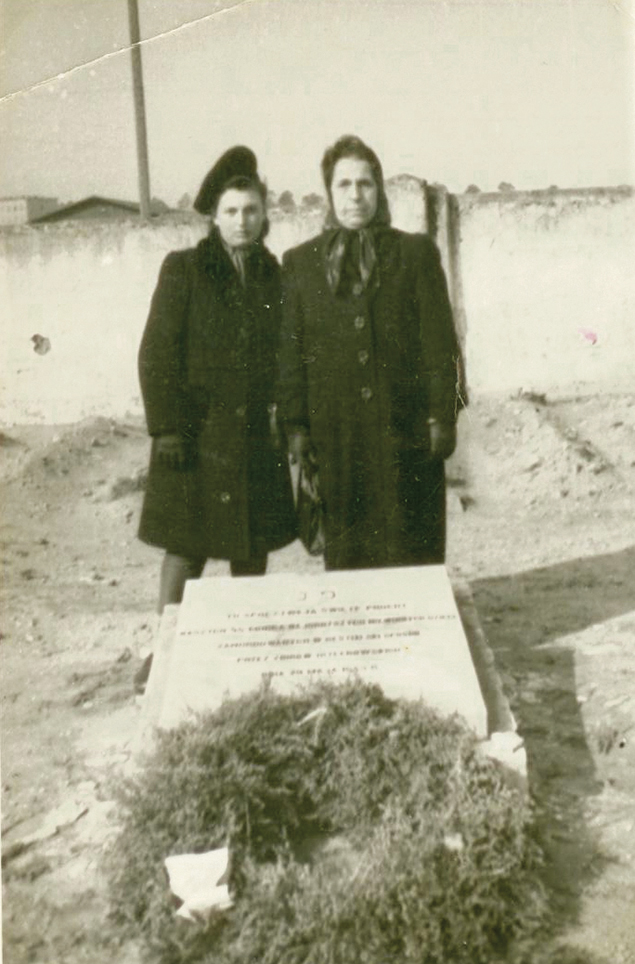
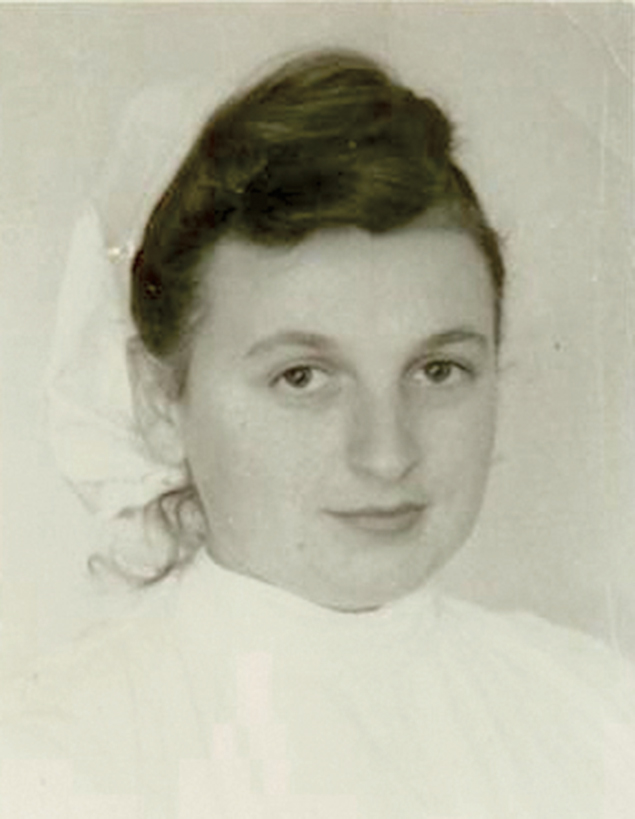
“My mother was born on January 20, 1928. She was tall. The family made her look like she was able to work, and the story she told is that her uncle hid her in a duffle bag, and that saved her.
“In May of 1943, they were sent to a labor camp called Pionki, where there was an ammunition factory. She made bullets. Later, she said that she tried to sabotage the bullets by spitting into them when she could. There were these little ways in which people rebelled when they could.
“In 1944 they sent her to Auschwitz. Her father and mother were sent there too, and she never saw her father, Shulem Meppin, again. She found out later that he was gassed.
“She got a number tattooed on her arm in Auschwitz. She was A-14861. Then she was sent to Bergen-Belsen.
“The people who survived were the ones who were sent to different labor camps,” Mr. Montag said. “The ones who died either were sent immediately to Treblinka to be killed, or got sick or couldn’t work well enough or they starved or they died for hundreds of other reasons.
“My mom was fortunate in that she was strong enough and capable enough so that every few months she was sent to work in different places. She was also sent to Buchenwald and finally ended up in Bomlitz. That’s because she had a skill set. She learned how to work with chemicals to make gunpower.” Her mother had the same set of skills, and the two were shipped from camp to camp together.
“That was in the spring of 1945. It was toward the end of the war, and the Allies were bombing a lot of the camps, so 800 of the prisoners at Bomlitz were corralled into a cattle car. Then a bomb hit the tracks, the train flipped over, and she and her mother were able to run away into the forest.
“Her mother was born in Russia and she understood Russian,” Mr. Montag continued. “So when they were in the forest, scavenging, she heard voices speaking Russian, and they heard tanks. So they ran toward the Russians, and that’s how they were saved.
“Of the 800 people on that train, only 200 survived,” he added.
His mother’s aunt had survived separately; they reconnected in America many years later.
The Russians handed Mr. Montag’s mother and grandmother to the Red Cross, who asked them what they wanted to do. “Do you want to go home?” The two women said yes. “They had expected other family members to have survived as well.” But everyone else was dead.
“They went back to Kielce, only to find that their house had been destroyed,” Mr. Montag said. “They had no place to live.” That’s when they learned that his grandfather had been murdered in Auschwitz.
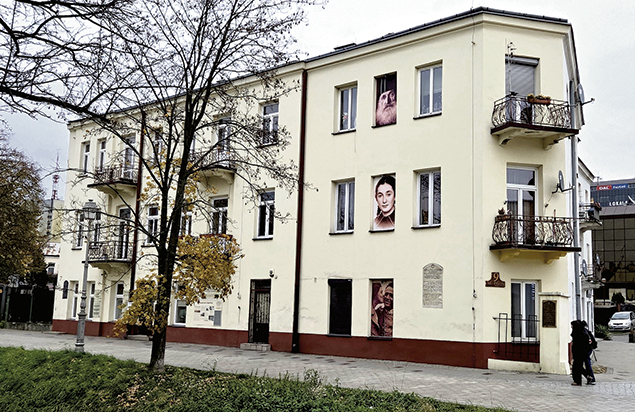
“My mother and grandmother and many other Jews who survived and came home to Kielce were put up in a tenement house,” he continued. “It was 7 Planty Street, and they and about 150 other Jews lived there. They were trying to get their lives together, waiting for the Joint and other Jewish organizations help them get to Palestine or America or anyplace else.
“Time went on, and almost a year after they got there, in July 1946, there was a pogrom.
“The story was that a young child, a young Polish boy, left his house without telling anyone and didn’t come back for a couple of days. When he did come back, his father asked him what happened. The boy didn’t want to get punished for what he’d done, so he said, ‘A Jew took me and hid me in the basement for three days, until I got away.’
“The father was irate, and told other people, factory workers, what had happened. They ran through town, screaming ‘Who took the child?’ and the boy pointed out a Jewish man by 7 Planty, and they started to attack the building.
“The townspeople became a mob, and the police stood by and allowed the mob to break down the building’s doors and windows.
“Forty-two people, Holocaust survivors, died in that pogrom, and another 80 were injured. My mom was on the second floor of the building. The mob had to work their way up the tenement. They dragged people out and killed them. My mom tried to help. There was a man who was injured — his forehead was severely cut — and one of the other women went to get bandages. She was shot.
“About 100 people survived. About half of them were wounded. The townspeople pillaged the building, took all the food.”
There was a groundbreaking documentary made about this pogrom in 2016. “Bogdan’s Journey” was made by Bogdan Białek, a Polish Catholic who was tired of living with the buried trauma. “In the documentary, the stories are about people yelling ‘The Jews have lots of food! Let’s take their food! Their flour! Their rice!’” Mr. Montag reported.
Eventually the police showed up and stopped the murderous riot. But “there is a river that runs through the town,” Mr. Montag said. “Many Jews were thrown into the river.” In the following days, “there was a parade of coffins.”
Eventually, his mother and grandmother got out of Poland and made it to America. How did they do it? How did they have the fortitude?
“I think it is the will to survive,” Mr. Montag said. “The Jewish people have a belief system that suggests that they don’t want to let their enemies win. The belief is that we will survive, and God will keep us going.
“And my mom was an unbelievably strong woman. She always made the case that Hitler did not accomplish his goal. The ‘final solution’ was not final. It did not kill all the Jews, and we are here to remind people of that. We are the ultimate survivors.”
With the help of the Joint, his mother and grandmother ended up in Ansbach, Germany, where they lived for a few years. “My mother trained to be a nurse, and she ended up as an obstetric nurse,” Mr. Montag said. “She delivered 42 babies in Ansbach and then in New York, and some of those babies remained in touch with her.”
His father, Abraham Montag, had a relatively easier time, although certainly by normal standards it was not easy. “He was from Tarnogrod, in Poland, near the Russian border,” Mr. Montag said. “At the beginning of the war, people could escape from Poland to Russia. He was one of five siblings; he and his family were able to survive.”
His parents met at a dance, married, and lived in Brooklyn. “My mom never wanted to go back to Poland,” Mr. Montag said. “She had no desire to go back. She didn’t want to give them any tourist dollars.”
That brings us to this year. “Our congregation is planning the trip, and I said to my wife, Rona” — that’s Dr. Rona Riegelhaupt, who is a pediatrician — “that this is a once-in-a-lifetime opportunity, and I think we should take it.
“There was a lot of support on the trip. About half of us are second-generation survivors, and we all felt that we needed each other’s support.”
The Fair Lawn group “visited my mom’s house in Kielce, where the pogrom happened, and we visited the cemetery,” Mr. Montag said. There’s a museum downstairs, where the whole group looked around. “I had a real desire to see upstairs, where my mom was,” he continued. “We couldn’t take everyone, but my wife and I were allowed to walk up the stairs, which were untouched since 1946. There had been only eight or so apartments, for 150 people. It was amazing to see how they lived, what an ordeal it was.”
Both of his parents are dead now, but Mr. Montag thought about what his mother might have felt about his visit to 7 Planty. “I think she would have been okay with it,” he said. “It would have been too traumatic for her.”
Seeing the place where his mother had lived and suffered helped him understand more of what she’d been through. It explained some of the geography and how places connect to each other — an understanding that he couldn’t get from maps.
Was it odd to see places in color that he’d probably imagined in the black-and-white of old photographs and newsreels? No, Mr. Montag said, because “it was a gloomy, overcast day in late October. It looked the way I imagined it.
“But it was so cold, and it was impossible to imagine how these people, who had been clothed so lightly, could have withstood it.”
The trip was deeply moving for him, Mr. Montag said, particularly now, with antisemitism once more on the rise.
“It is important to learn the lessons of what antisemitism can do,” he said. “Normal neighbors kill their neighbors. My mother’s family coexisted with those neighbors before the war. Many of them had shopped in her aunts’ and uncles’ store. But antisemitism can rise to the point where neighbor can kill neighbor. My mother felt it was important to continue to tell that story.”
So the experience that the Fair Lawn travelers had was mixed, from the lows of the cemetery and 7 Planty in Kielce to the highs of bring the sefer Torah to its new home, where it was welcomed with joy.
All the travelers went home enriched by all those experiences, the bad and the good. They also came home bonded more closely to each other, and to the merged synagogue that had provided the reason for the journey.