Repairing the world – Jewishly
Kaplen JCC partners with social service organization geared to the young
How do we repair the world? Clearly — with the overwhelming number of problems we face today — no one person or organization can accomplish that lofty goal, or even prioritize the problems that need fixing.
Still, one group — brave enough to make “repair the world” both its name and its mandate — is committed to the idea that service, paired with Jewish learning, can mend at least one thing at a time. It can also bring people together across communal divides, Lisa Bodziner, Repair’s senior director of national expansion strategy, said.
Ms. Bodziner, who has worked with the national organization since 2022 — before that she was the executive director of Hillel at the University of Maryland — is proud that the organization has expanded. Formed in 2009, it now has more than 300 partners and has engaged some 3,500 participants.
Targeted to young Jews between the ages of 18 and 39, Repair the World urges them to join for hands-on service paired with Jewish learning. In fact, every volunteer project has a learning component, Sue Gelsey, CEO of the Kaplan JCC on the Palisades in Tenafly, said. They recently entered into a partnership with Repair. To date, Repair has a presence in 11 communities.
High school and college students already are eager to be involved in community service, Ms. Gelsey said. “It’s their closest connection with their Jewish Identity.” The national organization’s pitch — “Live your Jewish values alongside your neighbors and address urgent issues like food insecurity, homelessness, and educational inequity” — will likely resonate loudly with this group, she added, noting that it will be more challenging to attract people in the next age cohort, particularly those with young families.
If Repair cannot mend the world, it can nevertheless “mobilize Jewish young adults and their communities to take action through service and learning that strengthens communities, deepens Jewish connection, and responds to urgent needs,” and that can have a cumulative effect, Ms. Bodziner said.
In addition, Ms. Gelsey noted that working together on service projects with members of other communities helps fight stereotypes and ultimately reduces antisemitism. She pointed out that the JCC’s new partnership with Repair was facilitated by the Russell Berrie Foundation. She already had worked with them when she was at the JCC Association. “They supported a new initiative of mine, ‘Community Calls,’ with a grant,” she said. “It’s a coalition of state-based and community-based organizations reflecting all heritages, doing work together to strengthen relationships.
“When Repair contacted the foundation, with the goal of embedding professionals into community organizations, they reached out to me, since I had already established these community relationships,” she continued. “It closed the loop. Community Calls was already looking to do hands-on projects.”
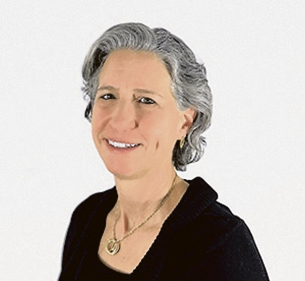
JCC staff member Avishag Ravid is the point person in the JCC’s new partnership with Repair, working with community groups to identify needs and bring them to the attention of Repair, which will help craft solutions. “This speaks to the core of our mission,” Ms. Gelsey said. “We developed relationships and now we are looking to flip the switch and make real change.”
Ms. Ravid, who began in August, spent her first months meeting and learning from her community partners. In these meetings and conversations, food insecurity was consistently mentioned as a significant local need and an important area for service. Aging and isolation also were identified.
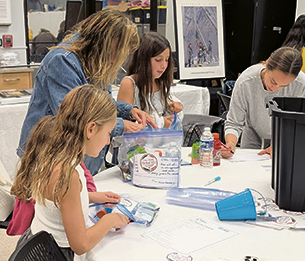
In the short time she has held her new position, Ms. Ravid has done a great deal, including running programs for two National Days of Jewish Service, one for teens and one for families. The programs, a Repair initiative, focused on honoring and supporting first responders. More than 100 volunteers assembled more than 450 care kits for first responders in the region.
The programs included Jewish learning and reflection around 9/11, remembrance, gratitude, and teshuvah. Participants also wrote thank-you notes to first responders. Ms. Ravid is now coordinating opportunities for interested volunteers to help deliver the kits, giving them the chance to meet some of the first responders they supported and express their gratitude in person.
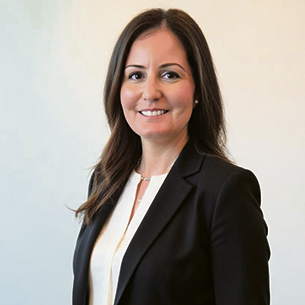
“We received very positive feedback from participants, and many asked about additional volunteer opportunities,” she said. “It was encouraging to see such strong interest in continuing to serve beyond these two days.” The next National Days of Jewish Service will take place over MLK weekend in January.
Within the JCC, Ms. Ravid is working with Senior Adult Services to find opportunities to connect community members with older adults. She is also looking to develop volunteer opportunities connected to the JCC greenhouse. Another initiative she is exploring is bringing back Heart-to-Heart, a volunteer effort that began after October 7 to support Israeli families arriving in the area.
Working with community organizations is also on her agenda. “We are meeting next week with Bergen Family Center to discuss their Thanksgiving food drive and potential opportunities for collaboration,” she said. “Following our meeting with Rev. Sanetta Ponton of Metro Community Church, we are also exploring ways to partner around the Open Store. Opportunities could include collecting clothing, helping with preparation and sorting beforehand, and volunteering during the Open Store itself.”
“It feels like the culmination of various parts of what we’ve done for years,” Ms. Gelsey said. “Part of our mission is how to engage people, to provide gates for Jewish engagement, since there are different ways for people to connect Jewishly. It’s a perfect match for us. We’re hopeful that in a few years we’ll look back and see that real change has been made.”
Ms. Bodziner believes that every act matters and that “there are infinite ways to engage young adults.” In addition, she said, “Deepening people’s experiences will make service a core value.”
In conducting Repair’s programs, she said, “education is the secret sauce.” Also, since needs are different in each place, and at different times, it is crucial to learn about each particular community. While Repair is the lead in each partnership, “we don’t do things in a vacuum.”
The organization is looking to create 10 new hubs. The goal is to engage a specified number of participants in each and to identify “local ambassadors” who can be trained as leaders.
Ms. Bodziner said that participation increased by more than 50 percent after October 7, and that most volunteers have remained with the program. “It’s a way for young adults to feel they can be part of a larger community without endangering their own identities,” she said, adding that Repair is in national partnership with the JCA, Hillel, and 13 bridge-building cohorts across the country.
She is proud of Repair’s continued commitment to excellence. “We set a high bar,” she said. “Our work is meaningful, deep, and excellent.” And, she added, “service connects to Jewish identity, deriving its DNA and inspiration from tradition.”