Remembering Rabbi Yosef Adler
Master educator, visionary leader, compassionate and passionate Jew
While eulogizing his father, Rabbi Yosef Adler, on September 21, Dov Adler apologized for wearing a long-sleeved shirt.
His inside joke was understood instantly by the hundreds of people who were at the funeral in Israel or watching the livestream from elsewhere: During his 43 years as founding rabbi of Teaneck’s Congregation Rinat Yisrael and his 30 years as head of the Torah Academy of Bergen County, Rabbi Adler was famous for wearing a short-sleeved button-down shirt regardless of the season.
He was also famous for his loyalty to the New York Yankees. Rabbi Adler always asked eighth-graders interviewing for a spot in the freshman class at TABC — it’s a high school for boys — to name their favorite baseball team, and Yankees fans usually left the meeting feeling especially confident.
Sleeves and sports aside, Rabbi Adler, 74, was renowned in Bergen County and beyond as a master educator and visionary leader. His centrist Orthodox worldview and approach were profoundly influenced by the late Rabbi Joseph B. Soloveitchik — “The Rav” — from whom he received rabbinic ordination in 1977 at Yeshiva University. In 2008, Urim published Rabbi Adler’s “Haggadah for Passover with Commentary Based on the Shiurim of Rabbi Joseph B. Soloveitchik.”
Following the example that Rabbi Soloveitchik set in Boston, Rabbi Adler championed women’s adult education and communal roles in Orthodoxy. Nearly 20 years ago, he was the first Teaneck rabbi to hire a “yoetzet halacha,” a female scholar certified to advise women on matters of Jewish law pertaining to their bodies. This initiative was embraced by the local female laity, enabling them to ask intimate halachic questions they’d been too embarrassed to ask their rabbis.
Nevertheless, most of the local rabbinate didn’t accept this innovation; to this day, only five of the approximately 15 Orthodox synagogues in Teaneck participate in the yoetzet halacha program.
Rabbi Adler also advocated the inclusion of people with special needs. TABC hosts the Sinai Schools’ Rabbi Mark & Linda Karasick Shalem High School for 14- to 21-year-old male students who are classified with developmental, neurological, or intellectual disabilities.
Donna Hoenig of Teaneck, who worked with Rabbi Adler for 27 years at TABC as director of admissions and as a learning specialist, said Rabbi Adler established the first yeshiva high school-based Learning Center in Bergen County in the belief that “every Orthodox boy deserves a yeshiva education.”
Ms. Hoenig said the entire staff was touched by Rabbi Adler’s sensitivity when he readily agreed to inaugurate an annual Pink Day fundraiser at TABC at the initiative of student Tzvi Solomon of the class of 2009. Pink Day, later adopted by some 200 Jewish institutions internationally, benefits Teaneck-based Sharsheret, a worldwide organization supporting Jewish women with breast and ovarian cancer.
“Most remarkable was that each year on Pink Day, Rabbi Adler wore something pink,” Ms. Hoenig said. “One year, his wife, Sheryl, made him pink tzitzit out of felt with white cloth fringes, and he wore them to his Wednesday women’s shiur” — Torah class.
Rabbi Adler was among signatories of the 2010 “Statement of Principles on the Place of Jews with a Homosexual Orientation in Our Community.” This 12-point paper, crafted and endorsed by centrist Orthodox rabbis, educators, and communal leaders, encouraged synagogues and schools to welcome “Jews with homosexual orientations or same sex-attractions” and to “display sensitivity, acceptance and full embrace of the adopted or biological children of homosexually active Jews” while reiterating that “halakhic Judaism cannot give its blessing and imprimatur to Jewish religious same-sex commitment ceremonies and weddings.”
Rabbi Adler’s career as a Jewish educator paralleled his career leading Rinat Yisrael from its 1979 inception until his retirement in 2021. He oversaw the congregation’s growth from a handful of families to approximately 430.

Before joining TABC in 1991, he taught Talmud and American history at the Frisch School in Paramus for nine years, then became associate principal at Hillel Yeshiva High School in Deal, and finally coordinated the advanced Talmud department at the Ramaz School in Manhattan.
In an interview for a Yeshiva University publication in 2011, Rabbi Adler said that nobody at shul or at school ever suggested that he cease working for the other one. He expressed his commitment to both growing institutions even though giving time to both meant forfeiting private time.
“During the week I’m in the school, and on weekends I’m in the shul,” he was quoted as saying. “I teach in the shul three shi’urim a week, at night. So I don’t have evenings, daytimes; it’s just full-full-time. But as long as I’m healthy and I can do it, and I can help my kids out financially as a result, I’m continuing to do it.”
Speaking at the funeral, the Adlers’ two sons and two daughters — Dov Adler of Teaneck, Chedva Rothenberg of Passaic, and Zvi Adler and Michal Jacob of Modi’in, Israel — said their father helped with homework, learned Torah with them, and chauffeured them to activities, despite his 24/7 communal responsibilities. He considered their spouses his children as well, Sheryl Adler said.
“He wanted to make his children feel loved and respected and happy,” she said. For example, “my husband used to carpool our youngest daughter every Friday from Yavneh, and would stop at Toys R Us and get them all little tchotchkes. He took our kids to a lot of Yankee and Giant games; people were always giving him tickets as a thank you.”
One time, somebody gave him two tickets to a Giants game. Rather than choose either Dov or Zvi, then about 8 and 9, to accompany him, he took both boys to the stadium and waited in the parking lot until the game was over. “He wanted them to enjoy the game and couldn’t leave one in the car, so he left himself in the car,” Ms. Adler said.
Rabbi Adler had been in declining health for the last decade. In 2017, his son Zvi donated a kidney to him, prolonging the rabbi’s ability to continue serving the community by several years.
About 20 months ago, the senior Adlers joined Zvi and Michal and their families in Modi’in. This central Israeli city is where Rabbi Adler, a Brooklyn native, was laid to rest, two weeks after his 74th birthday and 51st wedding anniversary.
Among his eulogizers was Rabbi Ezra Wiener, who was employed in both Rabbi Adler’s school and his shul.
“My wife, Adina, and I joined Rinat as affiliate members as a newly married couple 33 years ago,” Rabbi Wiener said. “I joined the TABC staff in 1999 and worked under Rabbi Adler for 21 years. I became Rinat’s assistant rabbi in 2014.” Following his aliyah last summer, he retains a long-distance educational role at Rinat Yisrael.
Rabbi Wiener described Rabbi Adler as “a model pedagogue” whose classes and sermons imparted a message about the centrality of Torah study, the nation of Israel, and the state of Israel, as well as the need to address communal and individual challenges openly and sensitively.
“These messages resonated with me and so many others. He spoke from the heart, empathized, and did not judge,” Rabbi Wiener said.
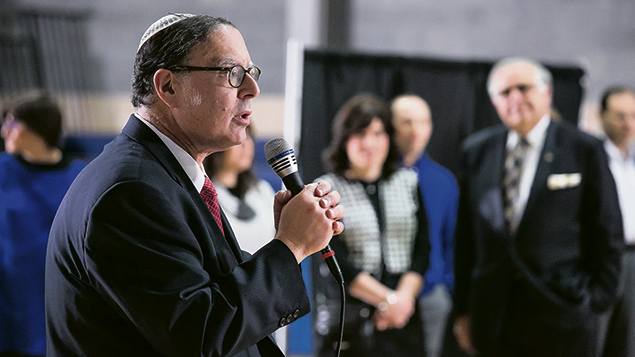
He recalled how Rabbi Adler “masterfully balanced a playful, humorous, and animated classroom with demanding excellence in analysis, involvement in class discussion, and performance.… He had a remarkable ability to take a complex topic in the Talmud and organize it, explain it, and present it to any audience.”
He noted that Rabbi Adler brought a unique perspective to the Rabbinical Council of Bergen County. “He spent his day in the high school classroom and as a high school administrator. He was able to see and understand things that others could not. His was a critical voice when delicate issues such as the tuition crisis or high school admissions needed to be discussed.”
Rabbi Wiener related that in keeping with Rabbi Solovitechik’s approach, Rabbi Adler believed that pulpit rabbis should pray on the same physical level as their congregants rather than on a stage or elevated platform. This view was based on an incident in Kings II:4, where the prophet Elisha asks a woman who hosted him in her family’s home if she would like him to request anything of the king on her behalf. The woman declines; she responds, “I dwell in the midst of my people,” not wanting special treatment.
“I realized, however, that for Rabbi Adler, this message meant much more,” Rabbi Wiener said. “It meant that we may live here in Teaneck but … our hearts are constantly with our nation. Rabbi Adler was our spiritual guide in connecting our minds and hearts with ‘medinat Yisrael’” — the state of Israel — through his words, his actions, and what Rabbi Wiener described as his “melodious voice” in leading prayers, especially on Yom Kippur.
“When I met with Rinat’s search committee as I was about to make a decision that would change me into the rabbi I am today, I told them that they need to be aware that, if I join Rinat, I could not be Rabbi Adler,” Rabbi Wiener said. “I am just a human being. He is superhuman.”
Rabbi Chaim Strauchler, who grew up in West Orange and succeeded Rabbi Adler at Rinat Yisrael in 2021, said he still remembers the first Torah lesson he heard from Rabbi Adler. That was more than 30 years ago, when he was a teenager attending a study event at the Teaneck shul sponsored by NCSY, the Orthodox Union’s youth movement.
“He was the model of what it meant to be a community rabbi and Torah educator,” Rabbi Strauchler said, and even at that young age it left an indelible impression on him.
For the congregants at Rinat and the young men educated at TABC, Rabbi Strauchler said, his predecessor’s legacy was helping to mold Modern Orthodox Jews “with a great deal of commitment and appreciation” for prayer, Torah study, and chesed by modeling “a fully lived, ideal Jewish life.”
In September 2022, the section of West Englewood Avenue encompassing the shul was renamed “Rabbi Yosef Adler Way.” In September 2025, TABC opened a new extension named the Rabbi Yosef Adler Building.
Jewish Standard/New Jersey Jewish News columnist Joseph C. Kaplan, a Rinat Yisrael congregant for more than 30 years, recalled that Rabbi Adler “had a strong sense of non-smug self-confidence which allowed him to accept disagreement with a mixture of respect and sweetness. I once disagreed with a theological/halachic point he made in a sermon. When I later expressed that disagreement strongly, though I hope respectfully, he didn’t give me a pat response or dismiss me with a jocular rejoinder.”
Instead, Rabbi Adler invited Mr. Kaplan to meet him one evening in the shul to review the source material together. “We ended that learning/discussion session still in disagreement but, perhaps ironically, with increased personal respect and friendship.”
Rabbi Yair Manas, an attorney and teacher who graduated from TABC in 2003 and now lives in Israel, cited a similar incident.
“One time, Rabbi Adler publicly shared his perspective on a certain issue,” he said. “Another faculty member asked for permission to share a different perspective, Rabbi Adler said yes, and then Rabbi Adler and the whole student body listened. Rabbi Adler’s respect and consideration of different opinions, and his ability to let high school students listen to different sides of an issue and decide which perspective made sense to them, is really remarkable.
“Rabbi Adler was a master educator who made studying Torah and Talmud come alive. His class was both challenging and fun at the same time, and his tests were impossible; how many other teachers have a choice for ‘none of the above’ in their multiple-choice questions? When I taught Talmud a number of years ago, I tried to teach in the same conceptual and analytical way that Rabbi Alder taught us, though my tests were easier.”
More than 20 years later, Rabbi Manas still remembers some of the Talmud classes that Rabbi Adler taught. “Rabbi Adler inspired me and continues to inspire me to deeply care about and value Torah study, to study Torah on a daily basis, and to live my life according to Jewish values.”
Rabbi Adler said in the Yeshiva University interview, “My number-one objective in yeshiva high school education is to turn people on to learning. I try to show them that learning can be taken seriously and is enjoyable, and I hope to pique their curiosity to learn.”
His wife said, “My husband had two personalities. In school he was a clown. He said that a teacher is an actor; you can’t just stand in front of the class and give pieces of information. You have to excite the students. And he did. But he was also very strict, and his tests were hard,” though he always threw in a freebie Yankees question at the end, she added.
“His shul personality was nice and proper,” she continued. “It was a great shul; they loved him and he loved them.”
The congregation’s leaders are collecting stories, letters, and photos documenting Rabbi Adler’s “quiet interactions with congregants, acts of kindness, and descriptions of his lasting influence” to compile and present to the Adler family, which includes 19 grandchildren and three great-grandchildren. Email submissions to RabbiAdlerMemories@Rinat.org.
comments