Reflections on the Toronto International Film Festival
Cinema impacts the way we see the world. French historian Marc Ferro opined that films actively participate in shaping collective memory and historical consciousness. Although Elie Wiesel famously argued that “Schindler’s List” should not have been made, he later acknowledged its enormous impact on how the public understands the Holocaust. Israelis often say that the film “Exodus” may have been the most successful public relations campaign Israel ever had. Other films, including “Apocalypse Now” (Vietnam), “Philadelphia” (AIDS), “Mississippi Burning” (civil rights), and “Erin Brockovich” (environmental pollution) changed perceptions and shaped public discourse. We know how Nazi propaganda minister Joseph Goebbels understood that movies help define how people perceive reality.
At this precarious moment, it is vital that filmmakers produce works that deepen understanding of Jewish life, the challenges facing us, and the complexities of Israel. I am not advocating propaganda, which discerning audiences usually recognize for what it is. I am arguing that presenting the Jewish and Israeli experience honestly and thoughtfully can profoundly affect public understanding. The Jewish community needs to be more supportive in making filmmaking a priority.
Making a film is one challenge; getting it seen is another. I recently returned from the Toronto International Film Festival, one of the world’s largest film festivals, where 294 films from 72 countries were screened. This year’s festival posed a personal challenge, beginning two days before Rosh Hashanah and ending on the eve of Yom Kippur. My solution was simple: Fly to Toronto immediately after Yom Tov and spend five days immersed in cinema.
For decades, TIFF regularly premiered half a dozen Israeli films. In the early 1980s, when it was still the “Festival of Festivals,” I was invited to help curate an Israeli sidebar program, an ideal way to showcase Israeli culture and creativity. But much has changed. In each of the past two years, TIFF has screened a single Israeli film, while Palestinian films have become increasingly prominent: four last year, five this year. It is difficult to believe that Israeli submissions suddenly lacked merit. More likely, Israeli cinema has become unwelcome, and the problem is not confined to Toronto. Israeli films rarely reach festival audiences, and when they do, they are often films critical of the state, like this season’s “Naza,” which alleges that the Israeli military deliberately killed Palestinian civilians. Films need to be seen, but this year, it seemed that there was intent to have at least that film not seen by a traditionally Jewish audience; the New York Film Festival showed “Naza” on the first two days of Sukkot.
A trend was evident last year, when TIFF initially accepted and then rejected Canadian documentarian Barry Avrich’s “The Road Behind Us: The Ultimate Rescue,” about retired Israeli General Noam Tibon’s efforts to rescue family members on October 7. Reports suggested significant internal pressure from festival staff to remove the film. Although it was eventually restored to the schedule, the episode reflected a noticeable discomfort with positive Israeli stories.
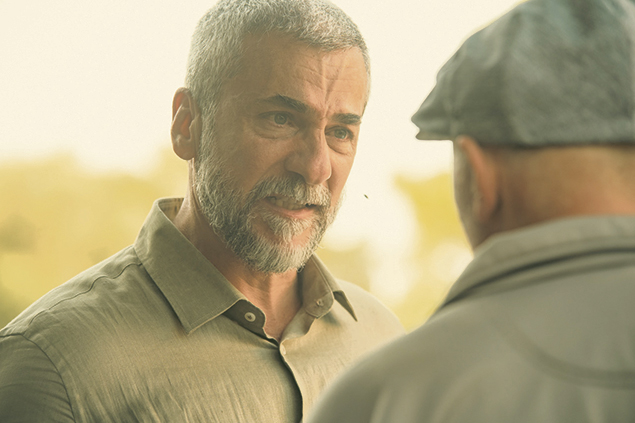
Despite this environment, several films at TIFF this year presented Jewish and Israeli experiences with depth and humanity. The sole Israeli entry, Avi Nesher’s “Our Loves” (“HaAhavot Shelanu”), had its world premiere scheduled, thoughtlessly, on the second day of Rosh Hashanah, but the filmmaker showed up and was received warmly. At the screening I attended two days later, a lively discussion with Nesher and three of the cast ended in a standing ovation from a diverse audience. The film, Nesher’s sixth at TIFF, is an empathetic portrait of five people in the days before, during, and after the attacks of October 7. Though I feared what I might see, Nesher handled every aspect of that timeframe with great sensitivity, capturing multiple emotions and perspectives without sacrificing complexity.
Several other notable films also explored Jewish themes. Israeli American director Guy Nattiv (“Golda”) presented “The Liberation,” based on the story of his Holocaust-survivor grandmother, who in middle age abandoned her family, joined a cult, and disappeared. Through her story, Nattiv examines not only the cult experience but the profound psychological scars survivors carried and the ways they coped with unimaginable trauma. Carrie Coon is remarkable as Rita, totally transformed from the doting grandmother, whom her grandchildren hoped to rescue and bring back home.
Another highlight was Riga-born, Toronto-based David Bezmozgis’s first feature, “The Betrayers.” Baruch, a former Soviet refusenik, now leads the Israeli Russian party. After rejecting Benjamin Netanyahu’s invitation to join a governing coalition, he travels to Crimea with his mistress, intending to leave his wife. The film, set in the months before Russia’s invasion of Ukraine, becomes truly compelling when Baruch unexpectedly encounters the former comrade whose betrayal to the KGB cost him a 10-year Gulag sentence. Few films have explored the Soviet Jewry movement or what Jewish life in Russia looks like today, which makes this movie particularly valuable and engaging. Michael Aronov is outstanding in the lead.
Director Lacey Schwartz Delgado (“Little White Lie”), who is Black and Jewish, brought together 38 Black and Jewish thinkers, activists, and artists and paired them for conversations in “Re/Pair.” By openly addressing both the historic ties and the contemporary tensions between the two communities, the documentary achieves something rare — dialogue that goes somewhere. What was especially powerful for me was listening to Ashley Jackson, Jesse Jackson’s daughter and a recent convert to Judaism, speak about her encounter with Judaism. Other participants include performing artist Matisyahu, broadcast journalist Van Jones, Rabbi Sharon Brous, and actors Harry Lennix and David Schwimmer.
Along with “Our Loves,” my favorite film of the festival was Ben Shirinian’s “The Housewife,” based on a true story. I knew little about it beforehand, which let the story unfold as intended, as I encourage everyone to allow. Naomi Watts is superb as a 1960s Queens housewife, and Ty Sheridan shines as young New York Times reporter Joseph Lelyveld, later the paper’s executive editor. The events of the film push Lelyveld to confront questions of identity and belonging, including his relationship to his Jewish heritage and to his father, Rabbi Arthur Lelyveld. That theme occupies only part of the narrative, but it is handled with uncommon nuance. A scene where Lelyveld is confronted for being a Jew was particularly compelling.
Jewish stories were present at TIFF, and audiences responded to them. The Israeli ones are the ones being squeezed, in programming and in the way they are scheduled and distributed. At a time when Jewish and Israeli stories too often are reduced to slogans, stereotypes, or political talking points, thoughtful films offer complexity, humanity, and empathy. Whether examining the trauma of Holocaust survivors, the legacy of Soviet Jewry, or Black-Jewish relations, they invite audiences to engage with Jewish experience as lived reality rather than as abstraction.
Near the end of “Our Loves,” a character who survived the attacks quietly declares, “I’m not leaving.” Afterward, I asked Nesher whether the line carried a broader message. He told me it was meant as an appeal to Israelis to stay and help make the country better, despite its challenges. That film, and the others I saw at TIFF, are a reminder that filmmakers need to keep telling Jewish and Israeli stories and that our community needs to support them. Movies can shape how the world understands us, but only if festivals, distributors, and funders make sure audiences get to see them.
Eric A. Goldman of Teaneck is adjunct professor of cinema at Yeshiva University and host/producer of “Jewish Cinematheque” on the Jewish Broadcasting Service. He is also the author of “The American Jewish Story through Cinema.”