Purim came early this year
Reflections on an 18th-century megillah at Sotheby’s
Rosh Hashanah begins on the first day of the Hebrew month of Tishrei. Yom Kippur follows 10 days later. So why are both holidays either early or late, and never on time?
And what about Purim? It begins at sunset on the 13th of the Hebrew month of Adar (Adar 2 in a leap year). It’s in February or March and always 30 days before the first night of Passover.
But for me, Purim came early this year. As a matter of fact, it arrived so early that it preceded Chanukah, on a cold, blustery, December evening.
How could this be?
As guests of Leket, the National Food Bank in Israel, my husband and I enjoyed a preview of Sotheby’s Judaica Collection, which was about to go to auction the following week. Guided by Sharon Liberman Mintz, Sotheby’s international senior specialist in books, manuscripts, and textiles, and John Ward, a consultant at Sotheby’s, our small private group entered a magical Jewish world in the Brutalist Breuer Building on 75th Street and Madison Avenue. More than 100 artifacts in the collection, from illuminated manuscripts to ritual items, not only welcomed us, but took our breath away.
My imagination ran rampant. Who were the artisans and craftsmen who created these works of art? Who were the owners? Were the pieces designed to be functional, ornamental, or perhaps both?

There were the Yemenite Torah scroll (circa 1425-1450) and the Ashkenazi Torah scroll from northern Italy (circa 1400). If I listened hard enough, I could hear the chanting of the Torah on Shabbat and holidays. I could visualize generations of families using the embroidered German Passover and festival tablecloth from 1799 (valued at $50,00 to $70,000).
Beautifully written and illustrated machzorim and ketubot invited us into Jewish homes and synagogues around the world and across the centuries. Some of the items had survived the Inquisition and the Holocaust.
As we continued our tour through the gallery, we stopped at the Megillat Esther.
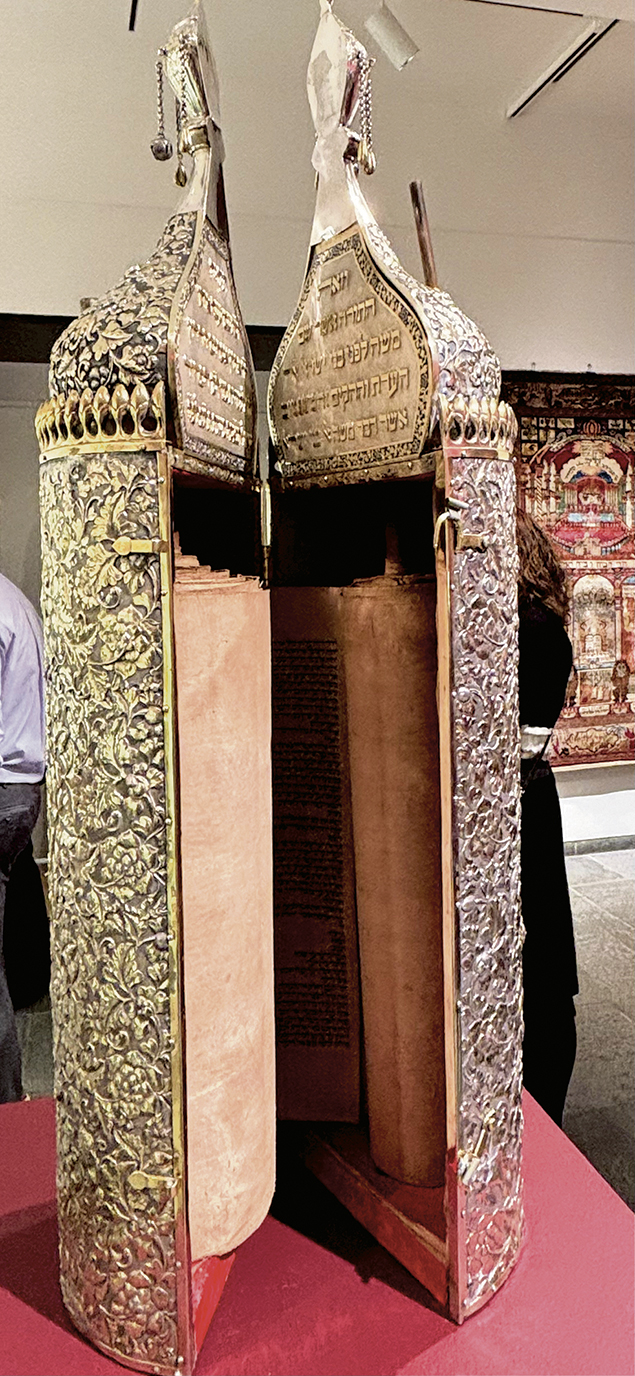
The megillah wasn’t the grandest item in the collection. In my opinion, that would be the exquisite Chinese/Iraqi silver Torah case and Torah. Nor was it the most expensive item. That might be the rare Hebrew Bible from Spain, circa 1300.
But the Megillat Esther, written and illustrated by the master scribe and artist Aryeh Leib ben Daniel of Goray, circa 1740, was the ritual item that stole my heart. It was magnificent; the illustrations embellished the text of the story of Shushan, and the text embellished the illustrations.
When our group tour ended, our guides encouraged us to browse the collection independently and ask questions. I noticed that some people requested items to be removed from the display cases. Maybe they wanted to scrutinize them before bidding at the auction. Or maybe they were just curious, like me.
I gravitated back to the megillah. With a combination of chutzpah and shyness, I asked our expert guide, “Would you mind taking the megillah out of the display case so I can look at it more closely? I’d like to find the chapter I read at my synagogue every year.” Much to my great amazement, she agreed!
In a few seconds, I located the familiar words introducing Chapter 3: “Achar hadevarim haayleh….” (“After these events…”). It was like meeting an old friend, but something was different. At Sotheby’s that evening, the words danced on the parchment of an Italian megillah, valued at $20,00 to $40,000. They were flanked by sepia illustrations of Esther and Mordechai on the right and left of the scroll, and pictures of animals and the gallows on the bottom.
Breathless and humbled, I couldn’t resist the opportunity to ask if I could chant a verse or two from this scroll. I promised to be inconspicuous. Much to my further amazement, she agreed.
And there I was, singing the words that men have been singing from this megillah for almost 300 years. For a moment or two, I was no longer at Sotheby’s; I was in 18th-century Italy — maybe Venice, a city I always dreamed of visiting. I heard the crowd drown out Haman’s name when he is introduced for the first time.
So, when Purim arrives — on time — this year, I’ll be remembering when it arrived early for me.
I’ll think about the auction bidding. Who owns these religious objects now, and how much did they pay for them? Would the items find a new home in a museum, or in a personal collection? I wondered if they will be admired in a showcase or used to enhance ritual practice throughout the year.
Most of all, I’ll imagine that my quiet voice is now part of the centuries-old story of the Megillat Esther of Aryeh Leib ben Daniel of Goray.
Merrill Silver and her husband live in Montclair; she’s a freelance writer and retired ESL teacher. Her work has appeared in the New York Times, Hadassah magazine, the Forward, the New York Jewish Week, and other publications. Find her at merrillsilver.wordpress.com