Offering an On Ramp to Jewish education
Yavneh provides students and parents with a chance to change their minds
Some decisions don’t matter so much. Eat dessert or don’t. Go to the party or stay home. Spring for expensive seats or sit in the nosebleed section. Buy those shoes or just be sane and don’t buy those shoes.
Others do matter. Do you leave the shtetl for the New World? Do you accept the marriage proposal? Do you take the new job?
Some decisions seem irrevocable. Do you send your child to day school, or do you not? Because if you decide not to, and then you change your mind — or your child changes her mind — then what? Your child will be behind. There will be maybe an impossible amount of catching up to do. It will take time and cost money. Maybe if you change your mind between kindergarten and first grade, it’ll be okay, but is it possible any later?
Rabbi Jonathan Knapp, who heads the Yavneh Academy in Paramus, thinks that it is possible for children who have started their school lives outside the day school system to move inside the system. For the last few years, Yavneh has been working actively to help those children and their parents.
That effort, which began in earnest after covid, ramped up after October 7.
“It all stems from the question of how we can further push out the school’s walls to accommodate more children and more families,” Rabbi Knapp said.
Yavneh goes from pre-K to eighth grade. It’s a modern Orthodox school, but it welcomes all Jewish children. The school’s not judgmental, Rabbi Knapp said; the goal is to provide a Jewish education to as many children as possible. “We are offering a warm school with high academic standards,” he added.
He’s been at the school for 25 years; during that time he’s seen changes in educational philosophy in general, and in Yavneh’s approach in particular. “Over the last two decades, we have done a number of things to allow and enable more children to have a Jewish education,” he said. “There are dozens of kids now who probably wouldn’t have been in a mainstream Jewish school.” He’s talking about the kinds of special services that help children learn; he’s also talking about institutions like the Teaneck-based Sinai Schools, whose organizations, embedded in yeshivot in Bergen and Essex counties, and in the Bronx and Queens, work with other children, who might or might not end up mainstreamed but who benefit from intensely tailored educations.
But to return to Yavneh, “the first emerging need was post-covid,” Rabbi Knapp said. Yavneh, like many other day schools and other private schools, “reopened, with sound medical advice and restrictions, in September 2021.” All local schools closed in the spring of 2021; most public schools stayed closed until the start of the 2022-23 school year.
“We opened with a robust, thoughtful plan; the ways we were set up physically were different than they had been, but the children were in school, with their peers, engaging in learning and social activities.

“Private schools in general have more room, more leeway, and a communal commitment,” he continued. “I was surprised that some high-end secular private schools were not open as early as we were.
“And our parents, who were in the workplace, would start describing their kids’ experience, and then other parents — doctors, lawyers, financiers — were shocked. ‘What do you mean, your kids are in school?’” they asked.
“Some parents became frustrated. They didn’t want to have another year of this. So Yavneh started seeing families who may have thought about their kids attending a Jewish school, who maybe considered it, but decided against it. And now, for the next two post-covid years, they decided that they were ready to make the change.”
Parents would come to talk to him, Rabbi Knapp said. They were interested in the school — in some cases they had been all along, and in others the idea was a new one — “but they’d say, ‘The impediment is that my child is, say, 9, and doesn’t read Hebrew.’ Or maybe the child can read Hebrew, but only mechanically, with no understanding.
“‘How will they catch up?’”
It was a question that Rabbi Knapp and Yavneh’s teachers and administrators took seriously. “So we quickly built a program. It was individualized. It was absolutely tailor-made for each child.”
The next question was affordability. “Most of these families’ children were in public school. Now they had the prospect of paying for private Jewish school. That can be daunting. So if you added the cost of private tutoring for each child, to catch up, that could basically double the cost. For many families, that became a potential deterrent.”
That tutoring also could demand hours of a child’s time, which also would have to be scheduled. Transportation would have to be arranged. It seemed like too high a hurdle for most families to clear.
“Then we came up with a creative idea, with the support from families in the community — families who did not have children at Yavneh at the time, who had children who had already graduated — who saw it as a communal need,” Rabbi Knapp said.
The families would have to pay the regular tuition, or apply for scholarships just as everyone else did. But they wouldn’t have to pay extra for the catch-up tutoring, and they wouldn’t have to take extra time to do it.
“We built a program for those students during school hours, at no additional cost to the students and their families,” Rabbi Knapp said. “We told the parents that over the course of two years, we would provide their children with the basic skills that they needed to be fully mainstreamed into our Judaics program.
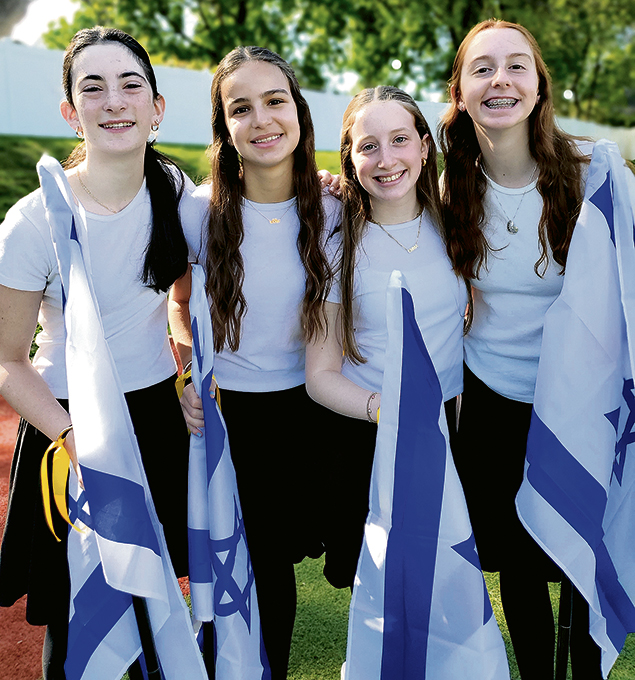
“We assessed each kid, and we assigned them to a teacher who taught that subject in that grade, and so they know the curriculum in detail. They worked either one on one or two on one.” The school tweaked the teachers’ schedules so they could take the time for the private tutoring, and they scheduled the tutoring sessions during times when the class was broken into smaller groups anyway.
“That was the first wave. We had about 10 children join us, from seven or eight families, from grades one to six,” Rabbi Knapp said.
Not surprisingly, the length of time it would take any one child to catch up depends on many variables. The most obvious is the student’s age. Someone starting day school in first grade rather than kindergarten has very little catching up to do — in fact, Rabbi Knapp said, those kids don’t need any special tutoring. The amount of tutoring each student needs generally increases by grade, although none has needed more than two years.
Although this program — called On Ramp — has been in place for three years, Yavneh hasn’t publicized it. Rabbi Knapp wanted to be sure that it was working properly first, that the kinks were straightened out.
Then October 7 happened; since then, more families have reconsidered the value of day schools. Parents moved toward it in two ways, Rabbi Knapp said. “Some people were leaving where they’d been. They were afraid. The others were running toward us. Running toward a rekindling, thinking ‘I want my child to know what it means to be Jewish. I want my child to know what it means to have a strong Jewish education.’
“The school is bursting,” Rabbi Knapp said. “We were at capacity even before this program. Last year we had seven new kids; we’re averaging six new students.”
One difference between parents who always knew they’d wanted day school and these new ones is when they apply, he said. Typically, a day school’s recruiting season is at the beginning of the school year. “Usually once we hit December, admission is closed,” Rabbi Knapp said. “So if I get an inquiry in March, or April, or May, and I see that the child already is in a Jewish school, I respectfully say that it’s too late for this year, and let’s set up a conversation early next year.
“But if a child is not yet in a Jewish school, even if we are at capacity,we try to make it work. We don’t want to make them wait for 18 months.”
Although kids who go to Yavneh from secular schools all need tutoring in Judaics, their needs when it comes to secular studies vary. Some of them need some help catching up there too, while others are more advanced than the classes they join. Those kids are given enrichment work. “The support we give can go in either direction,” Rabbi Knapp said.
Once the new children are at Yavneh, they’re quickly absorbed into the life of the class, the grade, and the school. “They make friends quickly,” Rabbi Knapp said. “Most of the kids have similar interests — playing soccer, going for ice cream, listening to music, watching movies — the social adjustment has been comfortable.”
They fit into the extracurriculars too. “They’ve been elected by their peers into student government, been on sports teams, in the choir. They’re fully integrated. And so far, they’ve all gone on to yeshiva high schools.”
On Ramp exists because “there is a communal need, an obligation, that if there is an interest in Jewish education, we have to step up to meet it,” Rabbi Knapp said. “Jewish education has always been at the core of the community, so there always is an obligation to provide it.”