‘Nuremberg’ is a must-see movie
When the Golden Globe award nominations were announced last week, I was disheartened to see that James Venderbilt’s “Nuremberg” failed to receive a single nod.
Was it that the film opened too late in the calendar year for consideration, or did it simply not merit consideration? Yes, reviews were mixed, but in my view, “Nuremberg” is among the finest films of the year. Some critics nitpicked the psychiatrist and his actions, but they missed the film’s profound core — how evil can punctuate a society.
Friends and colleagues told me that they had read that the movie was mediocre. Yet every person I urged to see it — without exception — returned to thank me and praise the film. That alone compelled me to write this plea to see this movie.
The film opens in Austria, just at the conclusion of World War II in Europe: a long procession of refugees line the road, fleeing devastation. From the opposite direction, a big black sedan approaches. It is carrying Hitler’s second in command, Herman Göring, and his family. When the car finally stops, the driver, after a few awkward moments, raises a white cloth in surrender to the nearby American soldiers.
Moments later, Göring, played brilliantly by Russell Crowe, steps out and orders the American GIs to fetch his bag. Who, exactly, is in command here? Until the film’s end we are never entirely sure. The contrast is unmistakable: the world remains filled with thousands of refugees seeking shelter, while figures of privilege, ensconced in their majestic vehicles, remain unmoved by human suffering.
This opening scene sets in motion a remarkable film that uses the past to interrogate the present. Cinema, even when it depicts the past, is always made in the present!
Sixty-four years ago, in 1961, an earlier film, “Judgment at Nuremberg,” addressed one of the later trials that took place in Nuremberg in 1948. American cinema had just begun confronting Holocaust-related themes. As film historian Pierre Sorlin noted, there was a societal readiness. The McCarthy era had receded, the Eichmann trial commanded global attention, and the civil rights movement was rapidly accelerating.
As Americans wrestled with questions of justice, many used German guilt as a metaphor for our own national upheavals. In that climate, producer-director Stanley Kramer assembled a star-studded cast to create this film. Notably, Kramer’s film featured no Jewish characters and implied that all victims of the Nazi regime suffered equally under its laws. Such a stance may have reflected its time, but it does not withstand scrutiny today.
Vanderbilt’s “Nuremberg” takes an opposite approach. It reflects on the present moment through the interactions between a U.S. Army psychiatrist (Rami Malek) and Göring, just before the first international tribunal to consider crimes against the peace of the world.
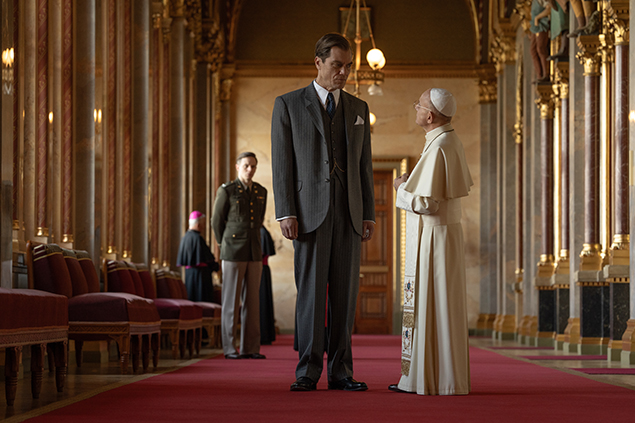
“Nuremberg” is about the effort led by U.S. Supreme Court Justice Robert H. Jackson (Michael Shannon) to see that Nazi leaders answer for their atrocities. The Allies understood that justice at Nuremberg required more than courtroom verdicts. It demanded a reckoning with the roots of human evil.
Were the atrocities of the Nazi regime the product of a few deranged minds, or could ordinary people be seduced by ideology and ambition into committing the unthinkable? The world needed answers. “Nuremberg” is a film about understanding wickedness, bigotry, and antisemitism — at a moment when these forces have resurfaced with alarming frequency in this country and across the world.
In many respects, “Nuremberg” is not only a courtroom drama, it is a thriller, even though we know the outcome. Göring and his associates will be found guilty; many will be executed. But the film’s deeper message concerns the moral responsibility of the individual — that one person can make a difference, and action must begin the moment one senses the presence of evil. One must resist, and resist early, when confronted with criminality or injustice.
The parallels to the present are easy to see. As director Vanderbilt told one interviewer, “The lessons of that era truly are the ones we forget at our peril.”
I was fortunate to attend the world premiere at the Toronto International Film Festival this past September, where it received a four-minute standing ovation — one of the longest in the festival’s history. This film is extraordinary. It is essential viewing for all Americans, all citizens of the world, and especially for Jews.
Do not listen to the critics. See this film.
Eric A. Goldman of Teaneck is adjunct professor of cinema at Yeshiva University and a member of the faculty at the Streicker Center for Adult Jewish Studies. He hosts Jewish Cinematheque on the Jewish Broadcasting Service, cablecast across America and streamed at jbstv.org.