Not just accepted, but celebrated
Eshel’s retreat for parents of LGBTQ kids gives support, builds community
Community is where you build it.
It’s where you find a home. Where you can talk about the things that really matter to you. Not all the time, of course; you can also laugh and tell stories and hand around your phone with the approximately 20,000 baby pictures on it. But at its core, a community is someplace where you feel free to be known.
And you can belong to more than one community, where you can divulge different aspects of yourself.
The Orthodox parents of LGBTQ children have communities back home, where they can feel loved and held and seen most of the time. But often there’s one aspect of their lives that they feel constrained about discussing. Their lesbian, gay, bisexual, or transgender children. Their queer kids.
So once a year, these parents go to the retreat that Eshel has established for them. According to its website, eshelonline.org, the organization sees building LGBTQ+ communities as its mission and working toward a world where LGBTQ+ people and their families are full participants in the Orthodox community of their choice as its vision.
The retreat, at the Pearlstone Retreat Center in Reisterstown, Maryland, from April 30 to May 3, draws parents from across the Northeast; there usually are about 90 parents. Most go as couples; some — who may be divorced, widowed, or simply married to someone who does not want to go to Reisterstown — go alone. Many are from towns across northern New Jersey, including West Orange, Teaneck, Englewood, Bergenfield, Passaic, and Highland Park, as well as from Monsey in Rockland County. The parents all identify as Orthodox and come from across the Orthodox world, from modern to yeshivish and chasidic.
Stefanie Diamond of Teaneck is going to the retreat for the fifth year; “last year was going to be my last year, but instead I am on the planning committee this year,” she said.
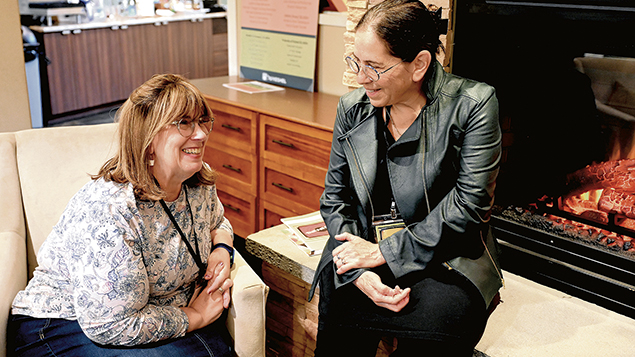
“I want to stay involved with it. I’m no different than some of the other parents, who first come needing support.”
Now she feels that she doesn’t need to find support, because she already has it, and it has strengthened her. Now she wants to offer support to other parents, who are where she was four years ago. “It’s a great experience to be with a group of people who have a common interest,” she said. “Now I go because I want to change the Orthodox world for our kids and grandkids and the rest of the community. I like being able to offer support and guidance to other people.
“Parents come at all different stages,” she continued. “Some have kids who recently have come out to them. Some of the parents saw it coming; others are completely blindsided. Sometimes parents have kids who are married and starting families of their own, and others cannot fathom a wedding for their kids.
“I think that a lot of parents wonder if their kids will be able to live a fulfilled, observant Jewish life. They wonder if their kids will be alone.
“There are so many people on different points of the timeline — of the arc — and it is interesting to share. Those discussions give parents hope. We have come such a long way. We are evolving, changing, and getting better.”
This year, the speakers will include Rabbi Dov Linzer, rosh yeshiva of Yeshivat Chovevei Torah, a modern Orthodox rabbinical school in Riverdale, and Suzie Marder and her husband, Rabbi Chaim Marder, who leads the Hebrew Institute of White Plains. Ms. Marder “is a clinical social worker, in addition to being the rabbi’s wife,” Ms. Diamond said. “As the rebbetzin, she very much guides the community. They are both incredible human beings, incredible leaders.
“They’re the parents of a married gay child, so they are coming not only as rabbinic leaders but as parents. I am excited about hearing them speak about their leadership, both personally and politically, about their challenges, and maybe even about how they’ve changed as a result of their own personal experiences.
“They’re all true leaders in the Orthodox world.”
Much has changed in the world. As parts of the Orthodox world have become more accepting of LGB Jews, the surrounding American culture has become less accepting of transgender people in general. “The parents of trans kids are terrified for their children,” Ms. Diamond said. “I wasn’t in those groups; those parents have a lot of their own groups because their challenges are unique to them, and very different from what parents of gay, lesbian, and bisexual children face. A lot of what I heard of their conversation last year was fear about their children’s safety, and even their legitimacy as people, because of the political climate.”
But in general, “there is so much growth and positive change in the Orthodox world, and that is what we dwell on,” she said. “We discuss the challenges and the problems we face as parents, and we help each other by talking about how to solve them. Everything comes from the framework of us as parents. We all have similar experiences, even though the specifics are different.
“And we all want the same things. We want our kids to be happy, to lead fulfilling successful lives, and within the framework of Orthodoxy. We want to make sure that our kids can live fulfilled observant lives if they want that, and many of them desperately do want that.
“We are working together to create a Jewish community where they will be comfortable, whether it’s by being active members of those communities or by raising families there.” Or, of course, by doing both.
The parents at the retreat are Orthodox, and most of their children grew up within that world; not all their children remain there, although many do. “Some have left,” Ms. Diamond said. That can create difficult situations for their siblings. “There may be hard things that can or cannot be discussed,” she said. “That can get complicated.”
Ms. Diamond’s own children — she and her husband have three daughters — are flourishing. Her oldest daughter, who is bisexual and the reason that her mother joined the Eshel community, is about to graduate from college. “She’s been active in Chabad and Hillel, and now she’s looking for an open, modern Orthodox community where she will find a place for herself. I am confident that those places exist; I am much more confident in that than I was when she first came out, eight or so years ago, when she was a sophomore in high school. Then I assumed that she wouldn’t find a place in Orthodoxy. Now I am confident that she will. And part of that’s because of the work that Eshel does.
“Eshel creates spaces where people are not just tolerated. They are not just accepted. They are celebrated. That is key. And I am sure that she will find a place that celebrates her.”
Miryam Kabakov is Eshel’s executive director. She’s enthusiastic about this year’s parents’ retreat, as she has been about the 12 that preceded it. (Eshel also has annual retreats for LGBTQ Orthodox Jews; there have been 15 of them so far.) “Nobody has written the guidebook on how to parent an Orthodox LGBTQ child yet, so there is a lot of mentoring each other and learning and support we get from each other,” she said.
She’s excited about the speakers, who all will present the parents with new information. The Marders are unusual, she said, because although “we’ve had rabbinic families with LGBTQ children, they’ve never been there as speakers, talking about their own experience.” As for Rabbi Linzer, “He’s the head of a rabbinical school and he’ll be talking about ordaining gay men,” Ms. Kabakov said. “That’s brand new.” And it represents “serious movement,” she said.
Eshel has been helping to spark small, incremental, but real changes in the Orthodox world, too, she said. For the past decade, the organization has been reaching out to rabbis and other leaders, presenting them with the human stories that each one of its members embody.
“The more conversations we have with rabbis and leaders, the better it is, because then they start thinking out loud about their beliefs,” Ms. Kabakov said. “They’re unearthing their deeply held beliefs and they’re able to actually have that conversation with someone who might shed light on how they could think about something a little differently, or about the needs of the LGBTQ people in their shul.
“We have so many dialogues going on, and I think that we really are changing the world, one dialogue at a time, one rabbi at a time, one shul at a time. It’s not as if all of a sudden a rabbi will publicly proclaim that it’s a welcoming synagogue, but they are at least thinking about it, and changing some of their attitudes. And that change will come through to their congregation.
“And it does some damage control. You know the rule ‘First, do no harm’? So if we can’t get to the things to do, we can talk to them about the things not to do.”
“There were two women who are now in college. They met in Jewish day school, and now they’re planning on getting married.” To each other, that is. “They talked about how they navigate their religious lives, and how they want to stay connected and be religious, and how they hope that they will find a community where that will happen.”
That’s a sweet story. The next story is amazing.
“There were two men from Turkey on the panel, a couple, who both found out that their great-grandmothers were conversos,” Ms. Kabakov said. That means that they had been Jewish until they were compelled to convert; usually that term is used to refer to forced converts to Christianity but it can refer to forced Muslims as well. “They both underwent conversion; they came here from Turkey to do it.”
That’s because “at Eshel, we do a lot of work with people who are getting converted. We have the connections to set up a beit din” — a rabbinic court — “that will convert LGBTQ people to Orthodoxy. It’s a unique service that we provide.” The couple had aliyot at the retreat.
Both Ms. Diamond and Ms. Kabakov talked about how the quick friendships that grow out of trust and understanding at the retreat turn into long-term relationships. Parents who meet at retreats often “become part of each other’s families,” Ms. Kabakov said. At the retreat, “they’re very open to new people. There is always a lot of love in the room. People stay in touch with each other. They have WhatsApp groups. They show up for each other’s events.” What starts as a bond over one particular fact of each family’s life becomes far more complex than that.
Eshel also runs training groups for allies — Orthodox Jews who are neither LGBTQ themselves nor the parents of a child who is, but who want to help the community and its members. “It’s for people who want to know how to help LGBTQ people in their community either explicitly or implicitly, by signaling that they are in a safe community,” Ms. Kabakov said.
That training will be soon after Pesach ends, and the plan is to have it in Teaneck.
Parents who are interested in the Eshel retreat should register for it soon; they tend to fill up. It’s scheduled for April 30 to May 3. To register, go to eshelonline.org/2026-parent-retreat.