‘My Mother the Architect’
Yael Melamede makes a film about her mother, Ada Karmi-Melamede, who designed Israel’s Supreme Court
We think of the people who lived in Israel during its founding — they fought in the war of independence or grew up in its Holocaust-cast shadow, lived through the hard economic times that followed, and saw it blossom into a democratic state — as its builders. And we’re right to think of them in that way.
Among those metaphoric builders were the literal builders, the people who drew the plans, arranged the financing, or were members of the crews who worked with their hands to put brick on brick or stone on stone to create the heroically scaled structures that house Israel’s government, and live in consonance with the ancient and medieval buildings that far predate the state.
Filmmaker Yael Melamede has told the story of one of those architects, Ada Karmi-Melamede, in “Ada: My Mother the Architect.” Yes, Ada is her mother, and the film, which will screen at Congregation Beth Sholom this Saturday night (see below), tells the story of Ada as both an architect and as the daughter and sister of other architects and as Ms. Melamede’s mother.
“This film is very personal, although I didn’t set out to make a personal film,” Ms. Melamede said.
“I have produced a lot of films and directed three of them,” she continued. “This is the third. They’re all about people who are obsessed with their work, all the mysteries of life they see through their work and solve through their work. My mother is similar to the other two in that regard.”
Those other two are the behavioral economist Dan Ariely, who was the subject of Ms. Melamede’s 2015 documentary, “(Dis)Honest: The Truth About Lies,” and the First Amendment lawyer Floyd Abrams, in her 2023 documentary, “Floyd Abrams: Speaking Freely.”
The film about Dr. Ariely “is basically an examination of dishonesty,” Ms. Melamede said. “It’s about why we all lie and still feel good about ourselves. Most people want to behave well, but we are allowed to rationalize in a way that leads us down unexpected and often not very heathy roads. So the film looks at some of the systems that allow us to do that through the stories of people whose lives fell apart as a result of that.”
Although this happened long after the film was made, Dr. Ariely turns up in the Epstein files. He’s mentioned often but not in any context that is inherently bad. ‘If you put yourself in the shoes of someone who loves Dan and believes in him and thinks he’s great, you’ll read the story in the New York Times about him and think, ‘There’s nothing here.’ And if you read it as someone who is suspicious of anyone in the files, who doesn’t know him, you’d look at it and go, ‘Oh my God!’
“I think that if you read it critically, there’s no there there.” But it is a prime example of how easy it is to be swayed to believe whatever it is you want to believe, and that’s true on both sides. On all possible sides.
“My second film, which I finished about six or eight months before ‘Ada,’ is about free speech,” Ms. Melamede continued; Floyd Abrams is possibly the First Amendment’s most well-known, vigorous, intellectually agile defender.” The film “tells the story of one of our great Constitutional amendments through his career.”
Mr. Abrams is also a very nice man, a characteristic that comes through in the film and in even the shortest conversation with him. Ms. Melamede tells a story that she had hoped to get into the film — “when you hear a line like this, it gives you a certain tremor,” she said — but could not, because although it is thoroughly wonderful, there was no logical place for it.
“He really loves young people,” she said. “I asked him what he would have been if he hadn’t been a lawyer. He looked at me, and he said, ‘I would have been a really good kindergarten teacher.’
“He takes pleasure in talking to kids. He loves other people’s perspectives, and he loves listening to them. That is what makes him such a good lawyer.”
So what the two subjects of Ms. Melamede’s first two films — Dr. Ariely and Mr. Abrams — have in common is that “they’re both very gregarious and extroverted. And they’re both men.” Whereas her mother — a woman — “is tremendously shy and humble. What all three share is that “they’re very powerful.” Her mother’s mixture of traits is unusual. “We don’t see that mixture very often,” she said.
Her mother’s story is a mix of the personal and the professional. “Her unusual story is the result of choices that she made; they were very serious choices, but when she made them, they were kind of casual. It’s not as if one day she packed her bags and said, ‘I won’t be coming back.’ Those choices just had an enormous impact.”
At the heart of Ms. Karmi-Melamede’s story is that she is the daughter of a famous Israeli architect, Dov Karmi, who won the Israel Prize for architecture in 1957. She’s also the sister of another famous Israeli architect, Ram Karmi, who was awarded the Israel Prize for architecture in 2002. She received the prize in 2007.
Ms. Melamede, the youngest of three siblings, was born in the United States; her siblings were not. The family lived in the United States when her mother and her uncle, working together, won a competition that gave them the job of designing the Jerusalem compound that includes the Israeli Supreme Court building. That drew her mother back to Israel but kept her and her siblings in America.
When she began the project, Ms. Melamede thought she’d be making a film about Israel “without getting into the binary terms of right or wrong, good or bad.
“Israel is a really small place, and it’s a new place, and my mother, my uncle, and my grandfather had a really big impact on it. The way my mother thinks about architecture is a very positive act, and it is fascinating to watch somebody who is tasked with building a positive building in a place that they feel is kind of falling apart around them from the inside. That was very poignant for me.
“My mother was born in Palestine in 1936,” Ms. Melamede said. “Her father came to Palestine young. He died young, at 56, but he still built more than 250 buildings in Israel. And her brother also had a very storied career. So architecture was in her blood from the day she was born. Not that she knew she was going to be an architect, but she spent so much of her time going from building site to building site, and seeing the country being built.
“I don’t think she saw the size of it, but to be part of an architectural family and to see the country was to truly see it. I remember that even when I was a kid, we would go to Tel Aviv, and the places that now are completely built were empty them.
“Back then, being a builder was being part of something. She says in the film that when she was young, the notion of self wasn’t there. You just did it. There was a common good. Something so much bigger than the self was at work, and that’s what she believed they all were building for. For something larger than themselves. For a communal good. For a better country.”
Ms. Melamede told another story that didn’t make it into her film. “It’s one of my favorite stories,” she said. “My grandfather worked on the Parliament building. He was asked to join in the design, and he did, but it wasn’t completed before he died. In my grandmother’s eye, the final building was not what he had designed, and so she sued to get his name off it.
“I love it. That’s not what we do today. Today we sue to make sure we get credit. But she was like, ‘Absolutely he should not have his name of it. I do not want his name on that building, with that design.’
“There was a kind of pride and honesty and ideals in it.” And yes, she won the suit.
Life in Israel, like life anywhere, like all human life, was complicated. My mother and her generation grew up and came into adulthood in a really beautiful period. And during that beautiful period, less beautiful things also were happening. And I think that our inability to accept that is destructive.
“The fact that we can’t hold two opposing thoughts and truth, when there are multiple truths happening at the same time, is a problem, both historically and in the present.”
The same thing is true in America, she continued. “There were beautiful things that happened in America while terrible things were happening in America, incredible heroism and incredible tragedy. Our refusal to allow them to coexist is part of what is making us so polarized now.
“I think that my family’s story is a way to honor the beauty and the dream, and also to see that underneath there are always darker things.”
She added the personal part of her family’s story at the end of her film, Ms. Melamede said, “because she’s an interesting lens through which to look at Israel, in its beauty and its complexity, and I thought it was important for people to care about her as a person.
“I didn’t set out to make this film in order to investigate our relationship,” but that’s what happened. “In order to tell a story that was a little bit about the sacrifice, the personal sacrifice” — her decision to leave her children behind, on the other side of the world, when she pursued her career — she had to do it that way. Yael Melamede was 14 when her mother left. She didn’t leave officially, she didn’t leave for emotional reasons, and she didn’t plan to be gone for most of the rest of her children’s adolescences. But that’s what happened.
“I couldn’t figure out another, better foil for her story, for that story, than me.
What about her siblings and her parents? What did they think? “My brother and sister are a bit more shy, a bit more ill at ease,” Ms. Melamede said. “But they really like the film. And as I always tell audiences, I didn’t show any of the footage to my mother while we were filming. The only thing she really cared about was that the buildings look good.
“But when I finally showed it to her, before we had completely finished — but really we were just about done — I just wanted to make sure that I hadn’t gotten something really wrong or had been disrespectful, or had left any big blind spots.
“She saw the film, and then she looked over at me, and I said, ‘So?’ And her eyes went wide, and she said, ‘I can’t believe that it’s not boring.’
“She is tremendously humble. Her work is so powerful, and it’s not humble.” In fact, most of her work is monumental.
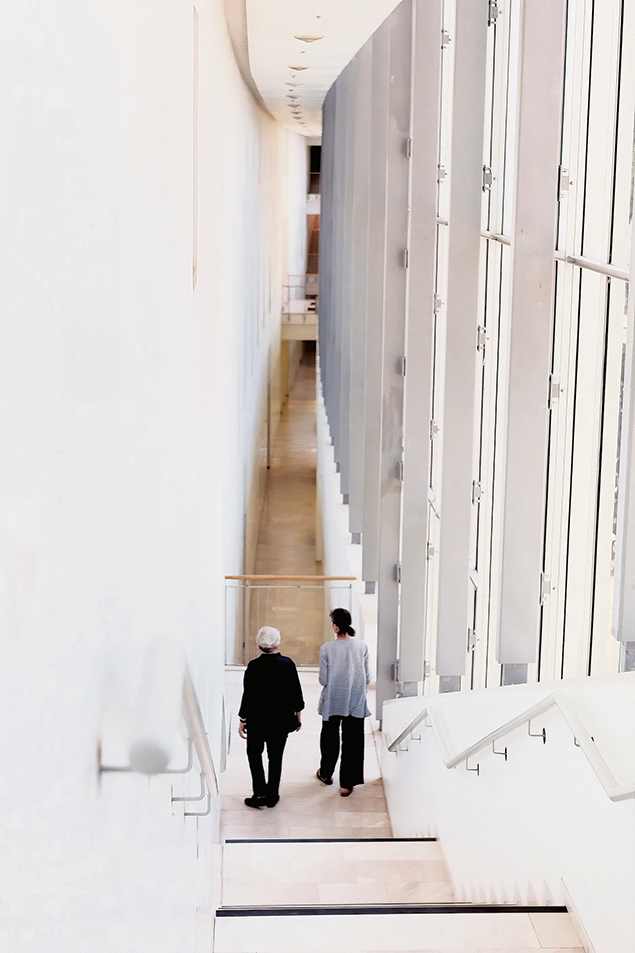
But, Ms. Melamede said, “it’s very rare for a woman architect to have had as much success as she has had. But what also distinguishes her work is the number of civic buildings she’s done, and also she’s done really beautiful private homes.
“I barely showed them in the film, because it felt more important to me to concentrate on the public ones, given the themes that were important to me. But she really had done some very beautiful private homes.” And yes, they’re all in Israel.”
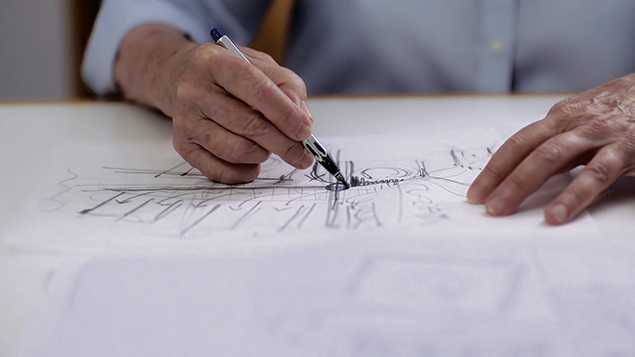
Ms. Melamed has spent her career as a producer and director of documentaries, but like her mother, her uncle, and her grandfather, she trained as an architect. Although she hasn’t practiced architecture, that training has informed the way she structures her films, and the way she sees the images in them.
“This is the most cinematically ambitious film I’ve done,” she said. “It’s very visual. A lot of thought was put into how it was filmed; you don’t always have that opportunity with a documentary. There are a lot of graphics, and we turn the camera vertical for some of the shots. It was amazing to be able to do that.”
She had the ability to make the documentary as visual as it is because it’s about something inherently visual, and also because it’s independently made, she said. “It’s a very architectural film, and it’s very structured.
“It’s in five chapters. All my films are chapter films. They’re all sort of essay films. I keep thinking that each one is so different from the others. And then recently I watched the one about Floyd Abrams, because it and the one about my mother were at the same festival. Given what’s happening around free speech and that we’re doing a lot of educational distribution with that film, I thought that I should watch it again. I hadn’t watched it for about a year. It’s hard to watch your own films once they’re finished.
“But I was sitting there, watching it, thinking that there is such a pattern here that I hadn’t recognized.
“I once told my mom that she had to design a private home without a curve, because all her private homes had curves. And she did. So I think that I should say to myself that the next film I do cannot have chapters.”
Her next two projects are films she’s producing but not directing. One is about disinformation and polarization, “about how technology is amplifying differences, and how dangerous it is,” she said. The other “is a father/daughter story, a true story, about a father’s descent into dementia.”
Meanwhile, she’s encountering difficulties with this film. “It’s been very hard to show this film, to get it distributed, because it’s an Israeli story,” Ms. Melamede said. “We’ve done incredibly well as an independent film, but distributors are very reluctant to take almost anything about Israel unless it’s highly, highly critical of Israel.
“As somebody who finished a film about freedom of speech, it makes me really sad to see so many voices censored instead of being part of the conversation, and criticized.
“I feel the same way with regard to Russian films and Ukrainian films and Palestinian films. I think it’s a testament to people being scared. I think that people should be more courageous. And I think that they should be more courageous about all the films. I don’t want people to think that it’s personal. Obviously it is personal, and it hurts personally, but I also see it from a bigger perspective.
“Having thought a lot about free speech, I know how dangerous the chilling of speech is. It’s people’s reluctance. It’s their saying ‘Well, I just don’t want this.’
“I was invited to a festival in Europe, and they” — the festival directors — “got nervous enough that they got me a bodyguard. I think they overreacted, and it was very kind of them.
“But the idea that a film like this one, which really is a portrait of an architect, can make anybody anxious for the filmmaker is just so sad. I didn’t feel any danger or any threat, but I really find it so very sad.”
Who: Documentary filmmaker Yael Melamede
What: Will talk after a screening of “Ada: My Mother the Architect”
Where: At Congregation Beth Sholom in Teaneck
When: On Saturday, March 7, at 7:15 p.m.
How much: $10
For more information: Go to cbsteaneck.org