Mosaic defense and intermittent foreign policy
How are the wars in Ukraine and Iran connected? And what will happen?
We will talk about our war with Iran soon — our analyst, Alexander Smukler of Montclair, will describe its connections to the war that Russia started when it invaded Ukraine four years ago — but first let’s start with Russia’s Victory Day parade in Red Square on May 9.
“I never saw anything like it,” Mr. Smukler said.
Although he grew up in Moscow — he left the Soviet Union in 1991, when he was 31, just months before it fell — Mr. Smukler never was able to watch the hours-long parade, commemorating the victory over the Nazis, in person. He’d watch it on television. He’d see massive numbers of army personnel and equipment, vehicles and weapons, marches and music and Air Force planes overhead. It was a huge spectacle.
It began in 1946, at the command of the dictator Josef Stalin, was on and off until 1995 and then was very much on all the time, soon turning into a glorification of the strongman Vladimir Putin, making clear that the military’s strength was his strength.
Mr. Smukler still watches the Victory Day parade on television, but now it’s from New Jersey.
What he saw last week shocked him.
“Last year, Xi” — that’s Xi Jinping, China’s president — “was there,” he said. “Putin used to have the choice of whom to invite. Leaders from around the world would compete to be invited. This year, I’ve heard from different sources that Putin’s administration called many world leaders asking them to come, and everyone tried to avoid his invitation. Nobody showed up.
“The only European leader who was there was the prime minister of Slovakia, but he refused to be onstage with Putin. He just met with him.” Guests included the leaders of former FSU regions — Belarus, Kazakhstan, and Uzbekistan — as well as the leaders of Laos and Malaysia.
“Putin looked old and tired,” Mr. Smukler said.
So what’s going on? How did we get there? (Maybe more to the point, how did Putin get there?)

Let’s go back to Iran, because the situations in Iran and Russia are deeply connected, Mr. Smukler said.
Iran is employing a mosaic defense in its fight against the United States, he continued. (That’s not Mosaic, as in the man who talked to God, it’s mosaic, as in an object made of disparate smaller pieces, put together willy-nilly.)
That means that each commander can make his own decisions, without having to get permission from a possibly nonexistent central command. “That’s something our Department of War,” as Secretary of Defense Pete Hegseth likes to call the organization he heads, “doesn’t know how to deal with,” Mr. Smukler said. “There is no kill chain,” as he has described in Ukraine, where a target is identified, the information goes up to the unit commander, permission to “eliminate the target” comes back down, and then the attack is launched.
“That’s creating incredible problems for the United States,” Mr. Smukler said. “And now, Trump has stopped active military actions and bombing and has turned to negotiations; he’s looking for someone who can negotiate with him to help him stop the war he started.
“I’m a strong supporter of that war,” he added. “I think that it is an existential war, and I applaud the administration for starting it. But unfortunately, as with many other actions, they started it, but they cannot finish it.
“It seems to me that this is a big strategic mistake. The opening was brilliantly organized and brilliantly executed, with the IDF and Israeli air force and Israeli intelligence. But it would have been so easy to predict what would happen with the Strait of Hormuz. They didn’t even have to predict it. The Iranians kept saying that they would do it, especially after last summer’s action,” when the United States and Israel, working together, bombed Iran’s nuclear facilities.
And that’s a big difference between the wars in Iran and Ukraine, he said, because the war in Iran is a global conflict, given its effect on the global economy. It’s also hard to understand logically, because “while Iran is conducting its mosaic defense, the American administration is demonstrating its intermittent foreign policy. That’s extremely hard to analyze, because it’s basically one step forward, two steps back. So it’s hard today to understand the real intentions of both sides.”
Had he wanted to send troops to Iran to help clear the strait, or to take Kharg Island, Trump would have been well advised to do it early, Mr. Smukler said. No one could fight in Ukraine in the winter because it was too cold, and because the lack of foliage made everything visible. In Iran, the problem is in the summer. “Now, there is a heat wave.” On Monday, “the temperature was 110 degrees. It is not an option to put boots on the ground now. No one can fight effectively in that heat.”
It’s hard to understand what’s going on in the Strait of Hormuz because we don’t really know what’s going on there — and our not knowing what’s going on is a recurrent theme here.
“The strait is blocked on both sides,” Mr. Smukler said. “The U.S. Navy blocks the exit, and the Iranians block it internally.” They’re blocking it with mines. “But nobody really knows how many mines have been installed by the mosquito fleet organized by Iran.” The mosquito fleet is made up of small, fast boats that can move quickly, and among other actions those boats can drop mines.
“Nobody really knows what kind of mines Iran is using,” he continued. There are two basic kinds of mines. One, “classical World War I-type mines, have no satellite connection. Even now, people still find World War I mines in the Baltic Sea.
“You can throw an old-fashioned mine into the water, and unless you are doing it systematically you won’t know where they are. It looks like a basketball. It’s really quite primitive. It seems the Iranians are using thousands and thousands of speedy boats in their mosquito fleet, and one boat can take two or three mines and just drop them over the side. Most experts think there is no system to it.
“There are also modern, sophisticated bottom mines that are connected to satellites. They will ignite only when a vessel moves over them. You can figure out where they are, and arm or disarm them.
“But most experts think that thousands of mines simply were dropped into the water, without any connection to devices that could disarm them. So the problem is that to demine the strait will take so much effort, it will be costly, and until it is completely demined, insurance companies will not pay to cover vessels going back and forth. And so the price of oil will skyrocket because of the risk.
“This is the key problem for the global economy. Even if some kind of agreement is signed, someone has to demine the strait.”
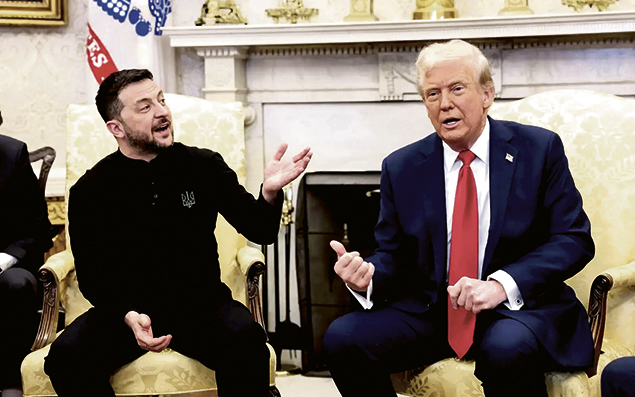
Next, as we move from Iran to Ukraine, we pause to consider Donald Trump’s trip to China. “He has no cards,” Mr. Smukler said, echoing the president’s comment to Ukraine’s President Volodymyr Zelensky in the Oval Office last year. “That will change the agenda.”
Trump had hoped to meet Xi in China in March, fresh off his victory in Iran, but that didn’t work. Now, “the Iranians are winning the negotiation process. Their intention is to delay, to buy time, to mislead.
“Trump doesn’t understand with whom he is negotiating, who represents the central power, or even if a central power exists. Nobody knows who is ruling Iran now. Is it Mojtaba Khamenei, the son of the executed ruler, Ayatollah Ali Khamenei?
“Nobody knows if he is alive, if he is active, if he is really making decisions. Some people say that he is recovering from serious injuries in Russia, and that is one of the reasons why Iran’s minister of foreign affairs just visited Putin in Saint Petersburg. Some people say that he was visiting the ruler of Iran, who was going through intensive medical treatment inside Russia.
“The situations in Russia and Iran are connected because today Iran has only one source for goods and equipment, especially military equipment. It’s massively coming from Russia. The most important parts for drones are coming through Russia, either through the Caspian Sea or by rail through Kazakhstan. That helps Iran build more and more drones, which are the most important weaponry in modern war right now.
“It also is my personal opinion that the 450 kilos of enriched uranium that everybody keeps talking about — how to disarm it and how to dissolve it — actually is safely stored in Russian nuclear facilities. In my opinion, that is the only safe place for the Iranians to keep it, and it was easy to transport out of Iran.
“I don’t believe that it’s buried in some mine in the mountains, and nobody has access to it. I think the Iranians are much more sophisticated and smart. They moved it out of their territory to protect it.
“We know that Iran successfully hit 18 military targets in the Middle East, including Saudi Arabia, the United Arab Emirates, and Kuwait. And we know that they’ve been getting satellite intelligence support and target identification from Russian intelligence.
“It is absolutely crazy. On the one hand, Putin is calling Trump to ask him basically to use his power with Zelensky to prevent missile and drone attacks during the Victory Day parade.
“At the same time, Russia is supplying drones and drone equipment through the Caspian Sea and helping Iran identify American targets in the Middle East. Iran has no satellite system to identify targets, so they are using either Russian or Chinese satellites. Most experts are saying that the Russians provided the Iranians with intelligence support to identify targets.
“So that makes it even harder to analyze this chaotic situation. On the one hand, they love each other, Trump and Putin, and they ask for mutual help and support.
“On the other hand, Putin is doing everything possible to support Iran against the United States. I tried to find similar examples in modern history, and I couldn’t. You are calling the president of the United States to say please help give me a chance to conduct a parade in Moscow, but just a month ago you participated in an attack on major U.S. military bases, eliminating lots of equipment and injuring and killing U.S. personnel.
“It is a very complicated and unpredictable time in the global game of thrones.”
The war in Iran does remind him of something, though. “I am very much afraid that we are getting into a situation similar to what happened when George W. Bush started looking for weapons of mass destruction in Iraq, which we never found,” he said.
“The ruler of the country, Saddam Hussein, was eliminated. More than 200,000 civilians died. And Iraq was destroyed.
“The army was completely destroyed. Iraq was destroyed as a state and basically split into different parts. We had to send in our troops. And as a result, we got ISIS, which was created by a group of generals who had been the commanders of the Iraqi army. Most of them were trained in Soviet military academies.
“I’m afraid that in Iran, we will have very similar problems. The Islamic Revolutionary Guard Corps is a Muslim radical group of military generals. They’re well trained and very, very sophisticated in terms of military science and actions. Even if they will not control Iran as a state” — remember, ISIS had no states formally under its control — “they are a real threat not only to the United States and Israel, but also to the global economy.”
He fears that the IRGC could grow into a movement similar to ISIS, which was defeated but not destroyed, and still exists in Syria. “So many countries were involved in defeating ISIS, including the United States, Russia, Turkey, Israel, France, Germany, many others, and it still is not 100 percent defeated. Unfortunately, I can see that we might have created the same kind of guerrilla movement in Iran that we did in Iraq.”
There are some obvious differences, he said — ISIS was Salafist, and grew out of an extreme form of Sunni Islam, while Iran and the IRGC are Shia. But the similarities are striking. “I haven’t seen anyone else make this connection between what happened in Iraq in 2007 and 2008 and what’s happening in Iran now, but I think that we might have created ISIS 2,” he said dolefully.
That brings him back to the links between the chaos in the Persian Gulf and the war in Ukraine.
Another one is the diplomatic efforts being made by the real estate developer and cryptocurrency trader Steve Witkoff, who is Trump’s friend and his special envoy to the Middle East, and investor Jared Kushner, Trump’s son-in-law. “It looks like they’re traveling the world making money, not preventing wars,” Mr. Smukler said.
“Trump promised to stop the conflict in Ukraine with 24 hours after he moved to the White House. Now he’s been there for 14 months, and it’s not over. We don’t see the end of the conflict. Zero was accomplished, even after Witkoff and Kushner making so many trips to Russia, and Witkoff having so many dinners at the best restaurants in Moscow. They still aren’t bringing us any good news.
“We see the result of the administration’s policies. It is losing its allies. Everyone is shocked when the Saudi forbade the U.S. from using its airbase.”
But the situation is changing rapidly, Mr. Smukler said.
“A few months ago, I mentioned that based on my understanding, I predicted that one way or other, the war in Ukraine would be over by the end of 2026. I repeat that prediction now, because, for the first time, I can say that Ukraine is becoming stronger and stronger every week, and Russia is really exhausted.
“Putin is not able to mobilize enough cannon fodder to break through the Ukrainian frontline. He is not ready for a massive strategic offensive operation.” On the other hand, “Ukraine has absolutely no manpower to liberate the occupied territories, so there is a stalemate on the front lines.”
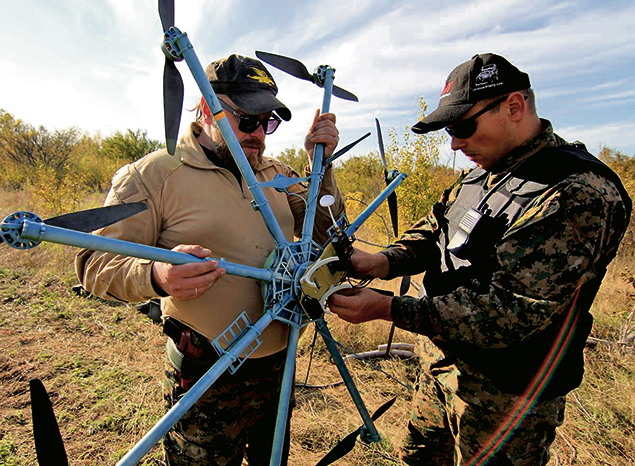
Because drones are so effective at patrolling the no man’s land between the two sides’ front lines, the so-called kill zone — “that corridor is almost 1,000 miles long, but everything tht is inside is eliminated immediately” — there is no movement there.
Although it is hard to get accurate information, Mr. Smukler believes, from the pro-Russian Telegraph channel he reads, that “Russia lost 150,000 lives in 2026. That’s 150,000 soldiers in four months. That means that Russia is losing more than 35,000 soldiers every month. Russia is not mobilizing people. They are paying them a high price to kill their brothers and sisters in Ukraine. Other sources say that Russia is able to recruit many few people than before. This is the first time during this conflict when Russia has not been able to recruit more people in a month than have died or been injured in that month.
“The channel that published the number of soldiers who had died said that if the Russian army will move at the same speed as they’re moving now, it will take them three to seven years to liberate Donbas.” Not all of Ukraine, just one region, Donbas.
“But that doesn’t mean that Russia won’t try another aggressive offensive in the Donbas area this summer, or try to occupy other areas that it can exchange later for the Donbas during peace negotiations,” Mr. Smukler said. “So we might see extremely aggressive operations this summer. It might not happen, but it is the last window of opportunity for the Russians to ‘liberate’ Donbas.”
There were two points about the parade and its aftermath that struck Mr. Smukler.
First, “Putin seemed to prove it in the press conference he gave after the parade, when for the first time he said that the conflict should be ended,” he said.
Putin said, “I believe the matter is coming to a close”; later, he added, in an apparent reference to Zelensky, “Whoever wants to meet, let him come.”
“Obviously Zelensky cannot go to Russia, but Putin also said that he did not exclude the possibility of meeting with the Ukrainian leader in a third country,” Mr. Smukler said. “This is shocking. A year and a half ago, Putin kept saying that Zelensky was not a legitimate leader, so he could not sign any documents. Now, he did not question Zelensky’s legitimacy.” (But he did not use Zelensky’s name.)
“Secondly, Putin looked so old and so tired at this press conference,” Mr. Smukler said. “His macho image changed. He has changed so much in the last few months that I didn’t even recognize him at first. He didn’t look like Putin any more. He looked like an old Russian leader looking for the way out.”
And he needs a way out, because Russia seems to be losing the war.
“Ukraine once again surprised the whole world with its ability to resist Russian offensive operations,” Mr. Smukler said. “It was able to develop a very sophisticated missile system. They make Flamingo missiles. They’re not the best missiles, but they are able to hit Russians objectives, especially oil refineries and industrial centers.
“During the last four months, Ukrainian missiles were able to hit targets far, far away from Ukraine. Nobody in Russian history has ever been able to bomb Russian industrial and military targets behind the Ural Mountains, so far away from Europe. During World War II, Russian relocated its military industry behind the Urals. But now Ukraine was able to send drones 2,000 miles away, and it has been successful at hitting objects at that distance.
“It shows that the Russian air defense and anti-drone systems are not effective at that distance. It’s understandable, because Russia concentrated on protecting Moscow, Saint Petersburg, and the industrial cities in the European part of the country. And Russia physically cannot close the air above it and build up so-called Iron Dome systems, or whatever they call umbrella systems above the largest country in the world. It’s technically simply impossible.
“The most important effect of this bombing is the incredible, enormous fires in the Russian refineries and in big Russia cities that are very, very visible to the Russian population.
“Now, Russian citizens realize that they could be a target. They could be hit. What Ukrainians realized four years ago, Russians are feeling now. They had lived with the idea that the war is somewhere far, far away, and that it wouldn’t affect them. Now, suddenly, they realize that they could be a target.”
Ukrainians aren’t aiming at apartment buildings, as the Russian have been, Mr. Smukler said. “But the drone could miss the target.
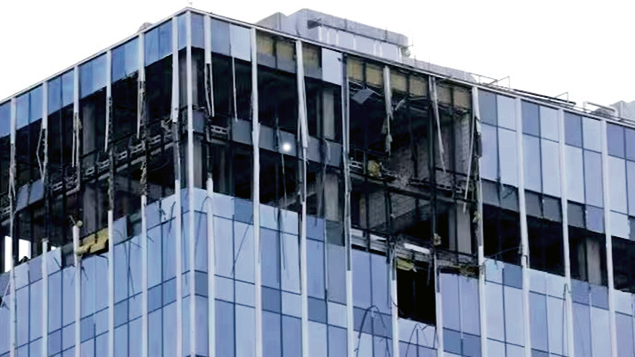
“Just a few days ago, a Ukrainian drone hit the tallest apartment building in Moscow,” he said. “It is visible to everyone. It is very prestigious. It’s in downtown Moscow. And the drone flew right into it. Ukraine obviously did not aim to hit the building, but the Russians are using a technology, called radio electronic defense system, that could change the drone’s direction.”
When Russian officials see a drone coming, they have to make a choice, he explained. “The drones operate on the internet or by satellite or Starlink. When the Russians see the drones flying to big cities, they shut down the internet or satellite.” That means that the Russians “can see where it is flying and they can try to shoot it down. But if they miss, there is a 90 percent chance that it will fall in a field or an unpopulated area,” before it gets to the city. But “in this case, the drone hit an apartment building. A few people were injured, but no one died. But in another city, a big city near Moscow, a drone hit an apartment building and a 14-year-old girl and her mother died, and 70 people were injured.”
If the Russians do not cut the drone’s internet access, it will be less likely to hit a building, but it can cause serious damage when it hits its target.
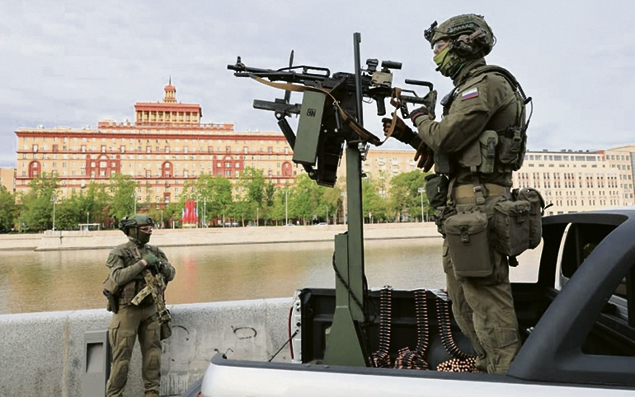
In response to the threat, Russian soldiers have started patrolling the streets. “There are anti-drone units everywhere, and they carry machine guns,” Mr. Smukler said. “Who would have imagined that?
Which brings us back to the parade.
“The Victory Day parade was the symbol of the Russian military establishment and the demonstration of the Russian military force’s scientific achievements.
“It was always a way for Putin to glorify his newly build-up empire. It was the symbol of his rebuilding imperial Russia. It was a holy event.
“The parade always introduced new achievements in the military industry — missiles, tanks, a new laser system — which didn’t exist, but it was shown off in the parade anyway. It was organized to show the Western world that Russia is back as a military superpower.
“This parade was the opposite of that. Only soldiers marched. It was only 45 minutes. No tanks. No missiles. No nothing.
“It was a disgrace and a humiliation. No Muscovite could have imagined it looking like that since World War II.”
But that’s how it looks now, and that’s why Vladimir Putin might have to agree to end the war. He won’t call it a defeat —but it’s quite likely that he’ll lose the war he started with Ukraine, and it will be a humiliation and a disgrace.