Miracle child
Civil rights lawyer Benjamin Pinczewski considers his parents’ survival
Sometimes a lifetime of good can grow out of unspeakable evil.
That doesn’t mean that the trade-off was a good one. It absolutely does not mean that the profound horror that gave birth to the good was worth it. But it does mean that sometimes someone can learn the right lesson from nightmare.
Never again.
As we approach the 88th anniversary of Kristallnacht — it’s November 9-10 this year — it’s useful to look at how attorney Benjamin Pinczewski of Closter shaped a career fighting for civil rights as a direct response to his parents’ extraordinary Holocaust survival story. (And yes, to be clear, every Holocaust survival story is both unique and extraordinary.)
Mr. Pinczewski’s mother, Helen, was born in Sosnowiec, Poland, in 1924; his father, David, was born one town over, in Bedzin, in 1916. David was conscripted into the Polish army in 1937. “That was not a good place for a young Jewish man to be,” his son understated. “He was subjected to tremendous discrimination.
“When the war broke out in 1939, he was captured by the Russians and taken to Siberia as a prisoner of war,” Ben said. (We’re using first names here because for much of this story, everyone is a Pinczewski.) “My father’s famous line was that when he got there, ‘I saw that the Russian soldiers didn’t have what to eat, so what would be for me?’
“He escaped,” Ben said. Wait. He what? “They used to send the prisoners out to work, and he just ran. He ran and he ran and he swam and he made his way back to Poland.” That was almost 3,000 miles. “He was a very determined man,” Ben said.
“He went back to his home town. It was occupied by the Nazis. The SS took him and sent him to a labor camp. That’s where he met my mom.”
David was one of five children; Helen was an only child. Her father was a kosher butcher. “Her father went out in the middle of the night to slaughter the animals” whose meat he would sell the next day, Ben said. That was his practice. He did so one night in 1939, and he became “the first person who was killed in the town. He went out, and he never came back.” Helen was 15.
She was taken to the labor camp, where her job was to give out food. “She was a very vivacious, outgoing person,” her son said. “Truly and exceptionally magnetic. Everyone loved her. She told the story that this young, handsome man came in. He didn’t look like the others. He was not pale. He was well built. He was dark. He was very handsome. She said to him, ‘I will give you a little extra food,’ but my father said, ‘This is garbage. I am not going to eat garbage.’ So she took the tray that the food had been on, and she threw it at him. She said, ‘You will be dying and you will beg for food when the time comes.’
“And that is when my father said, ‘This is the girl for me.’”
“They started to speak to one another,” Ben said.
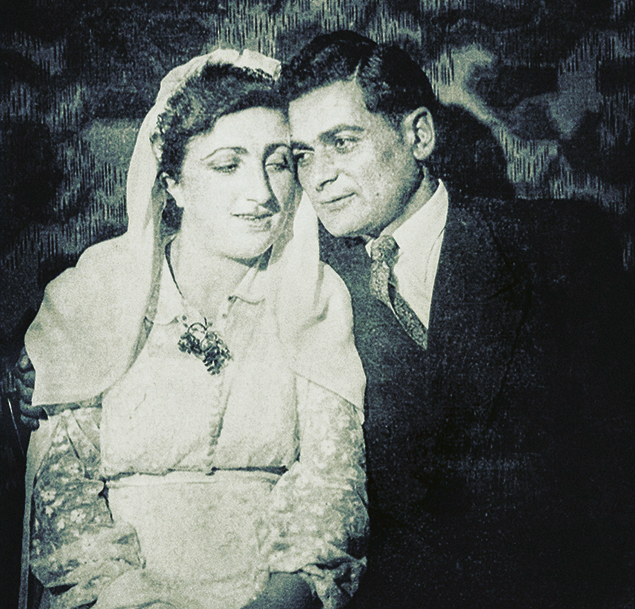
Then both of them were transferred to Blechhammer, the second largest of Auschwitz’s subcamps. “It was a concentration camp, not a death camp,” Ben said. “That doesn’t mean that it was a good place to be.” Inmates were not placed there just to wait until their captors decided, generally sooner rather than later, to kill them, but should they die of starvation or disease or accident or overwork, oh well. There were many more like them.
“My father was very involved with the underground movement there,” Ben said. David wanted to escape, and he tried to convince Helen to escape with him, but she didn’t want to. She wanted to know if her mother was still alive. So David was able to use his connections to smuggle a note to Helen’s mother, and she responded. “She said that she was okay, but it was very cold and she had no shoes, no coats, no nothing,” Ben said. “Anything would help. So my father arranged to have some shoes sent to her, and she wrote back saying thank you.
“And the SS intercepted that note.”
So at the next appell — the daily roll call — “my mother was called out. How do you explain this note?’ they asked her. She said ‘I don’t know.’” The Nazis kept asking her to explain it, she kept saying she didn’t know, the Nazis would beat her and ask her again, and she’d answer the same way, and they’d beat her again.
“‘Who gave you this note?’ ‘I don’t know.’”
Finally, David walked out from the line and said, “That’s all right, Helen. You can tell them.
“Tell them what? This is just a guy who has a crush on me and he is trying to make it like he’s a big shot.”
The Nazis kept beating both of them, but neither budged on his or her version of the story, and eventually, for some unknowable reason, they let them both live.
“My father always said that my mother saved his life,” Ben said.
Then, as the war came close to ending, they were both about to be sent on long marches, her to Bergen Belsen, him to Buchenwald.
“And again, he said to her, ‘Let’s run,’” Ben said. “‘Let’s go. Let’s try and get out of here.’ She said, ‘No, I don’t want to go.” So he didn’t go. He missed his opportunity to go.
“And when the time came to be separated, he said to her, ‘Just survive the war. I’ll come and find you.’
“And that’s why I’m here today.”
Ben Pinczewski has a thick New York accent. You can’t listen to him and think anything but Brooklyn. Normally guys from Brooklyn don’t cry. So when he tells this story, which he must have told at least hundreds of times, and he chokes up, it is hard not to cry too.
But moving on…
“My father escaped from Buchenwald, and he got to Germany with several other people from his hometown in 1945, before the war ended. When it had ended, he was riding on a train when he saw someone from my mother’s hometown, who had been in the camp with her. He asked him if he had seen Helen, and the man said that she was in Bergen Belsen, but she was in bad shape.
“My father got off the train and went to Bergen Belsen and he brought her back to where he was living and they married, just like he’d promised they would, in December 1945. It was the first Jewish wedding in that town since the war.
“My mother was an exceptional woman,” Ben said. “She said that the day when Bergen Belsen was liberated that ‘This is the first day of my life. I am going to live my life every day, and every day will be a winner.
“She pronounced it ‘vinna,’ because she had an accent. And she never complained. She was never woe-is-me. She always was positive.”
Helen and David lived in Germany for four years after the war; Ben’s brother, Solomon, was born there, in 1948. In 1949, the family came to America and settled in the Bronx — on Hull Avenue, near Crotona Park. “My father worked in a sweatshop in Harlem,” Ben said. “He had no skills. A lot of Holocaust survivors and refugees were doing one of two things. Some went to New Jersey and opened chicken farms. My father’s brother Max — before that he was Moishe — and his wife Hannah went to Haddonfield and had a chicken farm.
“Others opened up old-fashioned candy stores. That’s what my mom and dad did. They bought one in Dyker Heights, on 14th Avenue and 86th Street in Brooklyn, in 1954, and lived above the store. That’s where I was born, in 1960. And then we moved to Canarsie. They sold the first store and bought another one. They were always in that business, but the first store was old-fashioned, with a soda fountain and food. The others didn’t have that.
“The second store was in East New York, on Stanley and Van Siclen avenues. My parents’ friends, who were all Holocaust survivors, said to them, ‘Why are you buying a store there?’ And my father said, ‘What do you mean by there?’ They said, ‘Well, you know,’ and he said, ‘No, I don’t know.’
“My father was a lot of things. Stupid was not one of them. He knew what they were saying.
“So they said, ‘Well, you know, the colored live there.’ That’s the way they said it in 1965. And my father said ‘Oh, the colored! What color is the color? Because I say that it’s green.’
“They treated us with respect, and they treat us with respect.
“They had that store from 1965 until 1972. It was a short commute from where we lived to the store. My mom never drove. She took the bus to get there. So every Saturday, after I came back from going to synagogue, I took the bus to stay with her and help out in the store.
“Canarsie was segregated and racist, and East New York was primarily people of color. I was there every Saturday and Sunday. They were wonderful. I learned, like my father said, that you give respect and you get respect.”
“I didn’t have much family,” he said. “My uncle who had opened up the chicken farm was struck by a bolt of lightning and killed in 1956.” But he had the survivors community. “I was the miracle child,” he said. “My mother was told that she couldn’t have any children.” That made sense, given how badly broken by Nazis her body had become during her adolescence and young adulthood. But she got pregnant not once but twice. Not only was every child born into the survivor community cherished, but Ben, as one of the younger of those children, was particularly dear to them.
When he was a teenager, the family — just Ben and his parents, because his brother, who was 12 years older than Ben, was grown up and out of the house by then —moved to Rockville Centre, on Long Island, and opened a store in nearby Lynbrook. Ben went to Oceanside High School and then on to SUNY Stony Brook, farther out on the Island.
He worked in the family store throughout those years.
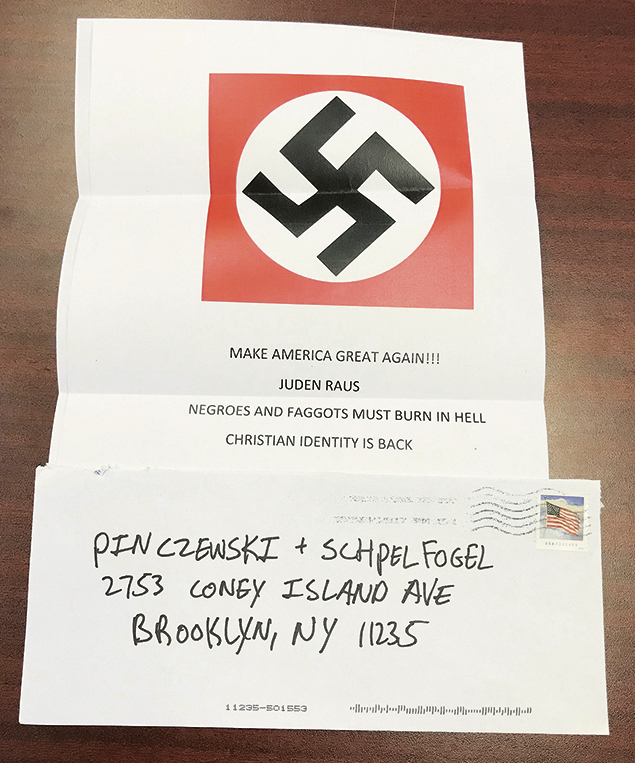
“I always knew I wanted to be a lawyer, not a doctor, like my mother wanted me to be,” Ben said. So after college he went to law school at St. John’s University in Queens, worked at the law firm Snitow & Pauley for a few years, and then “I decided I wanted to go out on my own. I did that in 1990, and that is what I have been doing ever since.” His firm, Pinczewski & Shpelfogel, is in Brooklyn.
“My focus is on civil rights,” Ben continued. “My passion is civil rights.”
He’s deeply involved in the city’s Black community, with the NAACP, and with a lot of Black churches, Ben said, and he’s done a lot of work with the Reverend Kevin McCall, the social activist who heads the Kingdom Justice Church in Brooklyn.
That’s theory. What does it mean in practice?
New Yorkers probably first heard about Ben Pinczewski in 2010, when he was on a popular reality TV show on ABC called “What Would You Do?”
It’s a show that hires actors and stages upsetting, confrontational, or just plain weird scenes, generally with an obvious victim being harassed by a clearly wrong abuser, in public. Hard-to-see cameras film bystanders’ reactions to these nasty little playlets, and they’re online now.
Ben doesn’t usually go to lunch, he said — he prefers working hard, straight through his time at the office, and then being able to leave to go to home to his wife, Kathy Graff, and their son, Nicholas — but “a dear friend of mine had come to the office, and wanted to go to lunch. So we went to the diner” — the El Greco Diner in Sheepshead Bay — “and we ordered lunch.
“And I see that this waiter is harassing a couple with their two children.” They’re a lesbian couple, and the waiter asks them if they’ve ever tried being with a man and tells them that they might be more comfortable elsewhere. The children sit at the table and watch.
“I won’t have it. I won’t sit still. I won’t have it for race, for religion, for anything. So I started to go after the waiter. It actually was more heated than it appears in the video. In my mind I hear my wife telling me that I have a very bad temper and no patience. I hear her saying ‘Do not lose your temper. Do not use your foul language. You lose the moral high ground when you behave like that.’
“But we are going back and forth, and the thing that always stands out in my mind the most is that there was a very large man sitting at a table right across from me, and I am about 5’5” and 160 pounds and he’s not doing anything. And I think, ‘Why does it have to be me? Why is it always me? You are sitting there, hearing everything this monster” — the fake waiter — “is saying. He hears everything. Why does it have to be me?
“I asked John Quiñones, the host — this was just the show’s second season, so I had no clue who he was — I said to him, ‘I don’t understand this guy who was sitting across from me. He didn’t react to me.’ And John said, ‘That’s our security guy. He had a walkie-talkie, and he radioed us and said, ‘You’d better come out. The little guy is about to go off.’
“Then all the actors embraced me. It was a special thing. I was just about to turn 50. I had always been an advocate for people who were being oppressed. And this was something that shined a light on it and brought it to the forefront.”
People watched that show, and they recognized Ben. He remembers walking down a city street with a young, attractive African-American lawyer, and “a bunch of guys sitting on a bench starting to call out, to say the things that men say, because they are idiots, to young attractive women. So I turn around and say, ‘Do you think that this is the right way to talk?’ She said, ‘Just let it go.’ And one of the guys said, ‘I know you. I’ve seen you on TV. And then he said to the other guys, ‘You should have seen that short mother…er.
“When Kathy and I first started to date, she said, ‘I never heard these curse words until I met you,’” he said parenthetically.
By leapfrogging many, many other stories — Ben probably could tell at least 15 stories every day for a decade and not run out of them — we get to something that happened last month. Like many of Ben’s cases, this one made the news.
On October 6, four men who were part of a Metropolitan Transit Authority group called Evasion and Graffiti Lawlessness Eradication — an odd collection of words curated so that the acronym is EAGLE — tackled Kyle Taylor, a 53-year-old school aide, as he got off a city bus. They accused him of not having paid the fare.
They seemed to slam him into the bus stop and then to the ground. He was hurt; later he went to the hospital. He had paid, it turned out; the ride had been a transfer so he had nothing to show for it. People in a nearby deli had taken videos, which clearly showed what had happened.
Ben is representing him.
“He is a beautiful man, who has worked with the board of ed for almost 20 years,” he said. “It is horrible, what he went through. He is truly traumatized. He will need surgery for his shoulder, and maybe for his foot.
“First of all, he had paid. And second, whether or not someone had paid, no one should be treated like that.”
Mr. Taylor “has to take the bus back and forth to work, but now he is traumatized and he’s afraid to go on the bus. When this fist happened, the MTA denied it. They said that he was resisting. They weren’t allowed to touch him, but they dragged him off the bus.
“Then the complete video came out, and then there was an outcry, and then the chair of MTA initially suspended the four Eagle team members. And then, because there was more uproar, the Eagle team was taken off the streets, so we achieved the result very quickly.”
It’s not over yet. “We filed a notice of claim against the MTA, and we will pursue it in state Supreme Court,” Ben said. (That’s not at all the same thing as trying to take a case to the U.S. Supreme Court; in New York state it’s the first level court.)
Ben is clear on how his devotion to civil rights, along with much of his outlook on life, and his understanding of marriage, came from his parents. “My childhood was not a walk in the park,” he said. “I worked from the time I was 5. But I never complain or look back at my childhood with anything other than love, because my parents gave me so much love and so much support.
“You never complain, because how can you complain if you are the son of parents who went through what they went through?
“I really do consider myself a miracle child.”