Learning and teaching in Berlin
Basketball students, as role models, pass on lessons from the Shoah
As the Holocaust recedes from living memory, it becomes harder to teach young people about its horrors. They are so grotesque, so cruel, so debased, that it often is hard for people born many decades after it ended to believe they actually happened.
But it’s vitally important to keep the knowledge of the Holocaust alive — to honor the memories of the dead and to try to keep it from happening again.
So how can it best be taught? Educators grapple with the question.
Dr. Stacy Gallin of Marlboro, the founding director of the Ferencz Institute for Ethics, Human Rights and the Holocaust in Marlboro — it used to be the Maimonides Institute for Medicine, Ethics and the Holocaust — studies the ways in which science and medicine were used to persecute and kill millions of people labeled unfit and therefore unworthy of living. She came up with an idea.
As a society, we respect athletes. When athletes promote a cause, it often flourishes. So why not send student-athletes to Auschwitz to learn about the Holocaust, and then to talk about it when they get back home?
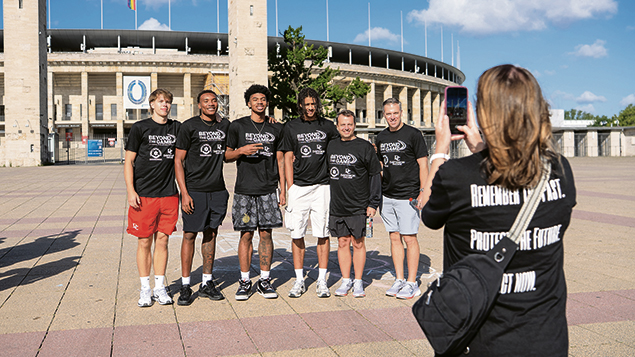
That’s why basketball players from Davidson College in North Carolina went to Auschwitz in 2018, and why another group of Davidson basketball players went this year.
Their education began with the experiments of Josef Mengele, the Nazi doctor whose quest for the ideal Aryan led to unspeakably evil experiments on twins imprisoned in Auschwitz. He’d perform amputations, castrations, and painful, anesthesia-free tests on one twin, while keeping the other as a control, and usually murdering both.
One set of twins, Eva and Miriam Mozes, arrived at the death camp from Romania in May 1944, and survived to be liberated in January 1945. Eva Mozes Kor and her husband, Michael Kor, also a survivor, eventually moved to Terre Haute, Indiana. Her sister, Miriam Mozes Zieger, moved to Israel. The Kors opened the CANDLES Holocaust Museum in Terre Haute in 1984 — the acronym stood for Children of Auschwitz Nazi Deadly Lab Experiments Survivors.
Stacy Gallin grew up in West Orange; her family belonged to B’nai Shalom there. Although she went to Hebrew school three times a week, her knowledge of the Holocaust was limited. “I understood what antisemitism was and I knew that the Holocaust existed, but I didn’t know enough about the mechanisms behind it,” she said.
She earned an undergraduate degree in behavioral sciences from Drew University, a master’s in developmental counseling from Montclair State University, and a doctorate in medical humanities from Drew. She learned about how science and medicine were used systemically to oppress people during World War II. Her doctoral program encouraged explorations of how health and medicine are constructed, experienced and practiced — socially, historically, ethically, politically, and legally.
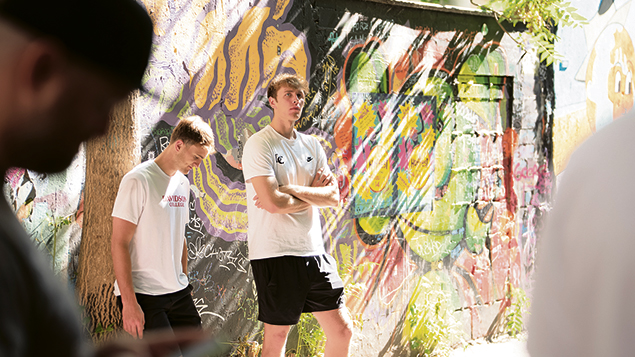
are outside the Museum of Otto Weidt in Berlin: Weidt is known as the city’s Oskar Schindler.
As an adjunct assistant professor of medical humanities at Drew, Dr. Gallin organized a conference on medicine, ethics, and the Holocaust there in 2015. That’s where she met Dr. Amanda Caleb, who then was an assistant professor of English at Misericordia University in Dallas, Pennsylvania.
“Amanda and I spoke about ‘Deadly Medicine: Creating the Master Race,’ a landmark traveling exhibition originally produced and curated by the United States Holocaust Memorial Museum,” Dr. Gallin said. “The exhibits revealed how the German medical profession spearheaded Nazi eugenics, forced sterilizations, and mass murder in an effort for the strongest people to survive and the weakest people to die.”
“As part of the launch of the medical and health humanities program at Misericordia, I brought the Deadly Medicine exhibit to the university in 2017 and built an eight-week speaker series around it,” Dr. Caleb said. “Eva Mozes Kor came to campus for the concluding talk of the series.” Listening to Ms. Kor’s talk was a turning point for both Dr. Caleb and Dr. Gallin.
“Eva’s experience being subjected to the cruelest medical experimentation motivated us to expand on the work we were already doing; to transcend the boundaries of traditional Holocaust education,” Dr. Gallin said. “We wanted people of all ages and stages to be inspired by her story.”
Dr. Gallin thought about her two sons, Ethan and Jordan. “They were huge sports fans, and I’d seen firsthand that when athletes talk, people listen,” she said. “Athletes seem to have a position of visibility and influence. Whether or not they should, they do.”
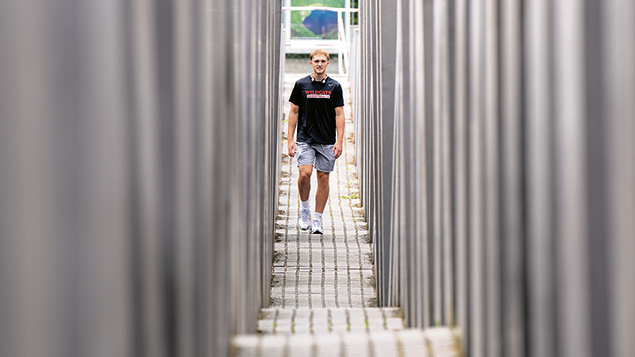
Memorial to the Murdered Jews of Europe.
Dr. Caleb, who graduated from Davidson in 2002, had been a college athlete; she was on the school’s field hockey team for all four of the years she spent on campus.
The next step seemed logical.
“With the hope of ensuring that the Shoah would never be forgotten, and in an effort to create a more sensitive and respectful generation of young adults, Amanda and I proposed that athletes could help tell the story of the Holocaust to young people for whom the Holocaust is increasingly distant,” Dr. Gallin said. “We’d read NBA all-star Ray Allen’s moving recollection for the Player’s Tribune about his experience visiting Auschwitz-Birkenau in 2017 and wondered if it would be possible to send a team instead of a single athlete.”
“Davidson popped into my head immediately,” Dr. Caleb said. “At Davidson, being an athlete was more than sports. It was more than what happened on the field. It was about who you wanted to be.”
“Amanda knew then assistant basketball coach Matt McKillop, who’d served under his father, head coach Bob McKillop, at Davidson,” Dr. Gallin said. “She asked if Coach McKillop and the team might have an interest in getting a personal tour of Auschwitz at the end of June 2018 with Eva Mozes Kor.” It was the beginning of April. The team had recently been bumped out of March Madness, and when Coach McKillop raised the idea of the trip with the team, every player wanted to go.
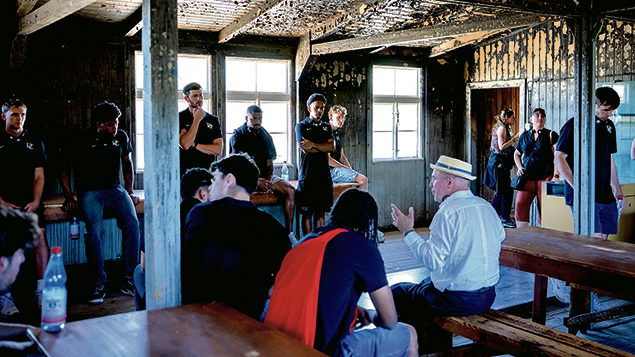
Dr. Gallin got in touch with Ms. Kor and her son, Dr. Alex Kor, a physician in Terre Haute, who was accompanying his mother on her annual two-week pilgrimage to Krakow/Auschwitz with 200 CANDLES members. “Once we described our loose plans and sites for the trip and determined how we would raise the funds to send the Davidson men’s basketball team to Poland, Eva and Alex agreed to add time to their trip so they could travel for four days with the team,” Dr. Gallin said. It was at Auschwitz-Birkenau that the Davidson student-athletes and their coaches met Ms. Kor and her son for the first time.
“I could never have imagined how the trip would affect the players,” Dr. Gallin said. “It was an experience unlike anything they’d known in their lives.” Dr. Caleb agreed. “Hearing Eva’s story while standing at the place she and her sister had been permanently separated from their siblings and parents and dehumanized as little girls showed the impact of place-based learning.
“The players did not just learn history,” Dr. Caleb said. “They felt it.
“Long after the trip, the student athletes kept photos of Eva walking through the gates of Auschwitz-Birkenau in their lockers. They fought against antisemitism on campus. One of the seniors wrote his thesis on the Holocaust. Bob McKillop wrote a Washington Post op-ed about the team’s experience at Auschwitz. Preachers delivered sermons about it. The players began working on other social justice initiatives. One student wrote the music to accompany Eva Mozes Kor’s documentary, ‘Eva A-7063.’”
“We saw how history was informing the present,” Dr. Gallin said. “These student athletes were becoming ambassadors for change. When we show videos of the trip to high schoolers throughout New Jersey and they see how the trip impacted these guys who they’ve seen play basketball on TV, they want to pay attention to it.”
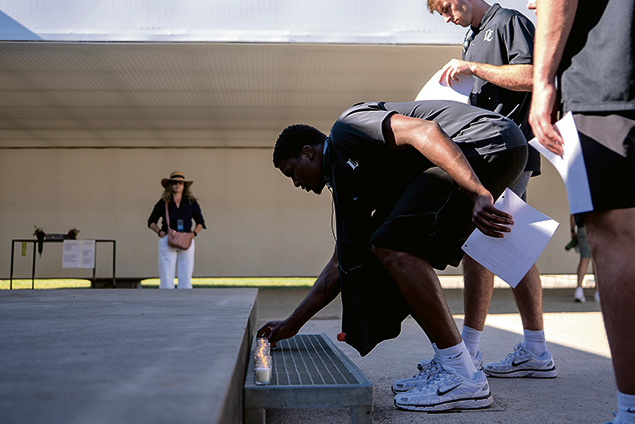
“She touched all of us,” Dr. Gallin added. “In every presentation I give, I tell her story and remind people that this is why I do what I do.”
When Ms. Kor died in July 2019, exactly a year after the Davidson College team ended its trip, many of the players reached out to Dr. Kor, reflecting on how much his mother meant to them. “They promised to take their ‘big feelings’ about what happened at Auschwitz and use them to make the world better,” Dr. Kor said. “I know they all continue to carry her memory with them.”
Although no Davidson athletes went to Auschwitz between 2018 and 2026, Dr. Gallin’s experience giving talks to students on combating antisemitism and responding to their very real concerns inspired her to do more.
Dr. Gallin’s father, Philip, died in September 2025. While she sat shiva for him, Dr. Gallin thought about his impact on her Jewish identity and her sense of ethics as she asked herself what she could do to honor him. “It was the 90th anniversary of the Berlin Olympics, and it felt like this was a time to connect the sports aspect of a trip with the lessons of the Holocaust,” she said. “I wanted to show student-athletes how sports were used to put forth Nazi propaganda and espouse a hierarchy of human life.”
Back at Davidson, Bob McKillop had retired in 2022, after 33 seasons as head coach, and his son had replaced him. “When we contacted Matt at the end of October 2025 with our idea to travel to Berlin on a five-day immersive educational study trip coinciding with the 90th anniversary of the 1936 Olympics, he was all in,” Dr. Gallin said. “Our Eva-focused trip in 2018 was a springboard to the 2026 trip.
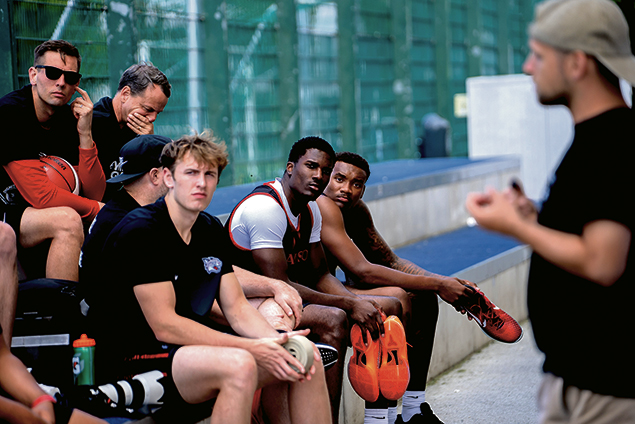
“As survivors leave us, the responsibility of remembrance falls increasingly to those of us who did not experience the horrors of the Holocaust firsthand, but who nevertheless inherit its memory and its obligations.”
Dr. Gallin and Dr. Caleb are working together to create the Ferencz Institute’s Beyond the Game program, a multimedia program for collegiate athletes. “Our goal is to teach student-athletes about a time when athletic freedoms — like the rights of athletes to exercise free expression, personal autonomy, economic choice, and civil liberties within sports — didn’t exist,” Dr. Gallin said.
The trip this summer and the one in 2018 were “very different for a number of reasons, but mainly because we weren’t traveling with a survivor,” Dr. Caleb added. “The 2018 trip was more emotional, while the 2026 trip was more cerebral.”
“The impact of all we learned goes beyond the game,” Mr. McKillop said. “Students were asked to think critically about the connections between past and present and their roles as athletes to be educated when speaking out on issues.
“I hope our experience in Berlin gives our players a profound sense of gratitude for the opportunity they have to play the game they love. They are able to compete because of their commitment, their preparation, and their character, not because of their race, religion, or background.
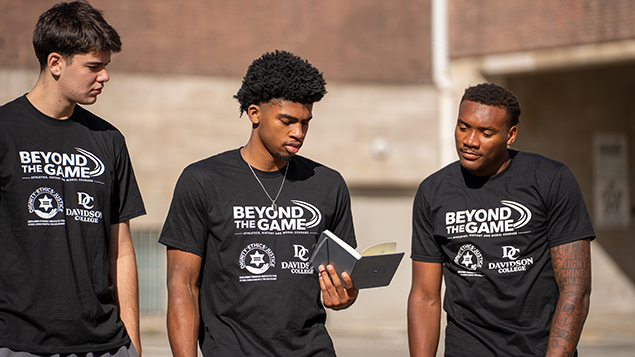
Dr. Gallin explained that the Beyond the Game program is a work in progress. “We are fortunate to have the support of the New Jersey Commission on Holocaust Education,” she said. “They have all the vetted resources and best practices of current Holocaust education to ensure that trustworthy information is presented to schools in New Jersey.” The multimedia program will consist of the trip, the curriculum, and a book, tentatively titled “From Propaganda to Protest: 90 Years Since the Berlin Olympics and the Battleground for Power and Resistance,” which will accompany the teaching modules.
“Everything we decide to include starts with what was gleaned from our trip,” Dr. Gallin said. “By focusing on the Davidson athletes’ impressions of the trip to Berlin as a contemporary case study, we can demonstrate what historical engagement can look like, what students learn, and how athletics can be a driving force for dignity, equality and social justice.”
Dr. Gallin’s hope for the athletes who participate in Beyond the Game is to develop reflective, informed, and ethically grounded leadership skills that extend beyond the athletic arena.
For more information, go to ferenczinstitute.org.