Going to day school means learning STEM
Local teens compete in Science Olympiad
Students from 11 local Jewish high schools, along with their science teachers and coaches, gathered on April 26 for the 2026 Yeshiva League Science Olympiad, a competition designed to challenge youngsters in different STEM (science, technology, engineering and mathematics) related events.
This year, for the first time, the Olympiad was held at Teaneck’s Torah Academy of Bergen County, one of the participant schools, which provided it with labs, classrooms, and assembly spaces.
The annual Science Olympiad for yeshiva high school students was initiated in 2005 to provide opportunities for Sabbath-observant students to compete. Dr. Linda Padwa, associate director for science education at Stony Brook University, pioneered the program after observing that her own grandchildren could not participate in science programs held on Shabbat. She has continued to be involved in the event since its inception, Dr. Ann Shinnar said as she introduced Dr. Padwa to the assembled participants and thanked her for many years of work on the program.
Dr. Shinnar, who organized and ran this year’s Science Olympiad, recently retired as associate professor of chemistry at Touro University’s Lander College. She has been volunteering to oversee the Science Olympiad since 2011. She described how “the Olympiad features 12 different events … with schools providing teams of two students for each competition.”
Dr. Shinnar explained that some of the competitive activities were hands-on. For instance, students in the electric vehicles competition had to build their vehicles in advance and bring them to TABC. “Electric vehicles were judged on how far the motorized car could travel in a short time, measured in meters per second,” she said. The chemistry lab competition included an experiment on kinetics, which involved calculating the rate of a chemical reaction. In metric mastery, students were challenged to estimate quantities, such as mass, area and density, then measure them to see how accurate their estimates were.
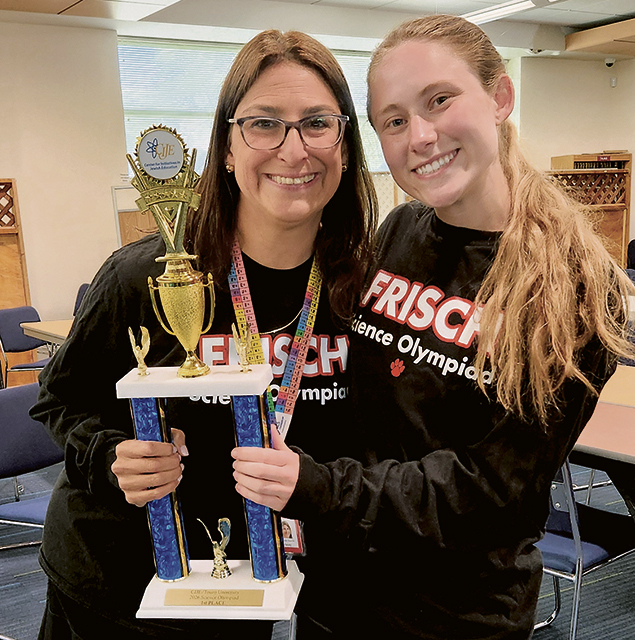
Two students from the Frisch School in Paramus — Revital Geva of Englewood and Livi Urman of Highland Park — competed in the hands-on “Write It, Do It” challenge. Revital, who hopes to become a doctor, had to write a highly detailed description of a 3D display so that her teammate, Livi, could reconstruct the display based on the written instructions. “You have to be very detail-oriented,” Livi said. The pair won second place in the competition.
Some of the events involved written tests of student knowledge. Those competitions included entomology, where students identified insects; knowledge of rocks and minerals; and questions in anatomy and physiology.
Lily Acton of Teaneck entered the knowledge-based competitions about designer genes and entomology. Although she did not win an individual medal, her team, Frisch, came in first overall. Lily plans to pursue a career in biomedical engineering. She expressed great appreciation to her team coaches and science teachers, Dr. Jennifer Blanck and Dr. Mindy Furman.
This is the first year that the Olympiad was sponsored by the Center for Initiatives in Jewish Education. Philip Brazil, CIJE’s vice president, said the organization serves a network of more than 200 schools, focusing on STEM education and K-12 curriculum. One example of a STEM activity is an upcoming middle and high school robotics tournament, Adam Jerozolim, CIJE’s director of curriculum development and programming, said. According to its website, CIJE runs STEM events for 26 Jewish elementary and high schools in New Jersey.
Orly Nadler, CIJE’s director of innovation, said that opting for Jewish education should not mean a deficiency in science education. “Schools should provide high levels of STEM education to foster the notion that their students can excel in the sciences,” she said. “When we bring schools together for activities, [students] see there’s a network where they can excel,” and they are encouraged “by competing against other schools and shining.”
CIJE has prioritized getting girls involved in science and technology. There are all-girls events, such as visits to Google and to the MIT Media Lab. “We took the girls to the Broad Institute of MIT, the Genome Sequencing center,” Ms. Nadler said.
CIJE’s website emphasizes that “Jewish students deserve to shape the future.” Their mission statement declares: “We believe Jewish day school graduates should be prepared to succeed in an ever-changing global society and to reach their potentials in their future careers and life.”
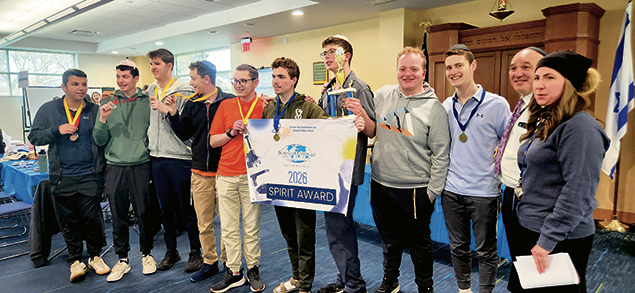
In the awards ceremony, dozens of awards were presented to teams of students from the 11 participating schools. That included three New Jersey schools, Ma’ayanot and TABC, both in Teaneck, and Frisch in Paramus. The other eight schools are in New York — the Heschel School, DRS Yeshiva High School for Boys, YDE Boys High School, North Shore Hebrew Academy, Ramaz High School, SAR High School, SKA High School for Girls, and Yeshiva University High School for Girls.
The awards for schools with best overall performance went to Frisch, in first place; SAR, in second; Yeshiva University H.S. for Girls, in third; and TABC, in fourth.
As part of the program, students viewed a video interview that Dr. Shinnar conducted with biomedical engineer Jeremy Bekritsky. Dr. Bekritsky gave the budding scientists helpful career tips and encouragement. Knowing that science can be challenging, he said, “When learning difficult concepts, sometimes it doesn’t register right away. Be patient with the process… Follow guidance of your teachers, ask questions, and you’ll figure it out.”
He further counseled them, “In addition to technology skills like AI, the soft skills are important: Learning how to work with people, being confident in yourself and what you know that you know, being friendly, being respectful. AI will never be able to replace a smile.
“Ultimately, relationships and working hard will help you advance.”
Information on the Center for Initiatives in Jewish Education is at www.thecije.org. For more on the Yeshiva League Science Olympiad, go to educator.jewishedproject.org.
Dr. Miryam Z. Wahrman of Teaneck is professor of biology at William Paterson University of New Jersey and a big fan of STEM education for students of all ages and abilities.