First it’s yes, then suddenly it’s no
Photo anthology about coexistence in Jerusalem rejected because it’s by an Israeli
On September 4, we ran a cover story about the Israeli photographer Sharon Gabay’s new book, “Jerusalemites.”
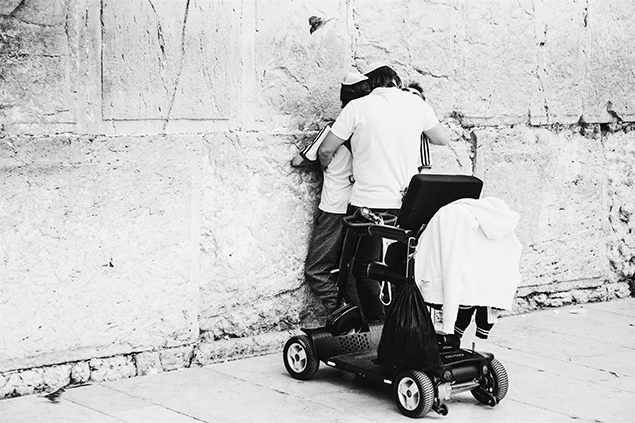
As we wrote then, the book is about 300 photos, culled from about 2,000 that he’d taken over 15 or so years. The shots are all unposed, taken by his battered, unassuming old camera. They show the extraordinary range of people who live in Jerusalem; some exotic to our eyes, some gorgeous, all fascinating. Throughout the book, which is wordless except for the preface and introduction in the front and the acknowledgements in the back — all in three languages, English, Hebrew, and Arabic — the images are juxtaposed to show the similarities that coexist with the differences.
Mr. Gabay stopped taking photos for a few years, after the trauma of October 7, which he photographed, but then he decided to put together “Jerusalemites,” and to pick up his camera again. Once he was ready to live again, the nightmare brutality of October 7 spurred him in the other direction. He increasingly felt drawn to showing the truth that, as he says, 99 percent of the time, everyone in Jerusalem gets along. The city is not the roiling pit of rage that outside media shows it to be. It is instead a place of mystery, art, beauty, humor, and shared humanity.
The book drew praise from such diverse people as Israel’s president, Isaac Herzog, and the U.S. ambassador to Israel, the evangelical Christian Mike Huckabee.
I wasn’t surprised to get another email from Mr. Gabay after the story was published — I often stay in touch with people whose work impresses or touches me — but when I read it, I was outraged.
Mr. Gabay had been canceled for being Israeli.
This is what happened.
Mr. Gabay began to enter “Jerusalemites” in international competitions. They included one in India, which has a three-part contest — for picture of the year, exhibition of the year, and book of the year.

“I submitted my book to the book-of-the-year contest, and I was chosen, with 22 others,” he said. “I was told that they received more than 1,000 entries from 66 countries.”
He filled out the information form, which included his name, his publisher, and his home country. But as in many similar competitions, the judges got none of those details, which might have swayed them. Instead, “there were five judges — two of them from National Geographic — and they saw only the inside of the book. They chose 23 books.
“So what happened is that they sent me the email, and they uploaded the list of winners to their website. I’m experienced at this, so I immediately took a screenshot of the email, with my name on it.
“On Friday, I went to my parents’ house in the morning, to do a little shopping for Shabbat. I wanted to show my father the list, so when I got back, I opened it — and my name wasn’t there. It wasn’t on the list.
“That’s how I found out that they took me off the list.
“My father already was proud of me, but he became even more proud when he realized why they kicked me out.”
As to why he was kicked out — Mr. Gabay wrote to the festival to ask what had happened, and he was answered first with an email that said this:
“We regret to inform you that, following a subsequent review of the circumstances surrounding this year’s exhibition, we have decided not to include your photobook in the final exhibition at IPF 2026.
“We understand that this decision comes after your work had been selected, and we regret any disappointment or inconvenience this may cause. Following the selection, certain concerns were brought to the festival’s attention regarding the inclusion and after careful consideration of these concerns and the broader context in which the festival operates, we have decided that it would not be appropriate to proceed with the exhibition in this edition.
“We would like to emphasize that this decision is separate from the artistic evaluation of your work and is not a reflection of its artistic merit. We respect your practice and appreciate the time and effort involved in participating in the festival. We sincerely thank you for your understanding and wish you continued success with your work and future engagements.”
That short email was followed by a three-page work of art, a muddled and self-contradictory opus that repeatedly assured him that his work had not been rejected because of its quality, but for some other reason. This extract from that second email is perhaps the argument at its most succinct:
“The accurate position is therefore this. The book was selected on the published artistic criteria. After that selection became public, concerns were raised about inclusion in this edition. The Organiser then decided not to proceed with the exhibition of the book at IPF 2026. The festival does not accept that this amounts to a breach of the Open Call, or to a decision taken on nationality as a published criterion.”
So it doesn’t actually say that it is rejected because Mr. Gabay is Israeli, but it doesn’t not say it either. It leaves it to the reader to fill in the blanks.
Or, as Mr. Gabay put it, “The Iranians are still in. Just the Israeli is kicked out.”
It is hard to understand why the festival promoters would bother to anonymize the contest entries they send to the judges, only to reject winners because of where they come from. Surely it would have been easier to leave that information unmasked in the first place and avoid this mess.
“We’re lucky that these antisemitic people are so stupid,” Mr. Gabay said. “The Germans were smart. They succeeded. But the people who hate us now are so stupid that they kicked out a book that gives a place to everyone.”
He does think, though, that the Indian festival’s move is smart politics for Indians. “They’re getting good publicity on my back, but they know what the people where they live want,” he said.
He’s reached out to embassies, politicians, and festival partners. “The U.S. embassy in Jerusalem responded,” he said. “Ambassador Huckabee’s executive assistant told the ambassador about the case in person, and he will see my letter. In her words: ‘We are shocked.’ The embassy’s cultural program specialist wrote that it is very sad and disappointing, though unfortunately not surprising, that they are seeing similar cases around the world in almost every artistic discipline, and that it says nothing about the artistic quality of the book, which was selected and highly regarded.”
Israel’s foreign ministry also is looking into the case, and has told Mr. Gabay that it will be in touch with him.
When Mr. Gabay wrote to Lufthansa, which is listed as the festival’s airline partner, he was told that it was not affiliated with the festival, and it has asked to have its logo removed from the website. “The Goethe Zentrum Hyderabad, listed as an associate partner, replied that it takes the concerns seriously, is reviewing the matter and will come back to me,” he said. “Letters to National Geographic, the Telangana government, Telangana Tourism, Alliance Française and the other partners went out, and I am waiting for replies.” So far, he’s heard nothing.
Mr. Gabay is most upset by the way the simple, unavoidable meaning of his book has been ignored.
“I worked to give everybody their place in it,” he said.
He repeated a version of what he said in the first story. “‘Jerusalemites’ is about hope,” he said. “It tells people around the world that what you know about Jerusalem isn’t right. We live together, day by day, all of us, everyone.”
If only the rest of the world would allow themselves to open their eyes and see that truth.