Finding God in community
Congregation B'nai Sholom/Fair Lawn Jewish Center welcomes its new rabbi
Synagogues, like many other institutions, want their leaders to be walking paradoxes. They should be young, vital, magnetic, able to attract young families with their enthusiasm and boundless, bounding energy.
They also should be wise, carrying years of learning and decades of institutional knowledge, so deep that it’s intuitive, and a network of friends and mentors in the Jewish world.
Congregation B’nai Sholom/Fair Lawn Jewish Center appears to have hit both those marks. The Conservative shul’s new rabbi, Eitan Bloostein, is only 30 years old, with the open-hearted, open-eyed eagerness that comes with youth. He’s also the grandson of a rabbi, the son of parents deeply involved in congregational life, and the beneficiary of a day-school education, a gap year in Israel, and work with synagogue teen programs, as well as unusually intense rabbinic internships.
In other words, CBS/FLJC has hit the jackpot.
Rabbi Bloostein, sitting in his office in front of big windows, still partially empty bookshelves, and the bicycle he’d ridden to work on a recent beautiful day, told his story.
He’s a product of the Boston Jewish community, Rabbi Bloostein said; he grew up in suburban Needham, where his family was active in Temple Aliyah, the egalitarian Conservative synagogue in town. He went to the Schechter School in nearby Newton through eighth grade, and then to the Gann Academy in Waltham for high school.
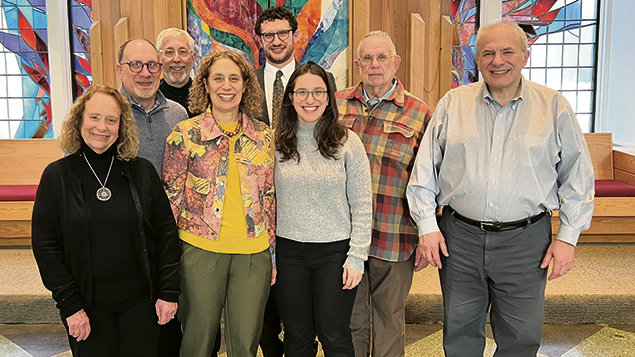
Next, Rabbi Bloostein went to Yeshivat Maale Gilboa, an Orthodox yeshiva in Israel, for a gap year.
That was a change for him, but it fit his family history; as the movements changed and the world changed around them, members of his family considered and reconsidered their philosophical and theological world views and behaviors.
Rabbi Bloostein comes from a staunchly Conservative family with Orthodox roots. His grandfather, Daniel Jezer, is a Conservative rabbi who retired after decades heading Congregation Beth Sholom Chevra Shas in Dewitt, in suburban Syracuse; he’s now the shul’s rabbi emeritus. Rabbi Jezer’s wife, Rhea Jezer, is a musician — a harpsichordist — who earned a doctorate in education. “She got into state politics, and ran for Congress twice,” her grandson said. “She ran on the issue of climate change.” She didn’t win, but she went on to work with senators Hillary Clinton, Chuck Schumer, and Kristin Gillibrand, all New York Democrats.
Rabbi Jezer’s paternal grandfather, Philip Jezer, also was a rabbi, “Orthodox, from the Old Country,” Rabbi Bloostein said; he moved to New York, where he was a shochet in the meatpacking district, back when the meatpacking part of the neighborhood’s name was literal. “I’m very proud that he was an early religious Zionist, at a time when Zionism was in its early stages, and not so popular among religious Jews,” he added.
Rabbi Philip Jezer and his family moved to the Bronx — to the Grand Concourse, in one of those fabled grand apartments — and founded the Salanter Yeshiva, which later became part of SAR in Riverdale. Nevertheless, his son, who later became a cardiologist, went to Ramaz, in Manhattan. The details of that story are lost, but there must have been a story there.
Daniel Jezer, Rabbi Bloostein’s grandfather, the one in Syracuse, was faced with the question of egalitarianism — whether to allow women to have aliyot, to read from the Torah, and to be counted in the minyan — which was roiling the Conservative movement in the 1970s and ’80s (and largely has been resolved since then). “My grandfather was very proud of helping to bring egalitarianism into his synagogue,” Rabbi Bloostein said.
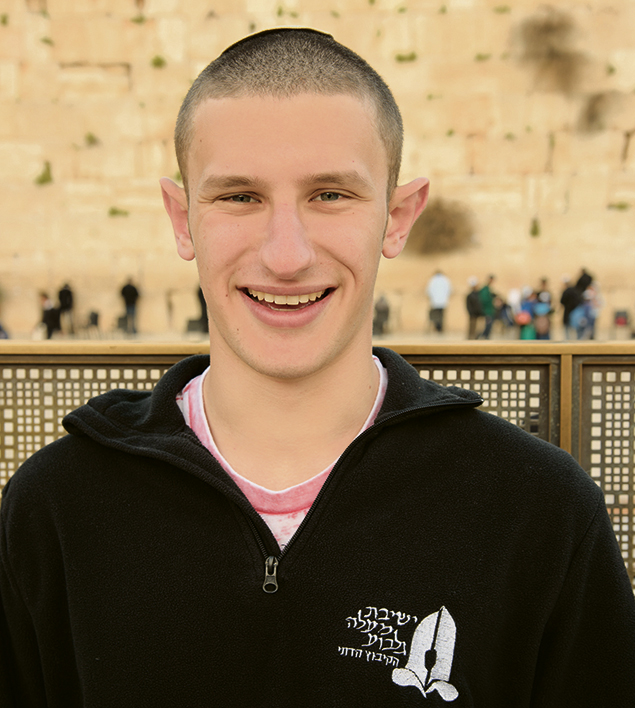
His grandmother, Rhea Jezer, who, remember, was a musician, had much to do with that. She believed strongly in counting women. “She led the choir in my grandfather’s synagogue, and when they got to the Barchu, she refused to start the choir because she was protesting it being nonegalitarian,” Rabbi Bloostein said. “My grandfather knew what was happening, and he started laughing uncontrollably and had to pull himself together.”
His parents, Aviva Jezer and Mark Bloostein, are divorced, and remarried to Jeffrey Rothschild and Stephanie Brown. None of them are rabbis, but they’re all involved in synagogue life, and Ms. Jezer is a former president of Temple Aliyah. She, in particular, knows a great deal about synagogue life, as both a rabbi’s daughter and a lay leader, and “when I call my mom for advice, she can give it,” her son said.
So. Eitan Bloostein went from the Conservative Temple Aliyah and the pluralistic Gann Academy to Maale Gilboa, which is “a school for Israelis, so I was exposed to Israeli culture in a very intense way,” he said. “I really wanted to keep learning,” and he wanted the immersion. And Maale Gilboa “was egalitarian,” he said. “There was no mechitza.” That’s because it was only men. “It was a very intense religious experience,” he added
“It was a holistic Jewish lifestyle, that I feel is possible only in Israel, and only when you are around people who are living it. It really inspired me to continue my Jewish learning, and I carry that inspiration with me to this very day.”
When he went back home after the gap year, Mr. Bloostein, as he was then, went to Tufts, “where I majored in religion, because it doesn’t have a strong Judaic studies department,” he said. “I ended up studying Christian theology, which was very useful. I grew up mostly among Jews, and I looked around and noticed that a lot of people in this world who are not Jewish are in positions of power. I thought it was useful to know what made them tick.”
Two things happened to steer Mr. Bloostein’s career when he was in college. “I was at a crossroads,” he said; he didn’t know what career path to take. “I went to my advisor and said, ‘I love studying religion, and I’m thinking of getting a Ph.D.’ He said, ‘Don’t do that! You could be the smartest person in the world, and there’d still be no job for you.’
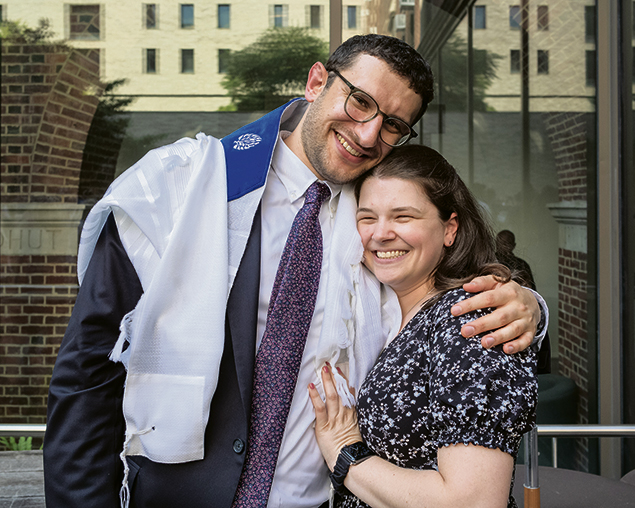
“At the same time, I started teaching Hebrew school at Temple Aliyah.” The leaders of his family shul noticed him and kept asking him to assume more and more responsibility. He became the youth director there. “It felt scary, going down a path I didn’t think I was going to go down, but I realized that I love theology, I love community, and theology happens in the context of community.
“I felt inspired by the work of Martin Buber, who says that the space between people is the space where God rests. I realized that I could dream up all the theological ideas I want in an ivory tower, but if I want to understand how God works in the world, I have to work directly with people.
“I believe that every person is created in the image of God, and that we can uncover that image in a deeper way the more we get to know one another. That’s how we get to know the divinity both in ourself and in the other.”
It wasn’t all abstract. “It was much more fun than the potentially dry theological language made it seem,” he said. “The process of uncovering the divine in each other brought a lot of joy.”
It made him realize that being in community, part of a community, and a leader of the community was exciting and fulfilling work. “I thought to myself, ‘I should be a rabbi,’” he said.
That got him to the Jewish Theological Seminary. “My grandfather went to JTS,” he said. “I continue to believe very strongly in the Conservative movement, and in the marriage of scholarship and practice of Jewish spiritual and religious life. JTS was the only place I considered. I applied and I got in.”
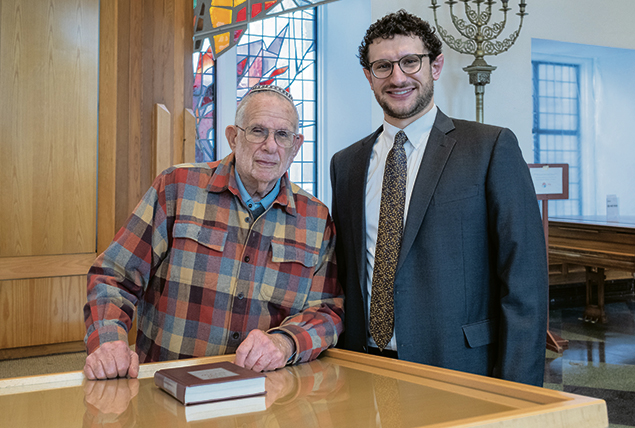
Rabbi Bloostein knew that he wanted to have a pulpit. In his second year at JTS, he became an intern at Congregation Etz Chaim in Monroe in New York’s Orange County, near Kiryas Joel. It’s an old, tight-knit community that used to be bigger, but has dealt with shifting demographics. It prides itself on the number of prominent rabbis who began their careers there, by but the time Eitan Bloostein got there, it could no longer support a rabbi and instead worked with rabbinical students.
“I totally felt in love with the community,” he said. His arrangement was to go up there once a month and on the High Holidays to lead services, “but I said early on, ‘If I can help in any pastoral way, I will.’” And he did, and it led to far more than one day a month in Monroe.
He lived on the Upper West Side then, and he had no car, so “I took the bus from the Port Authority,” he said. “That was my first time on Route 17. Sometimes, if the traffic was really bad, I’d get there a little nauseous, but I got there.”
“People told me their stories, and it gave me a new perspective on theology,” he said. “It helped me realize that being a spiritual leader means connecting deeply with people, and when you do that, when you hear their stories, you see the divinity in them. And they taught me.” One of the lessons was that if he didn’t get food at some point, probably early on, at kiddush, he wouldn’t have anything to eat. “And on a deeper level, by embracing me and giving me grace and care and opening their arms to me, they taught me to be a caring rabbi.”
He also was an intern — at the same time— at the Sutton Place Synagogue in Manhattan; that experience, at a big, well-staffed, wealthy urban shul also taught him a great deal; he’s particularly grateful to its senior rabbi, Rachel Ain, for teaching and guiding him. She was one of the rabbis who supported him when he was ordained at JTS in May; the other was his grandfather.
By then, Rabbi Bloostein had been offered and accepted the leadership of CBS/FLJC. He’s excited about it — and about the future — for both specific and general reasons.
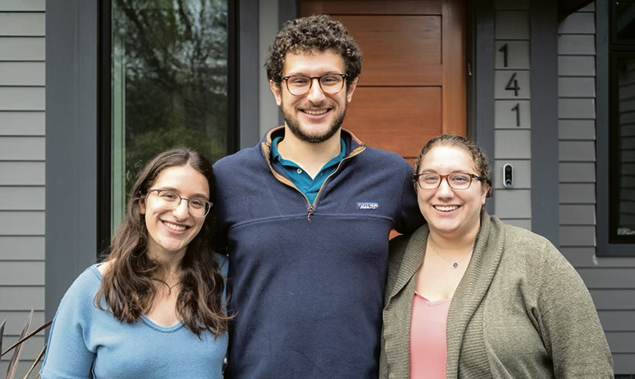
Specifically, because he grew up in a small, tight-knit suburban community, and Fair Lawn is another such community. He’s moved into town, and although now he has a car, he often rides his bike to work, and increasingly he recognizes the people he passes. He loves seeing people both in and out of shul.
Personally, because he’s getting married in the spring, he and his fiancée look forward to making an emotionally rich life in Fair Lawn.
And the general reasons are what he sees as hope for the Conservative movement.
“I feel that its values are alive and well and thriving,” he said. “The Conservative movement’s superpower is the marriage of Western values that we all hold dear with Jewish values. It says that we can incorporate these two things together without compromising either one.” He acknowledges that the movement’s having a lot of problems, and that many of them are demographically based, and also that throughout not just the Jewish world but the larger outside one, many people have a tendency to go either right or left. When it comes to religion, that means that “some people are seeking a sort of a pure truth, religion as it was practiced by my father and his father and his father.” On the other side, “they’re saying that religion isn’t for the modern day. It’s not for me. I’m free to live life and eat whatever I want and do what I want to do on Saturday, and I don’t need to get God mixed up in all of this.
“But as a Conservative Jew, I proudly stake the middle ground.
“And I am a Zionist,” he continued. “I believe that the state of Israel is important for the Jewish people around the world, and that it is a miracle that we have Jewish political independence for the first time in 2,000 years.
“Part of Zionism demands of me, part of what I believe it means tolove the state of Israel, is to hope for a state of Israel that reflects Jews around the world. The brand of Judaism that I come from is fiercely traditional and progressive — progressive meansing that it holds Western values, such as freedom of thought, freedom to ask questions, and egalitarianism dearly. I don’t see the state of Israel supporting a Judaism that reflects that.
“I believe that it is my job as a leader of a Conservative Jewish community to advocate for an Israeli society that is hospitable to Jews who believe that.”
Learn more about Rabbi Bloostein and Congregation B’nai Sholom/Fair Lawn Jewish Center at fljc.com.