‘Each page was inspired’
Rabbi Mark W. Kiel completes the ‘yizkerbukh’ his artist father began
Mark W. Kiel grew up surrounded by survivor sadness.
The American-born child of Holocaust survivors Chonon and Liza Kiel, Rabbi Kiel always felt immersed in everything his parents had experienced. “I knew about everyone being killed,” he said. He knew the details of his parents’ tragic and complicated story, how his father’s first wife — his mother’s sister — was murdered, and how his older half-sister Ruth was hidden and then betrayed, surviving the war in a convent, where she passed as Catholic.
But the now-retired rabbi of Congregation B’nai Israel in Emerson never thought that he would complete his father’s grand project of memorializing the murdered Jews of Czenstochov, the city in southwest Poland where his parents grew up, and that they loved so well. (Chen-sta-hov is the Yiddish pronunciation of the Polish Częstochowa.)
“Didn’t even occur to me,” Rabbi Kiel said.
His father died in 1998. “Once he passed away, I went through his stuff,” he continued; he found the book at the back of his father’s closet in Brooklyn. “I remember how much I admired it as he was doing it.” Now Rabbi Kiel has edited, translated, and published “Czenstochower Yizkerbukh,” an illuminated manuscript that his father compiled over many years. He also wrote three short explanatory sections for the book; one is on Yizkor books in general, one is a short biography of his father, and the last is an introduction to this book
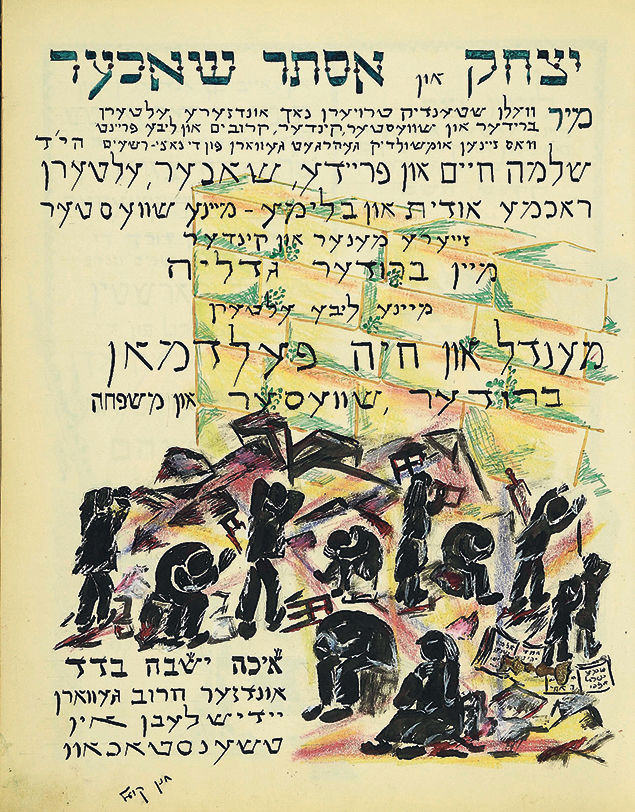
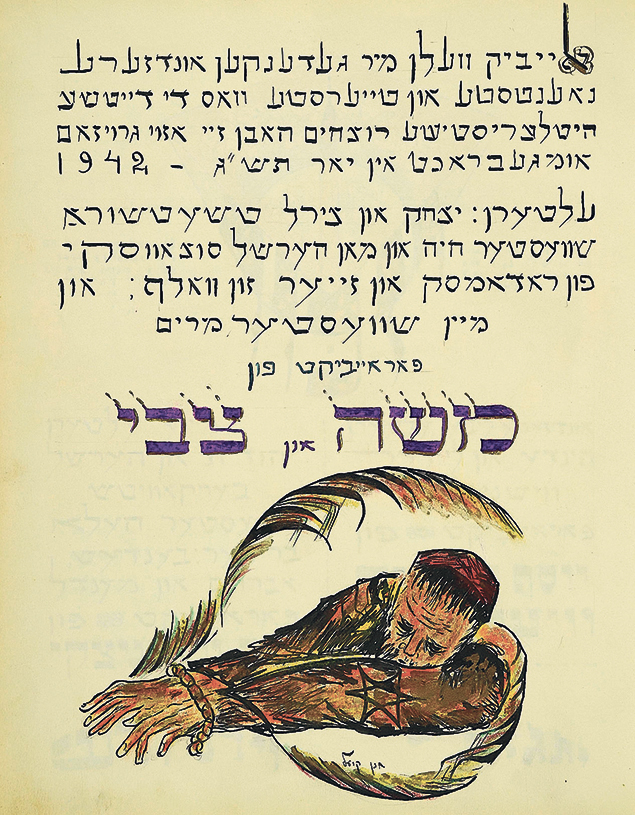
The volume consists of 56 illustrated, full-color plates, each dedicated to Jews with some connection to Czenstochov, many of whom were killed there or transported to Treblinka.
Yizkerbicher, or books of remembrance, have a long history among the Jews. They recorded and commemorated the killings of Jews during the Crusades and Eastern European pogroms, then took on a greater urgency after the Holocaust. Often commissioned by the landsmanschaften, those fraternal orders of particular communities, they were a way to remember and dignify those who had been lost, a literary funeral in a way.
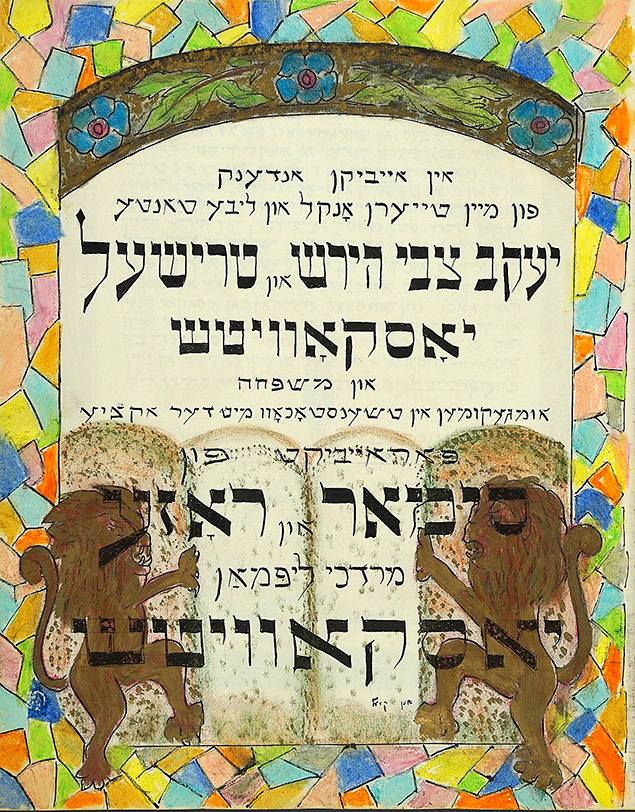
Mr. Kiel’s book was slightly different, because the Czenstochower landsmanschaft did not commission it. Instead, he created each page in response to a community member’s request, according to his son. In return, the families were asked to donate to the Kfar Saba Children’s Center in Israel, Rabbi Kiel said. Community members came to the Kiels’ house in Brooklyn to look at the pages. “Each page was inspired,” Rabbi Kiel said. “He didn’t have a plan of how to do the whole book.” Because of the unforgiving medium he used, Chonon Kiel couldn’t make corrections, so he created the plaques without mistakes.
Like many second-generation survivors, Mark Kiel felt weighed down by his family history. It may have been one of the sources of his occasional depression, he mused, and the project was a way to sublimate his sadness. “I was busy memorializing, and it made me happy to do that,” he said.
A historian as well as a rabbi, Rabbi Kiel was involved in organizing an academic symposium in Czenstochov in 2004 and has continued to attend conferences there.
Częstochowa is the fifth largest city in Poland and its most sacred, according to Rabbi Kiel, because of its connection to the Black Madonna, an icon of the Virgin Mary that was blackened in a fire. Millions of pilgrims come there. “It’s as important as Lourdes,” Rabbi Kiel said. Despite the ever-present antisemitism, his father loved Czenstochov “It was a thriving Jewish world inside an antagonistic Polish world,” Rabbi Kiel said, with political and social groups of all kinds.
His father was a member of Hashomer Hatzair, a left-leaning Zionist organization. “He was a Yiddishist among Hebraists,” according to Rabbi Kiel, and he was not irreligious, which also set him apart from the staunchly secular Zionists.
Chonon Kiel’s yizkerbukh plates exhibit a variety of styles, ranging from text-heavy to spare, with the illustrations primarily in the naive style of art, now gaining deeper appreciation. His work also reveals the influence of cubism and expressionism. The plaques include traditional motifs, such as the Eternal Light, cemetery gates, menorahs, and tablets of Moses. Stock funerary terms are there too: Al Kidush Hashem, Yizkor, and El Moley Rachamim. The artist used literary quotations from modern Yiddish and Hebrew poets as well as folk sayings.
Chonon Kiel showed early artistic talent, and one of his teachers, the prominent Czenstochover artist Peretz Wilenberg, encouraged his parents to further his education in the arts. According to Rabbi Kiel, Chonon’s father refused, saying that his son was going into the family business. “My father always resented that,” Rabbi Kiel, who long marveled at the range of his father’s talents. said. “He was totally untrained.” Still, he spent much of adult life working in various media – paint, ceramics, copper engraving, and papier mâché. He used watercolor, pen and ink, marker, pastels, and crayons to create the yizkerbukh. He also designed journal covers, theater sets at the summer camps where he worked, and did calligraphy for the Jewish National Fund.
Chonon Kiel never imagined that his son would finish his work. With the book published, “I fulfilled my obligations to my father,” Rabbi Kiel said. While the yizkerbukh is self-published, the academic publisher De Gruyter is considering publishing it as a companion volume to Rabbi Kiel’s history of Czenstachov’s Jewish community, The Jews of Częstochowa: The Life and Death of a Community,” he said.