Doing what you can with what you have
Teacher at GOA painstakingly rebuilds his life after Guillain-Barre strikes
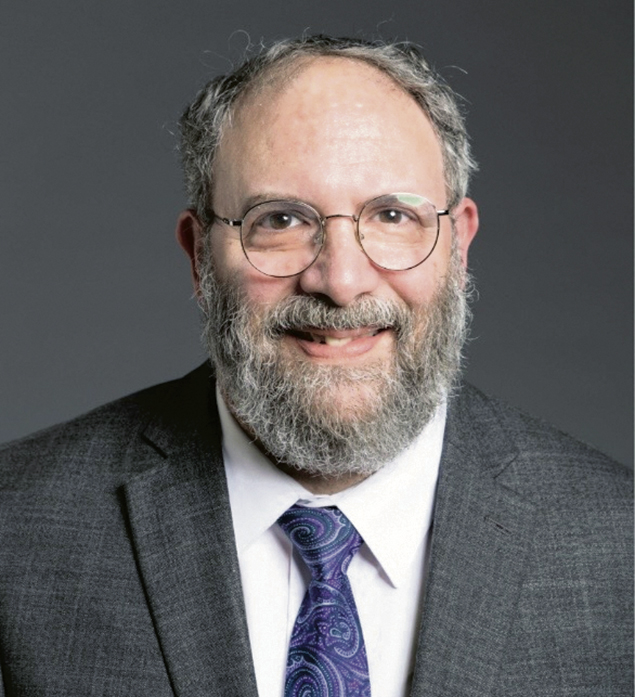
Rabbi Eric Yaakov Traiger is a middle-school teacher at the Golda Och Academy in West Orange.
That is a simple statement of fact. It is also a triumph, and a bit of a miracle.
Rabbi Traiger’s path to his career is as varied as his first and middle name hint that it might be, and that could be its own story. But the main story now is his recovery from Guillain-Barre syndrome — an autoimmune disease that attacked him with ferocity and has receded slowly and imperfectly — his return to teaching, and the community and internal fortitude that has allowed and protected that return.
Eric Traiger grew up in Sharon, Massachusetts. His family belonged to the local Reform temple — now it’s a Young Israel shul — and he became bar mitzvah there. “Sharon has a strong Jewish community,” he said.
His mother died when he was 8, and “my grandmother played a huge role in my growing up,” he said. “We spent a lot of time in my grandparents’ house, and that house had a very Jewish flavor.” It also had a kosher kitchen.
“My grandfather’s father came to this country in 1908. He became a tailor here, so he could open his own shop and wouldn’t have to work on Shabbat. He was a religious Jew.”
Still, though his connection to the Jewish world was strong, it wasn’t generally front of mind for him. “But when I was in high school, I saw two movies that had an impact on me. Even though they were about the breakdown in tradition, there was something about the religiosity and the emphasis on study that affected me.” Those two movies were “Fiddler on the Roof” and “Yentl.”
When he went to the University of Massachusetts in Amherst in 1984, “I explored my interest” in the Jewish world, he said. “I joined Hillel, became an active member, and was president. I took a lot of Jewish studies classes.
When he was in high school, “I had a job on the town newspaper, the Sharon Sentinel,” Rabbi Traiger said. “I wrote sports for them for two years. So I went to UMass as a journalism major. I also had a strong fine arts background and a talent for drawing.”
But he realized that as much as he liked both those fields, Jewish learning had a stronger pull on him. “So I became an education major and Jewish studies minor. I kept taking classes and reading, and by the time I graduated from college, I was keeping kosher, keeping Shabbes, davening every day. My grandmother bought me my first tefillin, and encouraged me about my increased Jewish observance.”
And that’s when “I decided to become a rabbi.”
He went to Israel for two years, at the Jewish Theological Seminary’s Midreshet Yerushalayim program. When he returned to the United States, he enrolled at the Reconstructionist Rabbinical School, an institution that has changed greatly since he studied there. “There were three Reconstructionist rabbis who had a strong impact on me in college,” he said. He was ordained in 1995 and started teaching at the Kellman Brown Academy, then a Solomon Schechter day school in Cherry Hill. (It’s now a community school in Voorhees.)
He joined the Orthodox shul in Cherry Hill, and “I was studying with three Orthodox rabbis in the area, and two of them, independently of each other, gave me smicha,” he continued, making him Rabbi Rabbi Rabbi Traiger, although he goes with the subdued single-rabbi title.
In 2004, he married Lisa and joined her in Passaic where they continue to live as part of the local Orthodox community. He started teaching at another Conservative day school, the Gerrard Berman Day School in Oakland, and stayed there until 2019, when he moved to Golda Och. As the middle school’s only Judaica teacher, he taught Mishnah, Talmud, Chumash, Jewish history, and Rashi, and he was the school’s assistant principal for the last years of his tenure there.
So Rabbi Traiger has been affiliated, learned, or worked with the Reconstructionist, Reform, Conservative, and Orthodox movements.
That’s just the background to his story.
Covid hit soon after Rabbi Traiger joined the GOA facility, and school became remote. Then, in 2020, “we had to come back to school,” he said. “Everyone had a mask on, there was social distancing, and everyone was on a computer, even in school.” Things still were odd; it would take the full academic year for them to return to normal.
In October 2020, “the week after Simchas Torah, I was driving home and I felt an ache in my left shoulder,” Rabbi Traiger said. “I got home, and the ache didn’t go away. I didn’t feel well. That night, the ache in my shoulder got stronger, and my left foot felt somewhat numb.
“I knew that something was wrong, so we called Hatzolah at around 11:30 that night, and they took me to Hackensack Hospital and did a complete cardiac workup to make sure that I was not at risk for a heart attack or a stroke. I was released at around 6 a.m. I didn’t feel better, but they couldn’t find anything wrong.
“I got back home, ate something, and at 9:30 or so I said to my wife, ‘I don’t feel right.’
“My wife was working from home then, and I said, ‘I have to go back to Hackensack.’ My shoulders were all hunched up. Hatzolah brought me back, and I sat in the waiting room, and found it more difficult to sit.
“When they called me to examine me, I had trouble walking. I had a CAT scan, they took blood, and they didn’t know what was going on, but they saw that I was having more and more trouble. So they said, ‘You are staying here.’ At one point I had to go to the bathroom and I couldn’t walk, and the ER nurse yelled at me, ‘What are you doing?’ and got someone to help me.
“They did an ultrasound on my neck and found that I was losing function in my arms and my leg.
“That was on Thursday. This started on Wednesday. By Friday, I was paralyzed from the neck down. I have always been an active person, and suddenly I couldn’t move anything.”
More testing followed, and eventually there was a diagnosis. Rabbi Traiger had Guillain-Barre.
“I had never heard of it, and it took me a little while to understand that I had it,” he said. “At the time, I couldn’t even remember the name. But Barre sounds like beret, so I thought of the hat. That was my mnemonic.”
Guillian-Barre is a rare autoimmune disease that causes a body’s immune system to attack the nerves. “Weakness and tingling in the hands and feet are usually the first symptoms,” the Mayo Clinic’s website says; Rabbi Traiger’s began in his shoulder. “These sensations can quickly spread and may lead to paralysis. In its most serious form, Guillain-Barre syndrome is a medical emergency. Most people with the condition need treatment in a hospital.
Rabbi Traiger’s illness was caused by the flu vaccine he’d gotten eight days before he started feeling symptoms. That is highly uncommon but in no way unique. This is not an anti-vaxxer story. As the website of the Institute for Vaccine Safety, part of the Johns Hopkins Bloomberg School of Public Health, puts it, “Influenza vaccines reduce the risk of influenza infection, which causes Guillain-Barré syndrome (GBS). Thus, influenza vaccines prevent GBS by protecting against natural influenza infection. However, influenza vaccines can very rarely cause GBS within 6 weeks of vaccination in adults, at an estimated rate of 1-3 cases per million vaccinations.”
In other words, get a flu vaccine. Your risk of developing Guillain-Barre is one to three per million vaccines. Unfortunately, Rabbi Traiger was one of those one to three people in every million who did fall ill with the syndrome.
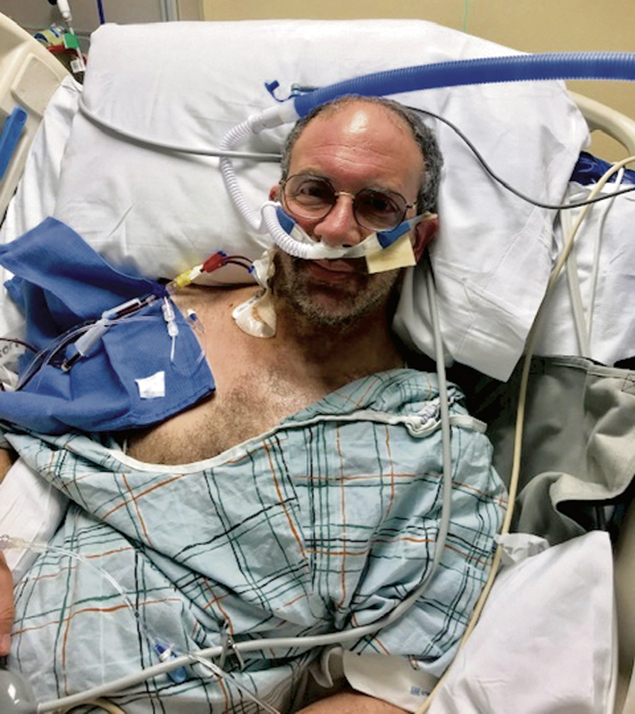
“Guillain-Barre attacks the nervous system. It affects the muscles, the lungs, the circulatory system — it attacks basically everything,” he said. His brain was working properly, but given the surreal nature of the information it was being asked to assimilate, “although I was fine cognitively, I was confused about what was going on.” His medical team “kept a close watch on my breathing. I had pneumonia. I aspirated into my lungs. I was in the IU for days on pure oxygen.”
This is just the start of the nightmare list of medical miracles that kept him alive, but “I was lucky because I didn’t have to be intubated,” he said. He wasn’t allowed to eat, because he wasn’t able to swallow. He was nourished by IV and shrank from 178 to 135 pounds.
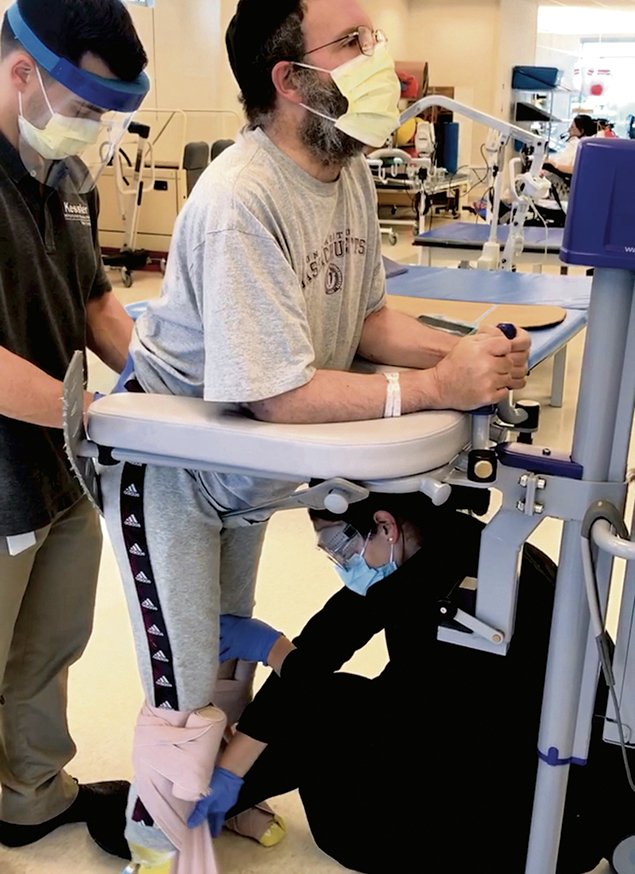
After 28 days in Hackensack Hospital, Rabbi Traiger was transferred to the Kessler Institute for Rehabilitation in West Orange, just down the road from Golda Och. “I’d driven by that place without thinking about it so many times!” he said. “I was there for 12 weeks, and I had to relearn to do everything.
“I had occupational therapy, physical therapy, and swallow therapy. I got to the point where I was allowed to drink thickened liquids. I was aching a lot of the time, but I couldn’t move anything. I had to ask people to move my legs; they ached, but I couldn’t move them.
“After about two weeks, I was able to eat solid food. It’s hard. I had to think about things I’d never thought about before,” because he could do them naturally. Who pays attention to the muscles you have to move to swallow? Or to swing your legs over the side of your bed. Now, he does.
“Being able to eat is something I don’t take for granted anymore,” he said. “There are a lot of things I don’t take for granted anymore.”
Rabbi Traiger was 54 years old when he developed Guillain Barre in 2020. He is 5 1/2 years into this strange new life now. He’s “still in pain most of the time,” he said. He can’t hold his arms up over his head very long. He can’t find comfortable positions to sit or sleep. He needs leg braces to walk because he still can’t feel his legs or feet. He no longer drives; it’s simply not safe. He’s gotten much better since the syndrome was at its worst, but he’s nowhere near his old normal and knows that he won’t be. But “I’ve learned how to adapt,” he said.
That gets us back to school.
“The school has been absolutely wonderful,” Rabbi Traiger said. “I was only in my second year here when I got sick. The principal, Jordan Herskowitz, and my department rabbi, Isach Waldman, constantly checked in. They called my wife almost daily to see how I was doing, and they said that whenever you’re ready, you’re welcome back at work.
“I came back in September 2021, just about a year later. At first, I was working part time, teaching seventh grade. And the year afterward, up to now, I’ve been teaching seventh and eighth grades. The school has been extremely kind in its accommodations. I could not ask for a better place to be.
“My colleagues, the faculty, not only in Judaic studies but in other departments too, have been wonderful. They have been extremely helpful. I was extremely lucky to find myself here, and I still am lucky. I am very happy here.”
Rabbi Traiger also feels deeply supported by his Passaic community. He and his wife have two children, a 21-year-old daughter who made aliyah and an 18-year-old son who still lives at home.
His son became bar mitzvah when Rabbi Traiger was unable to move. “So he had his bar mitzvah at his rebbe’s house,” Rabbi Traiger said. There was a party there for him too. “The shul made sure that he could celebrate.”
Rabbi Traiger wants his story told not “because I feel it needs to be told,” he said. “The reality is that we all live with challenges,” although certainly some are more formidable than others. “I also know that you may have to change what you are doing, but that doesn’t stop you from doing what you want to do.”
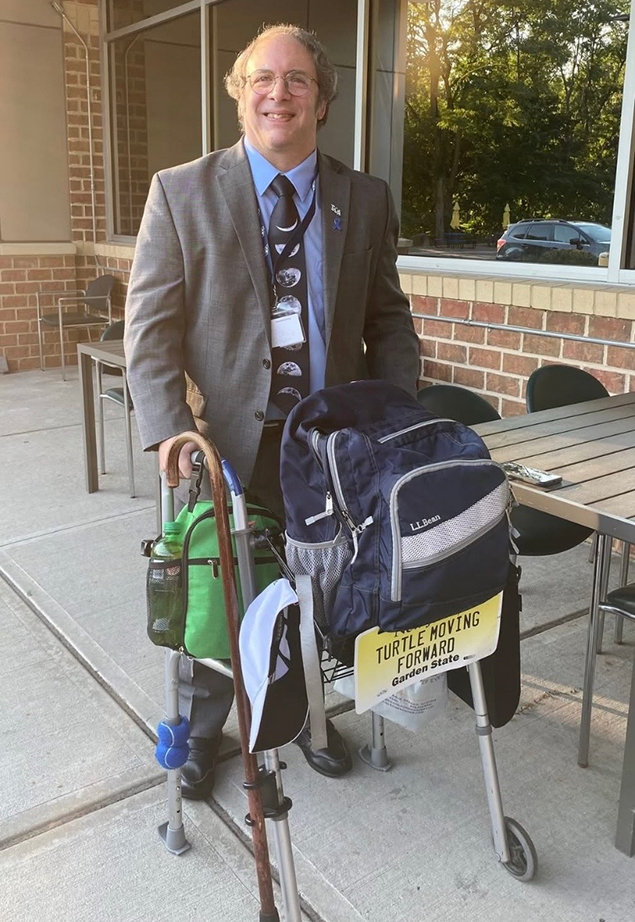
So he still teaches. He uses a cane at home, but at school he uses a walker. The halls are too crowded for him to risk being jostled or shoved inadvertently. But he absolutely comes to school to teach.
“There are times when you have to say that I can’t do something,” he said. “That’s hard.’
“But when a physical therapist asked me what my goals were, I said, ‘Getting back into the classroom. I don’t care if I need a walker or a cane or both.’ Even teaching has been a form of therapy to me.
“I didn’t stay at home in bed like a sick person. I came to work. I had a purpose. I have a purpose!”
He can’t move around the classroom like he used to. “I teach from my desk, with my computer open,” he said. “I can’t really write on the board” — remember, he can’t lift his arms — “so I teach from my computer.” Technology does its magic, and his students see what he’s written. “The experience we had in the pandemic, when we all had to adjust to it, actually gave me some of the technological skills I need now.”
He tells stories about the students he teaches.
“A few months ago, the elevator was out, and I had to walk up the stairs,” he said. “I had lunch duty. I got myself down and I was walking back up, and several kids whom I’d either already had in class or had just seen me came over and said, ‘Can we help you?’ That is a big thing.
“On the one hand, they are typical seventh- and eighth-graders, and that is good. They are normal. But they are always helpful. The other day, we had a fire drill. We have a protocol in place, so when there is a fire drill, there is a teacher designated to help me. I get the wheelchair and he wheels me out, and the kids go out with another teacher through another exit.
“But the kids stayed to make sure that I was all right. They had to be sure. They were wonderful.”
His illness has given Rabbi Traiger “a different approach to the birchat hashachar,” the daily morning prayers, he said. “Those brachot acknowledge things like being able to sit up, to get dressed. They have taken on a whole new meaning for me.
“I didn’t say them when I couldn’t do them. One of the rabbis I have been close to for a really long time — he lives in Philadelphia, he did our wedding, and he gave me smicha — he told my wife to tell me that I should say the six words of the Shema in the morning, and I should say those same six words in at night, because that was all I could do.” He added more brachot as he could do more and more of what they list. “On Friday nights I would say Mikrah Kodesh, and on Saturday nights I would make Havdalah and say ‘havdil ben chodesh l’chol.’ That was all that I could do.
“But that gave me structure. And as I look back, I realize that the structure didn’t really keep me normal, but it did give me a foundation.”
It reminded him of when his father died, in 2007, Rabbi Traiger said. He was punctilious in his observance “and it helped. One of the things I have come to realize is that ritual observance really gives you a way to structure your time and an awareness to what’s outside you.”
As he gradually got better, Rabbi Traiger added back elements that he increasingly was able to perform. “I started to put on tefillin again at Kessler,” he said. “My son helped me. I couldn’t put them on every day, though, because I was very tired, and that added a lot of fatigue.” It took some time before he could do it routinely by himself.
He also had to relearn such things as using his phone, which takes the kind of fine muscle coordination that most of us luckily do not have to think about. He still can’t write, because hands don’t work well enough for that. “One day I tried to write some thank-you notes and the pain stopped me.” He had to relearn how to get dressed, to work around the muscles and nerves that don’t work. He can tie a tie, he said, but he doesn’t know if he could tie shoelaces because he just wears shoes with Velcro. “I’ve learned how to do all these things,” he said.
He’s gotten inspiration from a number of places. One of them is Viktor Frankl’s “Man’s Search For Meaning.” “Frankl spends about half the book talking about his experience in the camps” — Frankl, a psychiatrist, was a Holocaust survivor who’d been in Auschwitz and other concentration camps. “Then he talks about what he learned from it. The biggest takeaway I got from that book is that if you know your why, then you can handle the what. If you know why you are here, if you know what our personal life mission is, then you can handle the challenges.
“I know that I had to get home. I had to be a husband again. I had to be a father again. That was my why.
“I have done a lot of reading in the last few years — I’ve read Rav Soloveitchik’s work, and Abraham Joshua Heschel — and I think that my outlook has changed a bit. I hope that I don’t take things for granted, like I’m sure I used to.
“I have come to believe that God is imminent in the world, but God becomes transcendent when we take our focus off God. So the Jewish tradition and the halachic system has allowed us to maintain that God is imminent in the world. Halachic practice keeps that immanence. It maintains it through my davening, through my teaching, through making brachot, through how we treat people.
“The Rambam tells us to appreciate God through nature. I grew up in New England, so I always loved the autumn. The changing of the colors, even thunderstorms to me are manifestations of God in the world.
“I can’t answer the question of why I got this thing, but all I can do is say ‘Okay. What do I do now?’ I got that straight from Rav Soloveitchik, who writes that yes, there is pain in the world. You have to acknowledge it, empathize or sympathize with the people going through it, and then there is a point where you have to accept it. And instead of saying ‘Why me?’ you say ‘What can I do now?’
“I feel that my Judaism is stronger now, because I had to think about it.”
One more question, Rabbi Traiger. What about your name? Are you Eric? Are you Yaakov?
“I’m both,” Rabbi Traiger said. Eric Yaakov Traiger. For a long time he was Eric. Then he was Yaakov. First he was secular. Then he was so fully immersed in the Jewish world that he was only Yaakov. But he heard a lecture from an Israeli rabbi who quoted the Ramban on why the names of the Jewish months are not in Hebrew. They’re Babylonian or Persian. Why? “It’s so you can remember where you came from.
“When I I was born it was very important to my father that we have strong names.” That was Eric. “I don’t want to give it up. I want to acknowledge who I was, and who I am. It is honest.”
And Rabbi Eric Yaakov Traiger certainly is honest. He’s healing. He’s teaching. He’s home.