‘Chess’ gambit works this time
Danny Strong becomes a hit-maker with a few key moves
One of the biggest hits of this Broadway season is the revival of the musical “Chess.”
“Hit,” though, is not a word usually associated with this show, which has gone through several incarnations since it was first conceived more than 40 years ago. It actually began life as a concept album, with songs by Benny Anderson and Björn Ulvaeus, both of ABBA, and Tim Rice, released in part to raise money to fund a production.
It’s about a chess match between an American grandmaster and his Russian counterpart (loosely based on Bobby Fischer and Boris Spassky). Supposedly a metaphor for the Cold War, it largely failed to excite audiences. A New York production of this expensive-to-mount show, for example, lasted only two months.
But the play continued to live on, through occasional productions around the world and concert performances of the score.
Enter Danny Strong, actor, screenwriter, and self-described musical theater nerd. “I was listening to a recording of ‘Chess,’” he said in a Zoom interview.
“I’m a big musical theater nerd, and ‘Chess’ is beloved amongst musical theater nerds. I started thinking, what’s wrong with this show, which famously doesn’t work and famously is never produced.
“I knew that it was supposedly very confusing, but the songs are so great, And the concept to me is such an exciting concept for a musical, you know: Cold War chess battles between Bobby Fischer and Boris Spassky. I thought it was an interesting idea.
“Then I watched a video of ‘Chess’ in concert with Josh Groban and Idina Menzel. And as I was watching it, my rewrite brain started kicking in. I started coming up with ideas for what I would do if I were to rework it and try to make the show work.
“Then I had a friend reach out to Michael Mayer, who is a very famous theater director, just to say I wanted to rewrite ‘Chess’ and I wanted him to direct. He emailed me the next morning and said he wanted to do it.”
The pair reached out to Tim Rice and others, seeking permission to proceed. “It was difficult to explain what I wanted to do. So I just said, ‘I’ll write a treatment and send it to you. If you like it, I’ll do a script. If you have changes, I’ll make the changes. And if you hate it, we’ll just call it a day.’
“He really liked it right out of the box. He had some notes, which I immediately agreed with. I think that he was pleased to be working with someone who wanted to do this with him and not antagonistically.”
What Mr. Strong did was expand the role of the chess tournament arbiter, making him a de facto narrator who explains what had been mystifying in previous productions. He also reordered some of the songs and strengthened the love story.
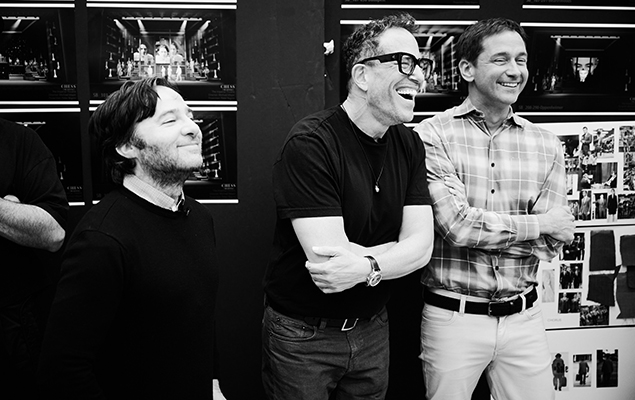
A brief 2018 run at the Kennedy Center (as it was called at the time) was a resounding success. It took seven years, but the show eventually made it to the Great White Way and has been at or near capacity since it opened there. Of course, the cast now includes Lea Michele, Aaron Tveit, Nicholas Cristopher (in a career-defining performance) and Bryce Pinkham — and that certainly didn’t hurt.
Still, despite the overwhelmingly critical and commercial success of the original recording, the play itself seemed almost jinxed.
Mr. Strong seemed unconcerned.
“I thought it could work, and if it did work, it would go like gangbusters. But if it doesn’t, I’d just be one of many who couldn’t make it work.”
Mr. Strong grew up in a secular Jewish household in Mountain View, California. “I wanted to be an actor since I was very young, seven, eight or nine, maybe even younger,” he said. “I was a classic latchkey kid of the 1980s. We were definitely a genre. I would just come home and watch TV by myself.”
He also spent time at the local video store with a clerk named Quentin Tarantino. Yes, that Quentin Tarantino. “I would spend a lot of time at the video store and just sit around and talk to him for long periods, about movies and what to rent,” he said. “My nickname was Little Quentin, because I spent so much time with him.”
Understandably, young Danny had no idea who Quentin Tarantino would be. “You don’t think your video store clerk is going to become one of the most famous directors of the last 30 years,” he said. “But the other clerks used to talk about his scripts all the time, saying they were amazing.”
But at the time, Mr. Strong concentrated on acting. He managed to land Jewish roles, including Jonathan Levinson on “Buffy the Vampire Slayer” and Danny Siegel, the eager ad man wannabe, on “Mad Men.”
He made the transition from actor to writer in his mid-20s. “I’d been working and supporting myself as an actor, but it wasn’t completely satisfying,” he said. “I was frustrated that I wasn’t further along as an actor. I was kind of supporting myself, which is kind of the dream. But then a friend of mine who was an actor I was constantly competing against wrote a screenplay and sold it.
“He was taking meetings with producers and studios and I was still going on guest-star auditions and commercial auditions. He kept saying that I should start writing.”
Mr. Strong took the advice. His first effort — a film written intended to star Danny Strong — went nowhere. But he followed that with “Recount,” about the 2000 election. It was broadcast by HBO, and earned him an Emmy nod for the screenplay.
He won the award for his next project, “Game Change,” about Sarah Palin’s 2008 VP run. Then came two seemingly unlikely projects, Lee Daniels’ “The Butler,” about a Black servant in the White House, and “Empire.”
The latter was about control of a Black recording and entertainment conglomerate. Around the time of the show’s debut, I spoke to Mr. Strong and suggested that a Jewish kid from California was unlikely as the author of “The Butler” and the creator, author, and director of “Empire.”
Quite the opposite, he said. He felt his culturally Jewish upbringing gave him a special kinship with the material.
“I think Jews feel very empathetic to any culture or race that faces discrimination,” he said. “Ever since I was young, I was very passionate about people being discriminated against in terms of civil rights or gay rights. There was something innate in me. That’s part of why I like to tell these kinds of stories.”