Beyond the pink
Authors discuss what’s new in breast cancer genetic testing
At a panel called “Beyond the Pink,” three authors explored the latest advances in breast cancer research and treatment, each from a different angle.
The Chabad Jewish Center of Northwest Bergen County in Franklin Lakes presented the October 13 program in partnership with JScreen, the Jewish genetic disease testing organization. About 40 women, including Chabad synagogue members and others from the local community, gathered to hear experts discuss developments in genetic testing and cancer risk.
The three deeply qualified panelists, each the author of a recent book on the topic, were on the program to explore different facets of breast cancer.
“Beyond the Pink,” by board-certified medical oncologist Dr. Eleonora Teplinsky, explains the scientific and medical aspects of breast cancer, but as the book jacket says, it goes “beyond the science and medicine to focus on the everyday challenges encountered by breast cancer previvors, survivors and thrivers.” Dr. Teplinsky, who lives in Franklin Lakes, defines previvors as “those with a strong family history or genetic predisposition.” Now that extensive genetic screening for cancer genes is possible, there is a whole community of previvors — people who are at risk but have not developed cancer.
“Nearly Departed” by Gila Pfeffer, a Jewish American humor writer and personal essayist, is a memoir of her family’s cancer saga. Ms. Pfeffer, who lost both of her parents to cancer, tested BRCA positive. To use Dr. Teplinsky’s word, she was a previvor. Then she became a survivor, when doctors discovered two tumors during her prophylactic double mastectomy.
“Everyone Has Boobies” by Dr. Robyn Roth of Cherry Hill, a board-certified breast radiologist, is a colorful, engaging illustrated children’s book written to help young children deal with family members diagnosed with breast cancer. On her social media platform, @TheBoobieDocs, Dr. Roth “discusses breast health in an educational and fun way.”
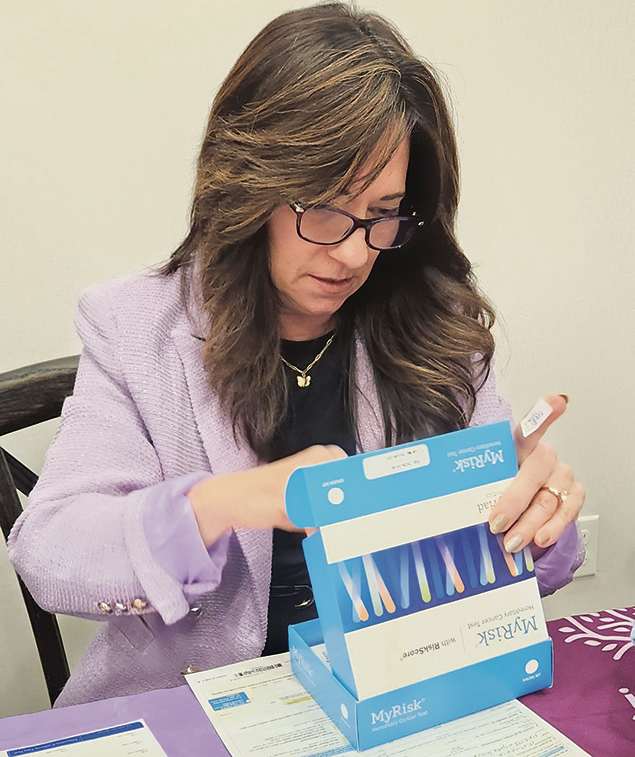
JScreen was a major part of the evening’s program. Shari Ungerleider of Wayne and Abbe Golding of Raleigh, North Carolina, representing the organization, provided opportunities to sign up for genetic testing, specifically focusing on the hereditary cancer test. This panel of tests is described on Jscreen.org as “an at-home genetic test that checks 63 genes (including BRCA1 and BRCA2) for changes that increase the risk of cancer, including breast, ovarian, colon, and pancreatic cancer.”
JScreen’s website, jscreen.org, identifies Ms. Ungerleider as senior manager and head of education and outreach “for the national non-profit organization dedicated to saving lives through genetic testing.” After Ms. Ungerleider and her husband lost their son Evan to Tay-Sachs, she dedicated her life’s work to advocate for genetic testing and to educate the Jewish community about the importance of “genetic testing coupled with genetic counseling.”
At the program, Ms. Ungerleider presented a display offering registration for genetic tests on the spot. JScreen notes that “the cancer genetic test goes beyond just BRCA1 and BRCA2 to provide a comprehensive picture of your inherited risk across a broad panel of clinically significant genes.” The variants tested can be associated with breast and ovarian cancer, but also uterine, pancreatic, colorectal, prostate, skin, gastric, renal, lung, and other cancers.
Since the panel of genes that are tested covers many more variants of cancer genes, Ms. Ungerleider said that even if someone tested negative for BRCA1 and BRCA2 years ago, it is worthwhile to consider testing again, as the tests look for more variants of a wide assortment of cancer-associated mutations, flagging more people at higher risk who would benefit from increased surveillance (such as more frequent mammograms and colonoscopies).
The Jscreen.org website also notes that knowing about such mutations before cancer is detected “empowers individuals to make informed decisions about prevention, monitoring, and family planning.”
Mimi Kaplan introduced the panel; she and her husband, Rabbi Chanoch Kaplan, are co-directors of the Chabad Center. Rebbetzin Kaplan, who was diagnosed with Hodgkin lymphoma in 2014, described her experiences as a cancer survivor. She said that she “lives life on a whole different scale than I ever imagined… Even when [treatment is] over, it’s something you live with for the rest of your life.”
“I pray and wish for all of us that this is a conversation we never have to have again…” noting that “in the time of Moshiach” — the messiah — “there will be no more disease.”
“Should I take JScreen?” Rebbetzin Kaplan asked. “God wants us to do everything in our power to know what’s in our genes,” as it empowers us to take steps to save our lives.
Abbe Golding, who moderated the panel, is a certified genetic counselor and an education and outreach manager at JScreen. She opened the discussion by asking the three authors, “Why did you feel compelled to write about this? What do you wish women would know more about?”
Ms. Pfeffer, who lives in Manhattan, lost both her parents to cancer. She wrote a memoir about her family’s battles with the illness.
“I’m not a doctor at all,” she said. “I’m a breast cancer previvor and survivor. My mother died at 42, and her mother died at 45.” Ms. Pfeffer’s father died of colon cancer at 54. Because of her family history, Ms. Pfeffer tested and found out that she was BRCA1 positive. “At 34 years old I got a double mastectomy, back in 2008, before Angelina Jolie,” the actress who went public about her double mastectomy in 2013. “They discovered two small tumors but were able to remove them at an early stage. It saved my life.”
Speaking about her three sisters, who followed her lead in testing and treatment, Ms. Pfeffer said, “In saving my life, I saved their lives.”
“I speak and write humor through adversity,” she continued. “Nearly Departed” is a “serious book with humor. I get people to laugh…. It has led to people checking themselves, finding something, and saving their lives.”
Dr. Roth, who lives in South Jersey, spoke about compelling reasons for testing. “My cousins were diagnosed with breast cancer in their 30s — BRCA1,” she said. “Screening is so important. Breast protection is the best protection.”
Dr. Teplinsky, whose practice is in Paramus, is concerned with “debunking myths about mammograms. It’s the same radiation we’re exposed to walking around for six weeks, or in one flight to California.” Dr. Teplinsky was referring to fact that mammograms are relatively low-level radiation, presenting not much more risk than exposure to the natural background radiation affecting all life on earth. She warned against alternative screening methods, such as thermograms or QT imaging, which have not been deemed effective and are not approved for routine breast cancer screening.
“Mammograms can detect calcifications, which can be the first stage of cancer,” Dr. Roth said. “We add ultrasound or MRI if you have dense breast tissue. Early detection is the breast detection.”
Dr. Teplinsky asked the audience, “Has anyone talked to you about breast cancer risk assessment? It includes BRCA testing and family history.
“The biggest misconception is if you don’t have family history or a positive BRCA test” you’re not at risk, she said. “Only 15 percent of women with breast cancer have family history or positive BRCA test.” Most cases of breast cancer are in women without family history or positive BRCA test. Clearly, everyone is at risk.
And a woman’s risk does not stay the same throughout life.
“Your breast cancer risk is fluid,” Dr. Roth said. “It changes as new information becomes available.” There are risk assessment tools online; she recommends the National Cancer Institute’s bcrisktool.cancer.gov. “If your risk is greater than 20 percent, we recommend high-risk breast cancer screening,” including an early MRI at age 25, she added.
When should children of breast cancer patients be screened? According to Jscreen’s genetic counselor Abbe Golding, members of a high-risk family should start monitoring and surveillance when they are at least 10 years younger than when the youngest person in the family who had breast cancer received that diagnosis. So if a mother, grandmother, older sister, cousin, or aunt was diagnosed at 35, start screening at 25.
The panel discussed early menopause that occurs after the ovaries are removed. Dr. Teplinsky’s book covers that issue, and many related challenges, in detail. She said that you can have hormone therapy to alleviate symptoms of menopause even if your breasts have not been removed. “It won’t increase the breast cancer risk,” she said. She’s a strong advocate for vaginal hormones. “We love them” — hormones — whether you have breast cancer or not. What can help you stay healthier? Movement, healthy diet, sleep, and hormones help people feel better.”
Dr. Teplinsky explained that getting periods earlier and having menopause later is associated with higher risk for breast cancer. In other words, the more ovulations and menstrual cycles a woman has, the higher her risk. And that explains why “having kids later in life, or not having any kids at all, is higher risk. Every month you ovulate, breast tissue is more vulnerable.”
Dr. Roth, who is the mother of three children, has reflected long and hard on children’s perspective on their mother’s disease. “Knowing you are carrying mutations can change the way we talk about breasts with our children,” she said. “There’s a level of shame or embarrassment to go to the doctor.” She wrote “Everyone Has Boobies” to open up the conversation with young children.
Ms. Pfeffer, who has four children, also grappled with that issue. “It’s a delicate conversation to have,” she said. Her mother was diagnosed at a later stage, received chemotherapy, and eventually had a mastectomy, but it was too late to save her. “My mom wasn’t fine,” Ms. Pfeffer said. The description of her mother’s cancer battle in “Nearly Departed” is gripping and heartbreaking. But Ms. Pfeffer, who survived her mother’s tragic death and her own cancer, keeps an optimistic tone and a sense of celebrating life. “[My children’s] mom is fine,” she said. Because she took charge of her fate with early testing and treatment, she is still present for them. “I wrote the book,” she said. “They can understand their family history. And everyone needs to deal with it differently.”
Ms. Pfeffer said there’s a barrier to screening — some women are afraid to find out if they have the cancer genes. “There’s no such thing as zero level of risk, and genetic screening is well researched,” she said.
What do you say to a woman who is afraid to find out? Ms. Pfeffer knows from her own life: “Knowledge is power.”
Dr. Teplinsky, who has treated many cancer patients, accepts that “fear is real. If you don’t know, you can put your head in the sand.” She reported that “in Israel they tested everyone, and they picked up a lot more BRCA- positive people than they expected.”
Some women will say “my mom didn’t have breast cancer so I’m good,” meaning I don’t have to test. “But consider it,” Dr. Teplinsky said. “Think about family history and risk. What am I doing for myself? Then do it. But it is scary.”
What about men who have the BRCA gene? Rebbetzin Kaplan reported there were two men in her community with breast cancer.
Studies show that one out of eight women and one in 883 men get breast cancer, so it’s much less common in men. But it happens. Men with family histories of cancer do take genetic tests, but few BRCA-positive men follow up with screening and surveillance. It’s recommended that men check their chest area, especially around the nipples, as nipple inversion can occur in male breast cancer. Checking under the armpits also is recommended.
Ms. Golding wrapped up the discussion asking each panelist: “What’s most important?”
Dr. Teplinsky urged women to talk to their doctors about breast cancer risk.
Dr. Roth reminded the audience that “early detection is breast protection.”
And Rebbetzin Kaplan reflected that in our faith “a woman’s body is considered like a sefer Torah,” a Torah scroll. “We keep it pure,” she said. “U’shmartem et nafshotehem — watch your health. There’s a God who’s watching over us. He loves us. He wants us to do our part in watching our soul. It’s all going to be good because Hashem is in control. There are things we can do to watch our health.”
Rebbetzin Kaplan invited the community to a ribbon cutting and dedication ceremony for the group’s new building in Franklin Lakes on Sunday, October 25 at 11 a.m. Go to Chabadplace.org for information on the Chabad Jewish Center of NW Bergen County.
Information on Jewish genetic testing can be found at jscreen.org.
Dr. Miryam Z. Wahrman of Teaneck is chair of the biology department at William Paterson University. She is author of “Brave New Judaism: When Science and Scripture Collide,” and “The Hand Book: Surviving in a Germ-Filled World.”